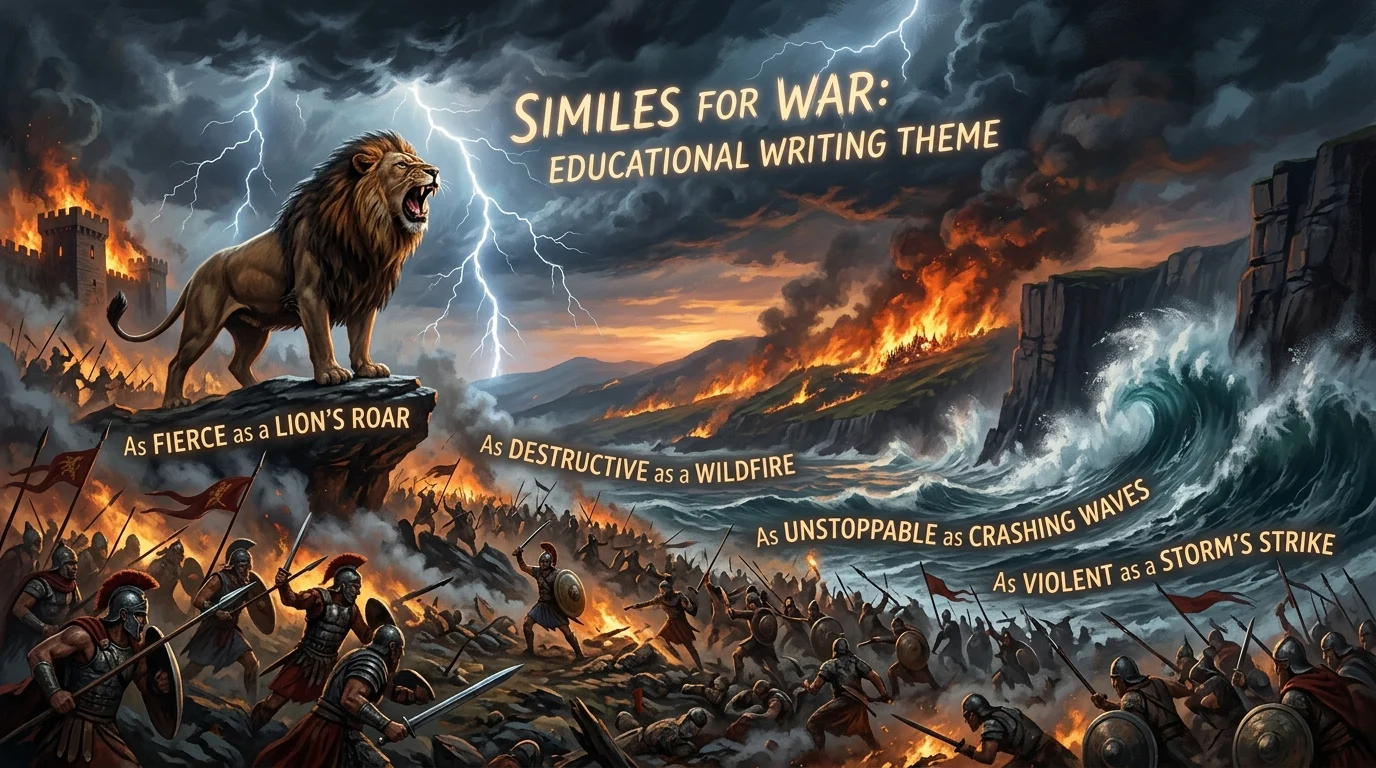
War is a strong and serious topic. Writers often use vivid language to explain it clearly. One helpful tool is the simile. Similes make ideas easier to imagine by comparing two things.
In simple terms, a simile is a comparison using words like as or like. For example, instead of saying “The battle was chaotic,” you might say “The battle was like a raging storm.” This creates a picture in the reader’s mind.
Strong similes make writing more powerful. They help readers feel the emotion and intensity of a scene. For example, in stories about conflict or struggle, similes can show danger, noise, fear, or bravery in a simple way.
Learning the meaning of similes also helps improve creative writing. They appear in novels, poems, speeches, and even daily conversation. When you understand how to use similes in writing, your sentences become more vivid and memorable.
Let’s explore some examples of similes related to conflict and struggle. These creative writing similes can help you describe war scenes more clearly and dramatically.
20 Strong Similes Related to a Metaphor for War
1. Like a raging storm
Meaning: Wild and chaotic conflict
Explanation: A storm is loud, powerful, and destructive, much like battle.
Examples:
- The battlefield roared like a raging storm.
- The clash of armies sounded like a raging storm in the valley.
2. Like thunder crashing
Meaning: Very loud fighting
Explanation: Thunder represents booming sounds and sudden power.
Examples:
- Cannons fired like thunder crashing.
- The soldiers marched like thunder crashing across the land.
3. Like a wildfire spreading
Meaning: Conflict spreading quickly
Explanation: Wildfires move fast and destroy everything in their path.
Examples:
- The war spread like a wildfire through the region.
- Anger moved through the crowd like wildfire.
4. Like waves hitting rocks
Meaning: Continuous attacks
Explanation: Waves hit the shore again and again, just like repeated attacks.
Examples:
- The soldiers advanced like waves hitting rocks.
- The enemy attacks came like waves on a stormy beach.
5. Like a hammer striking steel
Meaning: Powerful, forceful fighting
Explanation: A hammer hitting metal shows strength and impact.
Examples:
- The clash of swords rang like a hammer striking steel.
- Their blows fell like hammers striking iron.
6. Like wolves hunting
Meaning: Aggressive pursuit
Explanation: Wolves hunt together with determination.
Examples:
- The fighters moved like wolves hunting their prey.
- The troops closed in like wolves hunting.
7. Like lightning in the sky
Meaning: Sudden, fast attack
Examples:
- The ambush struck like lightning in the sky.
- The soldiers moved like lightning across the field.
8. Like a volcano erupting
Meaning: Explosive conflict
Examples:
- The battle erupted like a volcano.
- Anger burst like a volcano among the troops.
9. Like iron clashing
Meaning: Harsh and violent fighting
Examples:
- The battlefield rang like iron clashing.
- Their weapons met like iron against iron.
10. Like a dark cloud
Meaning: Threat or danger approaching
Examples:
- War hung over the nation like a dark cloud.
- Fear spread like a dark cloud across the land.
11. Like a lion roaring
Meaning: Powerful attack
Examples:
- The army charged like a roaring lion.
- The leader shouted like a lion roaring.
12. Like a drumbeat of danger
Meaning: Steady tension building
Examples:
- The marching soldiers sounded like a drumbeat of danger.
- War drums echoed like a steady drumbeat.
13. Like sparks in dry grass
Meaning: Conflict starting quickly
Examples:
- One insult spread like sparks in dry grass.
- The argument grew like sparks in a field.
14. Like a steel trap
Meaning: Tight and unavoidable conflict
Examples:
- The enemy closed in like a steel trap.
- The soldiers surrounded them like a trap snapping shut.
15. Like a tidal wave
Meaning: Overwhelming force
Examples:
- The army moved forward like a tidal wave.
- The attack crashed like a giant wave.
16. Like fire and smoke
Meaning: Destruction and chaos
Examples:
- War left the city like fire and smoke.
- The battlefield looked like fire and smoke.
17. Like a swarm of bees
Meaning: Fast and chaotic movement
Examples:
- Soldiers rushed like a swarm of bees.
- The fighters surrounded them like buzzing bees.
18. Like stones breaking glass
Meaning: Sudden violence
Examples:
- The attack hit like stones breaking glass.
- The silence shattered like glass.
19. Like shadows in the night
Meaning: Silent movement in war
Examples:
- The scouts moved like shadows in the night.
- The soldiers crept like silent shadows.
20. Like a battlefield storm
Meaning: Complete chaos and noise
Examples:
- The fight felt like a battlefield storm.
- The clash grew like a storm in war.
Practice Exercise: Test Your Simile Skills
Let’s explore some quick exercises to practice how to use similes in writing.
1. Complete the simile
The battle roared like a ______.
Answer: storm
Explanation: Storms are loud and chaotic like battles.
2. Which simile shows sudden attack?
A. Like lightning
B. Like feathers
Answer: A
Explanation: Lightning strikes suddenly.
3. Finish the sentence
The war spread like ______ through the land.
Answer: wildfire
Explanation: Wildfires spread quickly.
4. Which simile shows repeated attacks?
A. Like waves hitting rocks
B. Like wind blowing
Answer: A
Explanation: Waves return again and again.
5. Fill in the blank
The army charged like a roaring ______.
Answer: lion
Explanation: Lions symbolize power and strength.
6. Which simile means silent movement?
A. Like shadows in the night
B. Like thunder
Answer: A
Explanation: Shadows move quietly.
7. Complete the sentence
The soldiers rushed like a swarm of ______.
Answer: bees
Explanation: Bees move quickly and chaotically.
8. Which simile shows overwhelming power?
A. Like a tidal wave
B. Like a feather
Answer: A
Explanation: Tidal waves are huge and unstoppable.
9. Finish the simile
The clash sounded like iron ______.
Answer: clashing
Explanation: Metal hitting metal makes a harsh sound.
10. Which simile shows tension building?
A. Like a drumbeat
B. Like a cloud drifting
Answer: A
Explanation: Drumbeats create suspense and rhythm.
Conclusion
Similes are powerful tools in writing. They help readers imagine sounds, feelings, and action more clearly. When describing conflict or struggle, strong similes make scenes vivid and emotional.
As we explored above, phrases like “like a raging storm” or “like lightning in the sky” give readers a clear picture of battle and tension. These examples of similes show how comparisons can turn simple sentences into powerful images.
In simple terms, similes compare two things to make ideas easier to understand. When you practice creative writing similes, your storytelling becomes more exciting and memorable.
Keep practicing. Try writing your own simile sentences about action, conflict, or emotion. The more you use them, the stronger your writing will become.