Understanding the difference between emersion vs immersion can feel confusing at first because the two words look and sound similar. However, they describe completely opposite actions and are used in very different contexts. If you are learning English, writing academically, or improving your vocabulary, knowing when to use each term correctly can make your communication clearer and more professional.
In this guide, you will learn the exact meanings of emersion and immersion, practical examples, pronunciation tips, common mistakes people make, and how these words differ in American and British English. By the end, you will confidently know which word fits your sentence naturally.
Quick Answer
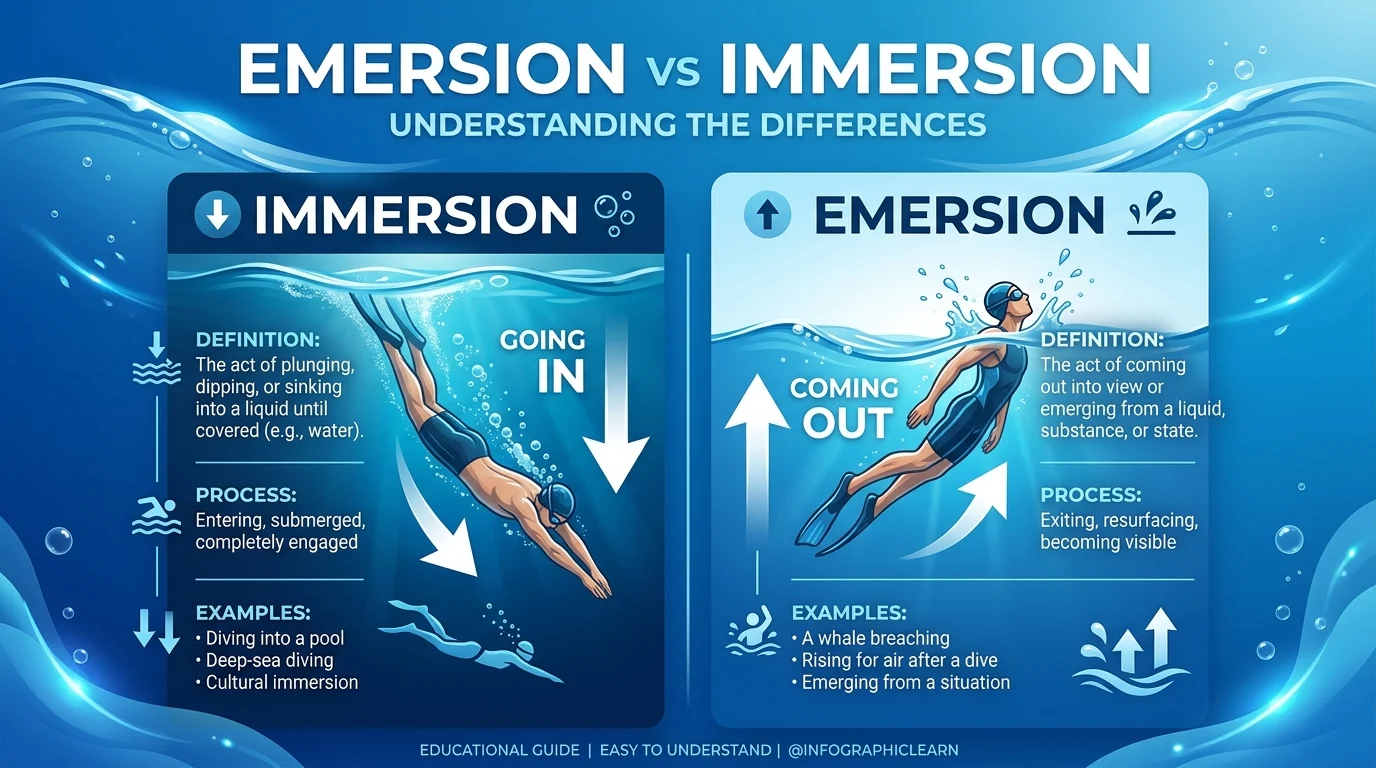
Immersion means being completely involved, surrounded, or submerged in something.
Emersion means coming out of water or emerging from a submerged state.
The easiest way to remember the difference:
- Immersion = going in
- Emersion = coming out
For example:
- “Language immersion helps students learn faster.”
- “The turtle’s emersion from the water was fascinating to watch.”
What Does Immersion Mean?
Linguistics Immersion refers to deep involvement or complete submersion in an environment, activity, or experience. The word comes from the Latin root immergere, meaning “to dip into.”
It is commonly used in:
- Language learning
- Education
- Virtual reality
- Gaming
- Psychology
- Water-related situations
Examples of Immersion
- She improved her Spanish through total language immersion.
- The movie created a strong sense of emotional immersion.
- Divers experience full immersion underwater.
- Virtual reality games increase player immersion.
Immersion in Language Learning
One of the most popular uses of the term is language immersion. This method places learners in an environment where they constantly hear and use the target language.
For example:
- Living in France while learning French
- Attending an English immersion school
- Watching movies only in the target language
This approach often speeds up fluency because learners practice naturally every day.
What Does Emersion Mean?
Emersion is the act of emerging or rising out of a liquid, especially water. It is less common in everyday conversation but appears frequently in scientific, biological, and environmental contexts.
The word comes from the Latin emergere, meaning “to rise out.”
Examples of Emersion
- The whale’s emersion thrilled the tourists.
- Scientists observed the emersion of aquatic plants.
- The submarine’s emersion happened at dawn.
Scientific Uses of Emersion
Marine Biology In science, emersion often describes:
- Marine animals surfacing
- Plants rising above water
- Geological formations appearing after flooding
- Tidal changes exposing surfaces
Because it is more technical, many English learners encounter this word less frequently than immersion.
Emersion vs Immersion: Key Differences
Here is a simple comparison to make the distinction crystal clear.
| Feature | Immersion | Emersion |
|---|---|---|
| Basic Meaning | Going into or being surrounded | Coming out or emerging |
| Direction | Inward | Outward |
| Common Usage | Education, VR, gaming, language learning | Science, biology, marine studies |
| Frequency | Very common | Less common |
| Example | Immersion in a culture | Emersion from water |
Easy Trick to Remember the Difference
A simple memory trick can help:
- Immersion starts with “Im” → think “in”
- Emersion starts with “Em” → think “exit” or emerge”
So:
- Immersion = into something
- Emersion = out of something
This tiny association makes the difference much easier to recall while writing or speaking.
Common Mistakes People Make
Many people accidentally use these words interchangeably because they differ by only one letter. Here are the most common errors.
Mistake 1: Using Emersion Instead of Immersion
Incorrect:
- “The game offers complete emersion.”
Correct:
- “The game offers complete immersion.”
Why? Because the player is deeply involved in the experience, not emerging from it.
Mistake 2: Confusing Scientific Contexts
Incorrect:
- “The turtle’s immersion from the ocean was beautiful.”
Correct:
- “The turtle’s emersion from the ocean was beautiful.”
Why? The turtle is coming out of the water.
Mistake 3: Assuming Both Words Are Equally Common
In reality, immersion is far more widely used in everyday English. Most native speakers rarely use emersion unless discussing science or nature.
Real Life Examples of Immersion
Here are some natural situations where immersion fits perfectly.
Education
- Students in immersion programs learn faster through constant exposure.
Gaming
Minecraft
- Realistic sound effects improve gaming immersion.
Travel
Tokyo
- Traveling abroad creates cultural immersion.
Meditation and Reading
- A great novel can create total emotional immersion.
Real Life Examples of Emersion
Although less common, emersion still appears in specific fields.
Marine Life
Humpback Whale
- Researchers tracked the whale’s emersion patterns.
Nature Observation
- The emersion of rocks during low tide revealed hidden sea creatures.
Underwater Exploration
- Divers carefully planned their emersion procedures.
American vs British English Differences
Interestingly, both American English and British English use these words similarly. However, there are slight differences in frequency and style.
American English
In United States English:
- Immersion is extremely common.
- Emersion is mostly scientific or technical.
Examples:
- immersion learning
- immersive technology
- immersion therapy
British English
In United Kingdom English:
- The meanings remain the same.
- Scientific writing may use emersion slightly more often.
However, there is no major spelling variation between the two dialects for these words.
Synonyms
Using related terms can improve vocabulary and SEO relevance.
Synonyms for Immersion
- involvement
- engagement
- absorption
- submersion
- participation
- deep focus
Synonyms for Emersion
- emergence
- surfacing
- appearance
- rising
- coming out
Why Immersion Matters in Modern Learning
Education Modern education increasingly relies on immersion-based experiences because active participation helps people retain information better.
For example:
- Language immersion classrooms
- Virtual reality training
- Interactive learning systems
- Cultural exchange programs
Research consistently shows that immersive experiences improve memory, confidence, and practical skills.
Immersion in Technology and Gaming
Virtual Reality The rise of digital technology has made immersion one of the most important modern concepts.
Today, companies aim to create immersive experiences through:
- VR headsets
- surround sound
- realistic graphics
- interactive storytelling
The stronger the immersion, the more emotionally connected users feel.
When Should You Use Emersion?
Use emersion mainly when discussing:
- marine biology
- underwater activity
- environmental science
- surfacing movements
- aquatic ecosystems
If your sentence is not related to emerging from water or a submerged state, immersion is probably the correct choice.
FAQs
Is immersion more common than emersion?
Yes. Immersion is far more common in everyday English, especially in education, gaming, and technology.
Can emersion and immersion be used interchangeably?
No. They describe opposite actions. Immersion means going in, while emersion means coming out.
What is language immersion?
Language immersion is a learning method where students are surrounded by and regularly use the target language.
Is emersion a real English word?
Yes. Although less common, emersion is a valid English word used mainly in scientific contexts.
What is an immersive experience?
An immersive experience deeply engages a person’s senses, emotions, or attention.
Which word is used in gaming?
Immersion is the correct term in gaming because players become deeply involved in the experience.
Do British and American English spell these words differently?
No. Both dialects use the same spellings: immersion and emersion.
How can I remember the difference quickly?
Think:
- Immersion = into
- Emersion = exit
Final Summary
The difference between emersion vs immersion becomes simple once you focus on direction. Immersion means entering into, being surrounded by, or becoming deeply involved in something. It appears frequently in language learning, gaming, education, and technology. Emersion, on the other hand, refers to emerging from water or coming out of a submerged state, mainly in scientific or environmental discussions.
If you are unsure which word to choose, remember this easy rule: immersion goes in, emersion comes out. In everyday English, you will likely use immersion far more often, while emersion appears mostly in technical or nature-related contexts. Learning this distinction will instantly improve your vocabulary accuracy and confidence in writing.
Actionable Takeaway
Before using either word, ask yourself one question:
- Is something entering or deeply involved? → Use immersion
- Is something emerging or surfacing? → Use emersion
That simple check will help you avoid mistakes every time.