The confusion between puting vs putting is very common, especially among English learners and fast typists. At first glance, both words may seem acceptable, but only one is grammatically correct in standard English. If you’ve ever wondered which spelling to use in emails, essays, social media posts, or professional writing, you’re not alone.
In this guide, you’ll learn the correct spelling, why the mistake happens, pronunciation tips, grammar rules, examples, common errors, and American vs British English differences. By the end, you’ll confidently know when to use putting and why puting should usually be avoided.
Quick Answer
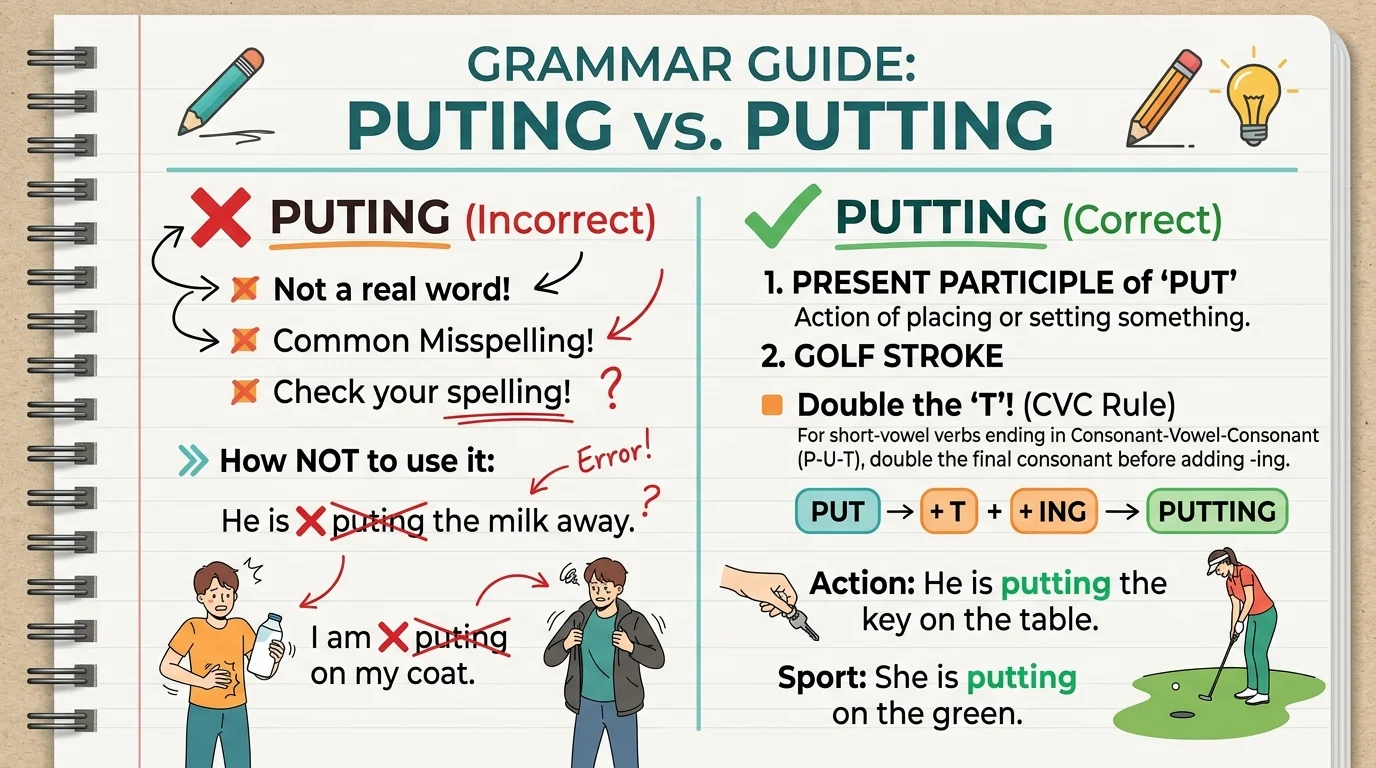
✅ Putting is the correct spelling.
❌ Puting is incorrect in standard English grammar.
Correct example:
- “She is putting the books on the table.”
Incorrect example:
- “She is puting the books on the table.”
The reason is simple: when adding -ing to the verb put, English grammar doubles the final consonant, creating putting.
What Does Putting Mean?
English Grammar Putting is the present participle and gerund form of the verb put.
The verb put means:
- to place something somewhere
- to position an object
- to express an idea
- to move something into a specific state
Examples of Putting
- He is putting the groceries away.
- They are putting effort into the project.
- She kept putting off her homework.
- We’re putting new furniture in the office.
Why “Putting” Has Double T
Many English learners wonder why the word becomes putting instead of puting.
This happens because of a common spelling rule in English:
The Rule
When a short verb ends in:
- one vowel
- followed by one consonant
the final consonant is often doubled before adding -ing.
Examples
| Base Verb | Correct -ing Form |
|---|---|
| put | putting |
| run | running |
| sit | sitting |
| stop | stopping |
Since put ends with a short vowel sound followed by the consonant t, the t doubles.
Is Puting Ever Correct?
In standard English, puting is considered a spelling mistake.
However, you may occasionally see it:
- as a typing error
- in informal online writing
- from language learners
- in usernames or brand names
But grammatically, the correct spelling is always putting.
Common Mistakes People Make
Mistake 1: Forgetting to Double the Final Consonant
Incorrect:
- “I am puting my phone away.”
Correct:
- “I am putting my phone away.”
Mistake 2: Applying the Wrong Grammar Rule
Some verbs do not double the final consonant.
Examples:
- read → reading
- clean → cleaning
This can confuse learners into thinking put follows the same pattern.
Mistake 3: Fast Typing Errors
Because putting contains double “t,” many people accidentally type puting while texting or writing quickly.
Real Life Examples of Putting
Daily Conversation
- She’s putting sugar in her coffee.
- I’m putting my keys on the desk.
Work and Business
Business Communication
- The company is putting more focus on customer service.
Sports
Golf
- His putting skills improved dramatically this season.
Interestingly, in golf, putting specifically refers to gently hitting the ball toward the hole using a putter.
Putting in Different Contexts
Emotional Context
- She’s putting her heart into the project.
Time and Effort
- They are putting a lot of effort into learning English.
Delaying Something
- Stop putting off your responsibilities.
Technology
Information Technology
- Developers are putting new security systems in place.
American vs British English Differences
The spelling putting is the same in both:
- United States American English
- United Kingdom British English
There is no spelling difference between the two dialects for this word.
Pronunciation Differences
The pronunciation may vary slightly because of accent differences, but the spelling remains:
✅ putting
❌ puting
Related Grammar Rules
Understanding similar spelling patterns can help prevent future mistakes.
Double-Consonant Examples
| Verb | Correct Form |
|---|---|
| swim | swimming |
| get | getting |
| cut | cutting |
| begin | beginning |
Non-Doubling Examples
| Verb | Correct Form |
|---|---|
| open | opening |
| read | reading |
| clean | cleaning |
Easy Trick to Remember the Correct Spelling
A quick memory tip:
Put + ting = putting
Or remember:
- Short verb
- Short vowel sound
- Double the consonant
This pattern works for many common English verbs.
Why Correct Spelling Matters
Education Correct spelling improves:
- professional writing
- academic credibility
- readability
- communication clarity
Even small spelling mistakes like puting can make writing appear rushed or less polished.
FAQs
Is puting a real word?
No. Puting is generally considered a spelling mistake in standard English.
Why is putting spelled with two Ts?
Because English grammar doubles the final consonant for short verbs ending in a vowel + consonant before adding -ing.
Which spelling is correct: puting or putting?
Putting is the correct spelling.
Is putting used in golf?
Yes. In Golf, putting means softly striking the ball toward the hole using a putter.
Do British and American English spell putting differently?
No. Both use the spelling putting.
Why do people write puting?
Usually because of typing mistakes or confusion about consonant doubling rules.
What is the base form of putting?
The base verb is put.
Can spell-check detect puting?
Most modern spell-check tools identify puting as incorrect and suggest putting.
Final Summary
The difference between puting vs putting is straightforward once you understand the grammar rule. Putting is the correct spelling because the verb put follows the English consonant-doubling pattern before adding -ing. The spelling puting is considered incorrect in standard English and usually appears due to typing mistakes or grammar confusion.
Whenever you use the verb put in continuous tense or gerund form, always write putting with double “t.” This small correction can instantly improve your writing accuracy, professionalism, and confidence in English communication.
Actionable Takeaway
Before writing the word, remember this quick rule:
- Short verb + vowel + consonant → double the consonant
So:
- put → putting
- sit → sitting
- run → running
That simple grammar pattern will help you avoid the mistake every time.