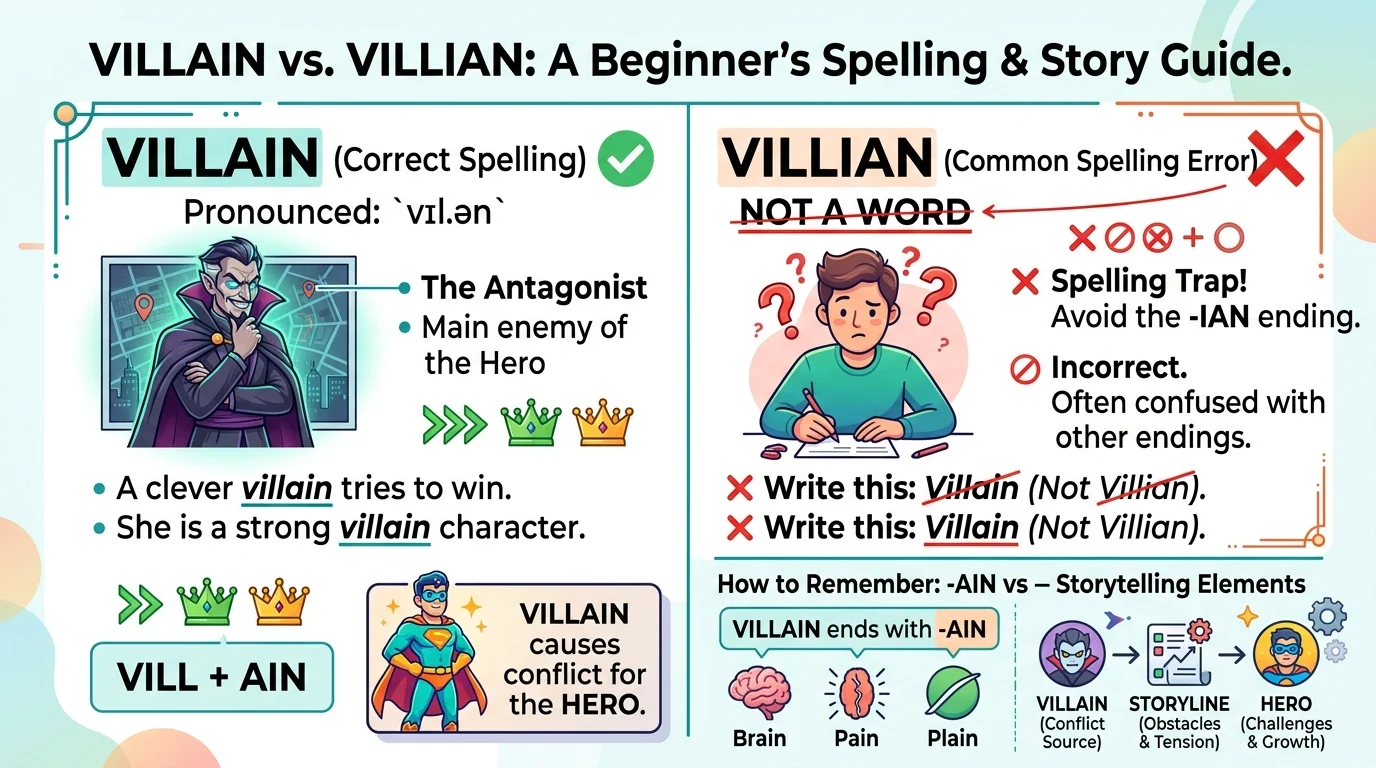
The confusion between villain vs villian is one of the most common spelling mistakes in English. Since the two words look very similar, many writers accidentally switch the positions of the letters “a” and “i”. However, only one spelling is correct.
If you’re unsure whether to write villain or villian, this guide explains the correct spelling, meaning, examples, common mistakes, and easy memory tricks.
Quick Answer
✅ Villain is the correct spelling.
❌ Villian is incorrect.
Correct example:
- “The villain tries to stop the hero.”
Incorrect example:
- “The villian tries to stop the hero.”
What Does Villain Mean?
Literature Villain is a noun that refers to:
- an evil character in a story
- a person who causes harm or trouble
- the main antagonist in a narrative
A villain is typically the character who opposes the hero or protagonist.
Examples of Villain
- The villain planned to take over the kingdom.
- Every superhero needs a memorable villain.
- The movie’s villain was more interesting than its hero.
- The detective finally caught the villain.
Why Is “Villian” Incorrect?
The spelling villian is a common misspelling caused by reversing the letters:
- ai
and
- ia
The correct spelling is:
✅ villain
Not:
❌ villian
Villain vs Villian: Main Difference
| Word | Status | Meaning |
|---|---|---|
| Villain | Correct spelling | An evil character or antagonist |
| Villian | Incorrect spelling | Common misspelling |
Common Uses of Villain
Literature
Creative Writing
- A strong villain creates conflict in a story.
- The villain challenged the hero at every turn.
Movies and Television
- The villain became one of the most memorable characters.
- Audiences often enjoy complex villains.
Everyday Speech
Sometimes people use villain figuratively.
Examples
- He was portrayed as the villain in the media.
- Nobody wants to be the villain in an argument.
Famous Villains in Popular Culture
Many stories feature iconic villains, such as:
- Darth Vader
- Joker
- Lord Voldemort
- Scar
These characters create conflict and drive the story forward.
Why People Misspell Villain as Villian
Common reasons include:
- reversing the letters “a” and “i”
- typing quickly
- relying on pronunciation rather than spelling
- confusion with other words ending in “-ian”
Example
Incorrect:
- “The villian escaped.”
Correct:
- “The villain escaped.”
Synonyms for Villain
Using related vocabulary can improve writing variety.
Common Synonyms
- antagonist
- criminal
- evildoer
- rogue
- enemy
- wrongdoer
Example
Instead of:
- “The villain appeared.”
You could say:
- “The antagonist appeared.”
American vs British English Differences
Both:
- United States American English
- United Kingdom British English
use the same spelling:
✅ villain
❌ villian
There is no regional spelling difference.
Common Mistakes People Make
Mistake 1: Switching the Letters
Incorrect:
- villian
Correct:
- villain
Mistake 2: Spelling by Sound
The pronunciation doesn’t clearly emphasize the letter order, leading to confusion.
Mistake 3: Assuming It Ends Like “-ian”
Many words end in:
- musician
- historian
- librarian
This can cause people to mistakenly write:
- villian
instead of:
- villain
Easy Trick to Remember the Correct Spelling
Remember the Phrase
A villain is vain about being evil.
Notice:
- villain contains “ain”
Memory tip:
- villain
- not villian
Another trick:
Think of the pattern:
- v-i-l-l-a-i-n
The a comes before the i.
Related Word Forms
| Word Type | Example |
|---|---|
| Noun | villain |
| Adjective | villainous |
| Noun | villainy |
Example Sentence
- “The villainous character became famous for his cruelty.”
FAQs
Which spelling is correct: villain or villian?
Villain is the correct spelling.
Is villian a real word?
No. Villian is considered a misspelling of villain.
What does villain mean?
It refers to an evil character, antagonist, criminal, or wrongdoer.
Why do people spell villain as villian?
Usually because they accidentally reverse the letters “a” and “i.”
What is the adjective form of villain?
The adjective form is villainous.
What is the noun form related to villainous behavior?
The noun is villainy.
Do British and American English spell villain differently?
No. Both use villain.
Can spell check catch villian?
Yes. Most spell-check tools identify villian as incorrect and suggest villain.
Final Summary
The difference between villain vs villian is simple but important. Villain is the correct spelling and refers to an evil character, antagonist, or wrongdoer. Villian is a common misspelling caused by reversing the letters “a” and “i.”
If you’re writing stories, essays, reviews, or everyday content, always use villain. Remember that the letter a comes before i, and you’ll avoid this common spelling mistake.
Actionable Takeaway
Before using the word, remember:
- villain = correct spelling ✅
- villian = incorrect spelling ❌
For accurate English writing:
- villain ✅
- villian ❌
That quick spelling check will help you avoid the mistake every time.