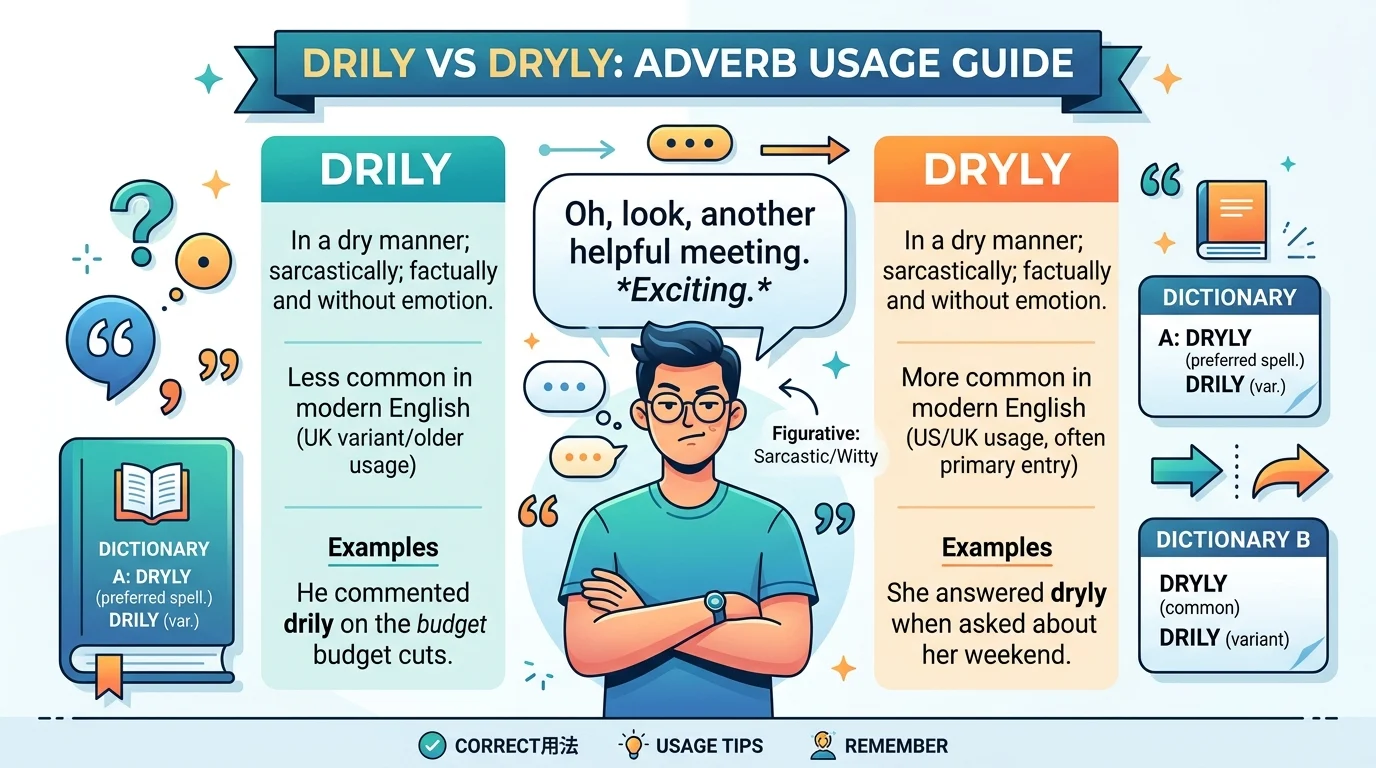
The debate between drily vs dryly often confuses writers because both spellings appear in dictionaries and published writing. Unlike many spelling comparisons where one option is clearly wrong, both drily and dryly are correct. The difference comes down to style, preference, and regional usage.
If you’re unsure which form to use, this guide explains the meanings, examples, common usage patterns, and when one spelling may be preferable over the other.
Quick Answer
✅ Drily is correct.
✅ Dryly is also correct.
Examples:
- “He drily remarked that the meeting could have been an email.” ✅
- “He dryly remarked that the meeting could have been an email.” ✅
Both spellings are accepted in standard English.
What Do Drily and Dryly Mean?
English Vocabulary Drily and dryly are adverbs derived from the adjective dry.
They usually mean:
- in a dry manner
- without emotion
- in a sarcastic or understated way
- with subtle humor
Examples
- She drily observed that the plan had obvious flaws.
- He dryly commented on the unexpected situation.
- The professor drily noted the student’s mistake.
In these examples, both spellings work equally well.
Drily vs Dryly: Main Difference
| Word | Correct? | Meaning |
|---|---|---|
| Drily | ✅ Yes | In a dry, unemotional, or sarcastic manner |
| Dryly | ✅ Yes | In a dry, unemotional, or sarcastic manner |
The meaning is identical. The difference is mainly stylistic.
Which Spelling Is More Common?
Historically, drily was often preferred by dictionaries and traditional style guides.
Today, dryly is extremely common and widely accepted.
General Trend
- Dryly is slightly more common in modern writing.
- Drily remains accepted and appears frequently in literature and journalism.
Because both forms are correct, consistency is more important than choosing one over the other.
Examples of Drily
- She drily thanked him for the unnecessary advice.
- The author drily criticized the policy.
- He drily pointed out the obvious error.
Examples of Dryly
- She dryly remarked that nothing had gone according to plan.
- The manager dryly responded to the complaint.
- He dryly joked about the situation.
Common Uses of Drily and Dryly
Sarcastic Remarks
- “That’s one way to solve the problem,” she dryly said.
Understated Humor
- He drily observed that the weather forecast had been inaccurate.
Formal Writing
Writers often use either spelling when describing a restrained or unemotional tone.
Literature and Journalism
Both forms regularly appear in novels, newspapers, and magazine articles.
Why Are There Two Spellings?
English sometimes allows multiple adverb forms for words ending in -y.
The adjective:
- dry
can produce:
- drily
- dryly
Over time, both became accepted spellings.
Common Mistakes People Make
Mistake 1: Assuming One Is Wrong
Unlike many spelling comparisons, both forms are correct.
Mistake 2: Mixing Spellings in the Same Document
Choose one version and use it consistently.
Mistake 3: Confusing Literal and Figurative Meanings
Drily/dryly often refers to tone or humor, not a lack of moisture.
Example
- He dryly replied, “That worked perfectly.” (sarcasm)
- The clothes dried quickly. (literal dryness)
Synonyms for Drily and Dryly
Depending on the context, you can use:
- sarcastically
- wryly
- ironically
- coolly
- matter-of-factly
- unemotionally
Example
Instead of:
- “She dryly commented.”
You could say:
- “She wryly commented.”
American vs British English Differences
- United States American English commonly uses dryly.
- United Kingdom British English accepts both drily and dryly.
However, neither spelling is considered incorrect in either variety of English.
Why Correct Usage Matters
Professional Communication Choosing a consistent spelling helps improve:
- readability
- professionalism
- editorial consistency
- writing quality
Most readers will recognize either form immediately.
Easy Trick to Remember
Remember: Both Are Correct
Unlike many spelling debates, you don’t need to memorize a “right” and “wrong” version.
Just remember:
- drily ✅
- dryly ✅
Then choose one and stay consistent throughout your writing.
Related Word Forms
| Word | Part of Speech |
|---|---|
| Dry | Adjective |
| Dryly | Adverb |
| Drily | Adverb |
| Dryness | Noun |
Example Sentences
- The air is dry.
- She dryly responded to the question.
- He drily noted the contradiction.
- The region experiences severe dryness.
FAQs
Which is correct: drily or dryly?
Both drily and dryly are correct spellings.
Do drily and dryly have different meanings?
No. They have the same meaning and can usually be used interchangeably.
Which spelling is more common?
Dryly is slightly more common in modern writing, though drily remains widely accepted.
Is drily old-fashioned?
Not necessarily. It is still used in contemporary writing and dictionaries.
Should I use drily or dryly in formal writing?
Either is acceptable. Choose one and use it consistently.
Do American and British English prefer different spellings?
American English tends to favor dryly, while British English commonly accepts both.
What does dryly mean in conversation?
It often describes a sarcastic, understated, or unemotional way of speaking.
Can grammar checkers flag drily as incorrect?
Most modern grammar and spell-check tools recognize both spellings.
Final Summary
The difference between drily vs dryly is unusual because both spellings are correct. They share the same meaning and describe speaking or acting in a dry, restrained, sarcastic, or understated manner. The choice usually comes down to personal preference, style guide recommendations, or regional habits.
While dryly is somewhat more common in modern usage, drily remains fully acceptable. The most important rule is to choose one spelling and use it consistently throughout your writing.
Actionable Takeaway
Remember this simple rule:
- drily = correct ✅
- dryly = correct ✅
For consistency:
- Pick one spelling.
- Use it throughout the document.
- Follow any style guide required by your organization.
That way, your writing will remain polished, professional, and easy to read.