Many English speakers and writers wonder whether skiddish or skittish is the correct word. The confusion is understandable because skiddish sounds similar to the way many people pronounce the word in everyday conversation. However, only one spelling is considered standard English.
If you’re unsure which version to use, this guide explains the difference between skiddish vs skittish, their meanings, examples, common mistakes, and proper usage.
Quick Answer
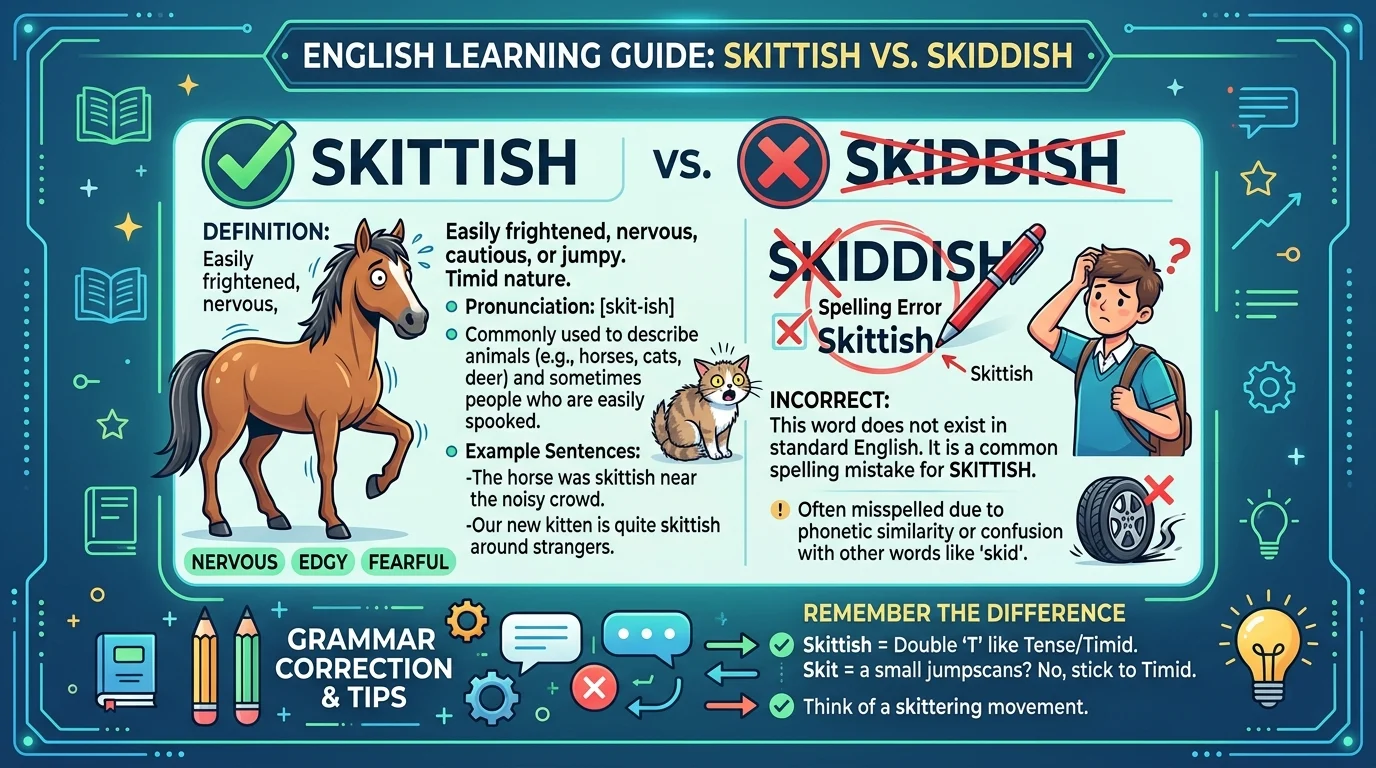
✅ Skittish is the correct spelling.
❌ Skiddish is incorrect in standard English.
Correct example:
- “The horse became skittish during the storm.”
Incorrect example:
- “The horse became skiddish during the storm.”
For formal, academic, and professional writing, always use skittish.
What Does Skittish Mean?
English Vocabulary Skittish is an adjective that describes someone or something that is:
- easily frightened
- nervous or jumpy
- easily startled
- reluctant to commit or settle down
The word is commonly used for animals, especially horses, but it can also describe people, investors, or situations.
Examples of Skittish
- The horse became skittish after hearing a loud noise.
- Investors were skittish about the uncertain economy.
- The puppy was skittish around strangers.
- She seemed skittish during the interview.
Why Is “Skiddish” Incorrect?
The spelling skiddish is not recognized as a standard English word.
People often write skiddish because:
- it sounds similar to skittish in some accents
- they spell the word based on pronunciation
- they have heard it spoken more often than seen it written
Despite its popularity in casual speech, dictionaries recognize only:
✅ skittish
not
❌ skiddish
Skiddish vs Skittish: Main Difference
| Word | Status | Meaning |
|---|---|---|
| Skittish | Correct spelling | Easily frightened, nervous, jumpy |
| Skiddish | Incorrect spelling | Common misspelling of skittish |
Common Uses of Skittish
Describing Animals
Horse
- The horse became skittish near traffic.
- The cat was skittish around visitors.
Describing People
- He became skittish when asked about the project.
- She was skittish about making a long-term commitment.
Describing Financial Markets
Finance
- Investors remained skittish after the market decline.
- Skittish traders sold stocks quickly.
Synonyms for Skittish
Depending on the context, you can use:
- nervous
- jumpy
- timid
- uneasy
- apprehensive
- wary
- restless
Example
Instead of:
- “The dog was skittish.”
You could say:
- “The dog was nervous.”
Common Mistakes People Make
Mistake 1: Writing Skiddish
Incorrect:
- The horse was skiddish.
Correct:
- The horse was skittish.
Mistake 2: Spelling Based on Pronunciation
Many people hear the word spoken and assume it contains -dish rather than -tish.
Mistake 3: Assuming Skiddish Is an Accepted Variant
While it appears in informal speech, it is generally considered a misspelling in standard written English.
American vs British English Differences
Both:
- United States American English
- United Kingdom British English
use:
✅ skittish
There is no accepted spelling difference.
Why Correct Spelling Matters
Professional Communication Correct spelling helps improve:
- credibility
- readability
- professionalism
- writing accuracy
Using skiddish in formal writing may be viewed as a spelling error.
Easy Trick to Remember the Correct Spelling
Think of “Jittery”
Both words describe nervous behavior.
Notice that skittish contains double letters, just like many expressive English adjectives.
Memory tip:
- skittish = nervous and jumpy ✅
- skiddish = incorrect ❌
Another reminder:
Skittish has two T’s.
Related Word Forms
| Word Type | Example |
|---|---|
| Adjective | skittish |
| Adverb | skittishly |
| Noun | skittishness |
Example Sentence
- “Her skittishness became obvious during the discussion.”
FAQs
Which spelling is correct: skiddish or skittish?
Skittish is the correct spelling.
Is skiddish a real word?
No. It is generally considered a misspelling of skittish.
What does skittish mean?
It means easily frightened, nervous, jumpy, or hesitant.
Can skittish describe people?
Yes. It can describe people who are nervous, cautious, or reluctant.
Is skittish commonly used for animals?
Yes. It is especially common when describing horses and other easily startled animals.
Do British and American English spell it differently?
No. Both use skittish.
What is the adverb form of skittish?
The adverb form is skittishly.
Can spell-check catch skiddish?
Yes. Most spell-check tools flag skiddish and suggest skittish.
Final Summary
The difference between skiddish vs skittish is simple. Skittish is the correct English word and means easily frightened, nervous, jumpy, or hesitant. Skiddish is a common misspelling that often results from spelling the word the way it sounds.
Whether you’re describing a nervous horse, a cautious investor, or a hesitant person, always use skittish. It’s the accepted spelling in both American and British English and the one recognized by dictionaries and style guides.
Actionable Takeaway
Remember this simple rule:
- skittish = correct spelling ✅
- skiddish = incorrect spelling ❌
For accurate and professional writing:
- skittish horse ✅
- skiddish horse ❌
A quick check for the double t will help you avoid this common spelling mistake.