Have you ever wondered if you should use a comma or a semicolon in a sentence? Both punctuation marks help connect ideas and organise writing, but they do different jobs. Using the wrong one can make a sentence unclear or create a common punctuation error.
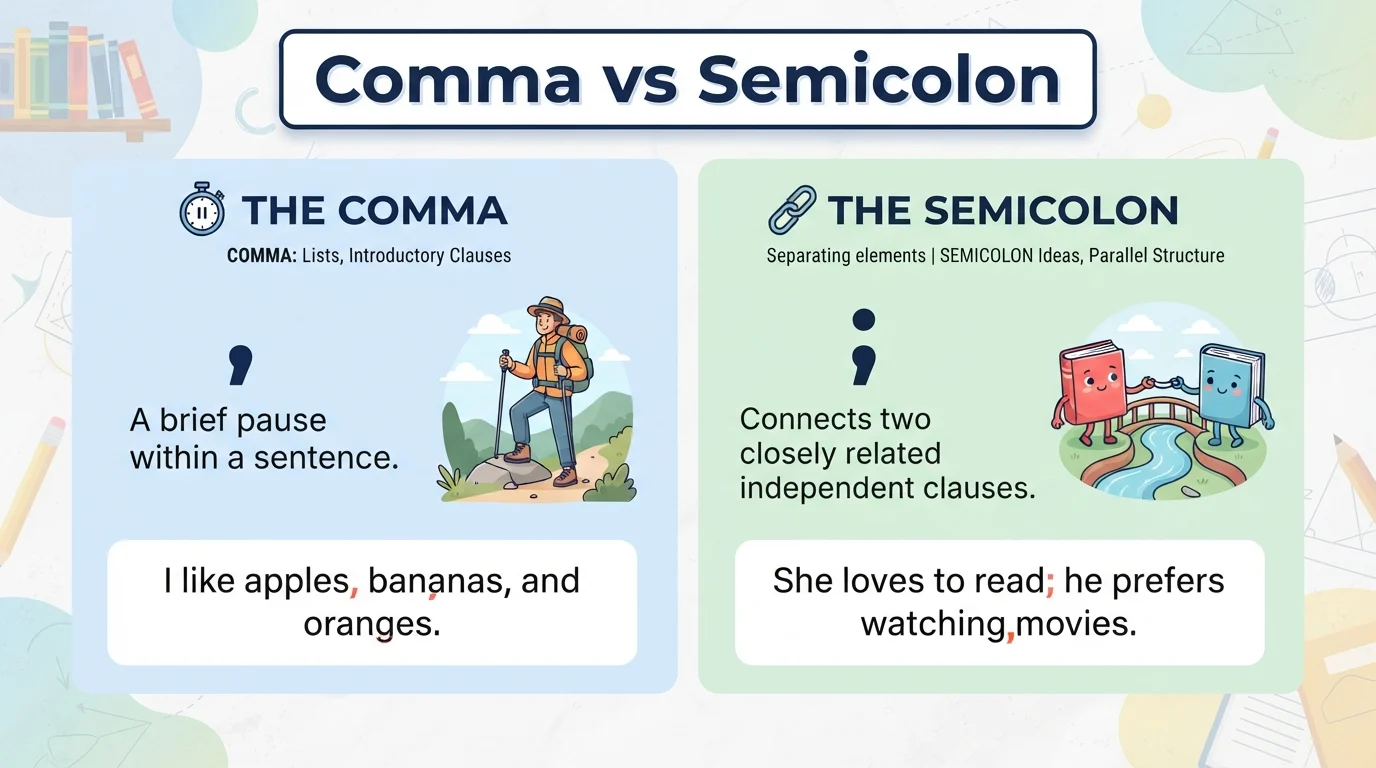
The key difference between comma vs semicolon is the strength of the connection. A comma usually separates parts of a sentence, while a semicolon connects two closely related independent clauses.
Once you understand how complete sentences work, choosing the right punctuation becomes much easier.
Quick Answer: Comma vs Semicolon
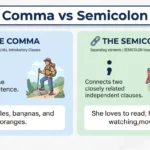
A comma (,) creates a lighter separation between words, phrases, or parts of a sentence.
- After lunch, we went for a walk.
- I bought apples, oranges, and bananas.
A semicolon (;) connects two closely related complete sentences.
- The if was terrible; we stayed indoors.
Easy memory trick
Comma = small pause.
Semicolon = stronger connection between complete thoughts.
What Is a Comma?
A comma is one of the most common punctuation marks in English. It helps separate words, phrases, and clauses to make sentences easier to read.
Commas separate items in a list
- I bought bread, milk, eggs, and fruit.
- She packed shirts, trousers, shoes, and a jacket.
In British English, the comma before and in a list is often called the Oxford comma. Its use can vary depending on the style guide.
Commas separate introductory phrases
- After the meeting, we went home.
- In the morning, I usually drink tea.
- However, the plan was successful.
Commas separate additional information
- My brother, who lives in London, is visiting us.
- The book, which I bought yesterday, is excellent.
Commas can separate two clauses
A comma can sometimes be used with a coordinating conjunction such as:
- and
- but
- or
- so
- yet
- for
- nor
Example:
- I wanted to go, but I was too tired.
- She studied hard, so she passed the exam.
What Is a Semicolon?
A semicolon (;) is stronger than a comma but weaker than a full stop.
It is commonly used to connect two closely related independent clauses.
An independent clause is a group of words that can stand alone as a complete sentence.
Example
- The rain stopped; we went outside.
Both parts are complete sentences:
- The rain stopped.
- We went outside.
Because the ideas are closely related, a semicolon can connect them.
Comma vs Semicolon: The Main Difference
| Punctuation | Main Function | Example |
|---|---|---|
| Comma (,) | Separates parts of a sentence | After work, I went home. |
| Semicolon (;) | Connects closely related complete sentences | I was tired; I went home. |
The simplest rule
Use a comma for a lighter separation.
Use a semicolon to connect two closely related complete sentences.
Comma vs Semicolon Examples
Comma examples
- Before dinner, we went for a walk.
- She bought apples, oranges, and bananas.
- I wanted to help, but I was busy.
- Although it was raining, we went outside.
Semicolon examples
- I was hungry; I made a sandwich.
- She loves reading; her brother prefers films.
- The shop was closed; we went somewhere else.
- He studied hard; he passed the exam.
How to Use a Semicolon Between Independent Clauses
Use a semicolon when:
- The first part is a complete sentence.
- The second part is a complete sentence.
- The two ideas are closely related.
Correct
- The sun was shining; we went to the beach.
Both sides can stand alone:
- The sun was shining.
- We went to the beach.
Incorrect
❌ Because it was raining; we stayed inside.
The first part, Because it was raining, is not a complete sentence. A semicolon cannot normally separate it from the main clause.
Correct
✅ Because it was raining, we stayed inside.
Semicolon With Transition Words
A semicolon can be used before transition words such as:
- however
- therefore
- nevertheless
- consequently
- moreover
- otherwise
Examples
- I wanted to go; however, I was too tired.
- The road was closed; therefore, we took another route.
- She worked hard; nevertheless, the project was delayed.
The usual structure is:
Complete sentence ; transition word, complete sentence.
Comma Splice: A Common Mistake
A comma splice happens when two complete sentences are joined with only a comma.
Incorrect
❌ The weather was cold, we stayed indoors.
Both parts are complete sentences, so a comma alone is not strong enough.
Correct options
✅ The weather was cold; we stayed indoors.
✅ The weather was cold. We stayed indoors.
✅ The weather was cold, so we stayed indoors.
Comma vs Semicolon vs Full Stop
These punctuation marks can all connect ideas, but they have different levels of separation.
Comma
Creates a light separation.
- After lunch, we went outside.
Semicolon
Connects closely related complete sentences.
- Lunch was over; we went outside.
Full stop
Creates a complete separation.
- Lunch was over. We went outside.
Think of punctuation as a scale
Comma → Semicolon → Full stop
The connection between ideas becomes progressively stronger.
Common Mistakes With Commas and Semicolons
Mistake 1: Using a comma between two complete sentences
❌ I finished my work, I went home.
✅ I finished my work; I went home.
This is a comma splice.
Mistake 2: Using a semicolon where a comma is needed
❌ Although I was tired; I continued working.
✅ Although I was tired, I continued working.
The phrase beginning with although is not an independent clause.
Mistake 3: Using a semicolon before a simple list
❌ I bought apples; oranges; and bananas.
✅ I bought apples, oranges, and bananas.
Use commas to separate ordinary items in a list.
Mistake 4: Using a semicolon with a coordinating conjunction unnecessarily
❌ I was tired; but I continued working.
Usually:
✅ I was tired, but I continued working.
A comma is normally used before but when joining two independent clauses.
Comma vs Semicolon in American and British English
The basic rules for commas and semicolons are largely the same in American English and British English.
However, punctuation style can vary slightly between style guides. For example, the use of the Oxford comma in lists differs between organisations and publications.
The main rule remains consistent:
- Use commas for separation within sentences.
- Use semicolons to connect closely related independent clauses.
A Simple Memory Trick for Comma vs Semicolon
Remember:
A comma separates; a semicolon connects.
Another useful test is the full stop test.
Look at the words on both sides of the semicolon.
Can you replace the semicolon with a full stop and still have two complete sentences?
Yes
- She was tired; she went to bed.
Both parts work independently.
No
- Because she was tired; she went to bed.
The first part is incomplete, so a semicolon is not correct.
Quick Practice: Comma or Semicolon?
Choose the correct punctuation:
- After work___I went shopping.
- I was hungry___I made dinner.
- She wanted to come___but she was busy.
- The shop was closed___we went home.
- Although it was late___we continued working.
Answers
- Comma After work, I went shopping.
- Semicolon I was hungry; I made dinner.
- Comma She wanted to come, but she was busy.
- Semicolon The shop was closed; we went home.
- Comma Although it was late, we continued working.
Why Are Commas and Semicolons So Commonly Confused?
The confusion comes from the fact that both punctuation marks can separate ideas. The main difference is the grammatical structure of the sentence.
A comma is usually used within a sentence to separate elements or clauses.
A semicolon is used when two complete sentences are closely connected and the writer wants to show a stronger relationship than a comma would provide.
The best question to ask is:
Can both sides of the punctuation stand alone as complete sentences?
If yes, a semicolon may be appropriate.
What is the difference between a comma and a semicolon?
A comma creates a lighter separation between parts of a sentence. A semicolon connects two closely related independent clauses.
Can a semicolon replace a comma?
Sometimes, but not always. A semicolon can replace a comma when joining two closely related complete sentences, but it cannot normally replace a comma after an introductory phrase.
Can a semicolon join two complete sentences?
Yes. For example: I was tired; I went to bed.
What is a comma splice?
A comma splice occurs when two independent clauses are joined with only a comma.
Incorrect: I was tired, I went to bed.
Correct: I was tired; I went to bed.
Should I use a comma or semicolon before “however”?
When however connects two independent clauses, a semicolon is commonly used before it:
I wanted to go; however, I was too tired.
Can I use a semicolon in a list?
Yes, especially when list items already contain commas.
Example: The conference included speakers from London, England; Paris, France; and Rome, Italy.
Is a semicolon stronger than a comma?
Yes. A semicolon creates a stronger separation than a comma but a weaker separation than a full stop.
Do American and British English use commas and semicolons differently?
The basic rules are the same, although specific punctuation preferences may vary between style guides.
Final Summary: Comma vs Semicolon
The difference between comma vs semicolon depends mainly on sentence structure. A comma creates a lighter separation between words, phrases, or clauses, such as in a list or after an introductory phrase.
A semicolon connects two closely related independent clauses that could each stand alone as complete sentences.
The easiest test is to look at both sides of the semicolon. If both sides could be complete sentences, a semicolon may be appropriate.
If one side is incomplete or the punctuation is simply separating items or phrases, a comma is usually the better choice.
Actionable Takeaway
Use a comma for lighter separation within a sentence. Use a semicolon to connect two closely related complete sentences. When in doubt, apply the full stop test: if both sides can stand alone as complete sentences, a semicolon may be the right choice.