Have you ever confused vary and very when writing or speaking English? These two words look and sound similar, but they have completely different meanings and grammatical uses. Using the wrong one can change the meaning of your sentence or create a simple spelling mistake.
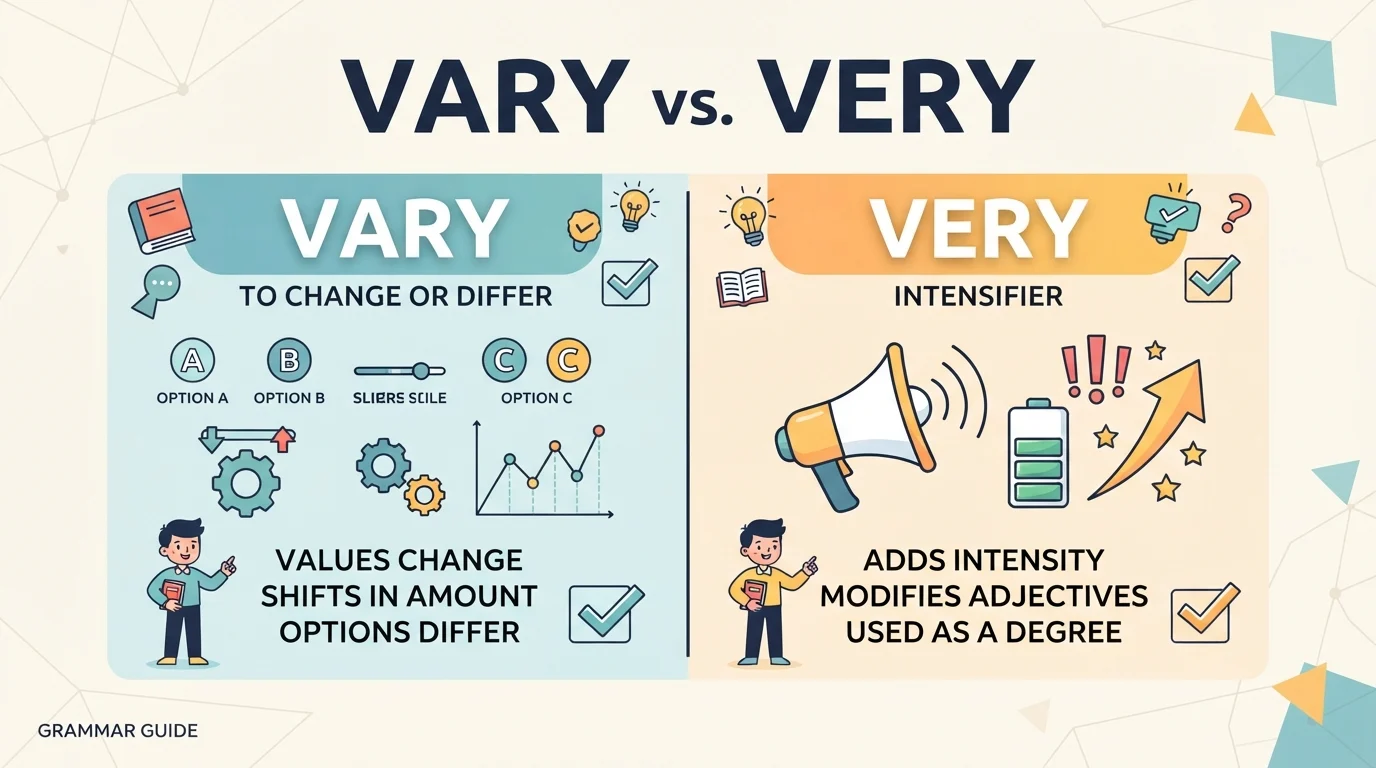
The easiest way to remember the difference between vary vs very is this: vary is a verb that means to change or differ, while very is usually an adverb used to add emphasis.
Once you understand this simple distinction, choosing the correct word becomes much easier.
Quick Answer: Vary vs Very
Vary means to change, differ, or be different.
- Prices vary depending on the season.
Very means to a high degree or extent.
- The film was very interesting.
Easy memory trick
Vary = variation or change.
Very = extra emphasis.
If you can replace the word with change or differ, use vary.
If you can replace it with really or extremely, use very.
What Does “Vary” Mean?
Vary is a verb. It means to change, differ, or be different depending on the situation.
Examples of “vary”
- Prices vary from shop to shop.
- Results may vary depending on the method used.
- People’s opinions vary widely.
- The weather can vary throughout the day.
- The colours vary from light blue to dark green.
In each example, something changes or differs.
Vary can mean “change”
- The schedule may vary slightly.
- The recipe can vary according to personal taste.
- The amount of rainfall varies each year.
Vary can mean “differ”
- The results vary between different groups.
- Costs vary depending on the location.
- The two products vary in quality.
What Does “Very” Mean?
Very is usually an adverb used to emphasise an adjective or another adverb.
It means to a high degree, extremely, or really.
Examples of “very”
- She is very happy.
- The test was very difficult.
- He runs very quickly.
- This book is very useful.
- It is very cold today.
In these examples, very strengthens the word that follows it.
Very can also mean “exactly”
In some contexts, very can mean exact or actual.
- This is the very place where we met.
- That was the very moment I understood.
- He arrived at the very beginning of the meeting.
This use is less common for beginners but is important to understand.
Vary vs Very: The Main Difference
| Word | Part of Speech | Meaning | Example |
|---|---|---|---|
| Vary | Verb | To change or differ | Prices vary by location. |
| Very | Adverb | To a high degree | The price is very high. |
The simplest rule
Use vary when something changes or differs.
Use very when you want to make an adjective or adverb stronger.
Vary vs Very Examples
Examples with “vary”
- The prices vary from £10 to £50.
- The results vary depending on the circumstances.
- The size and colour may vary.
- Opinions vary on this issue.
- The working hours vary from week to week.
Examples with “very”
- The product is very popular.
- She was very pleased with the results.
- The instructions are very clear.
- He speaks very quietly.
- This is a very important decision.
Common Mistakes With Vary and Very
Mistake 1: Using “very” when you mean “change”
❌ Prices very depending on the season.
✅ Prices vary depending on the season.
The prices change, so vary is correct.
Mistake 2: Using “vary” for emphasis
❌ The film was vary interesting.
✅ The film was very interesting.
The word adds emphasis, so very is correct.
Mistake 3: Confusing “vary” with “various”
Vary is a verb.
- Prices vary.
Various is an adjective meaning different or several.
- We offer various products.
Mistake 4: Confusing “very” with “vary” in pronunciation
In many accents, the words sound similar but are not identical. The spelling difference is important.
Remember:
- Vary contains a and relates to change.
- Very contains e and relates to emphasis.
Vary, Varies, Varied, and Varying
The verb vary changes form depending on the sentence.
Vary
- Prices vary between different suppliers.
Varies
Use varies with a singular subject.
- The price varies by location.
- The answer varies from person to person.
Varied
- The results varied significantly.
- The menu offers a varied selection of dishes.
Varying
- The company offers varying levels of service.
- The results showed varying degrees of success.
Common Expressions With “Vary”
Some useful phrases include:
- Vary from person to person
- Vary from place to place
- Vary depending on
- Vary widely
- Vary considerably
- Vary significantly
- Vary in size
- Vary in quality
Examples
- Opinions vary from person to person.
- Prices vary depending on the season.
- The results vary widely between the groups.
Common Expressions With “Very”
Some common phrases include:
- Very important
- Very difficult
- Very easy
- Very quickly
- Very carefully
- Very different
- Very similar
- Very useful
Examples
- This information is very useful.
- She answered the question very carefully.
- The two methods are very different.
Vary vs Very in American and British English
The meanings and spellings of vary and very are the same in American English and British English.
The main difference may be pronunciation depending on the speaker’s accent. However, the grammar rule remains the same:
- Vary = change or differ
- Very = to a high degree
A Simple Memory Trick for Vary vs Very
Remember:
Vary = variation
The words vary and variation are connected.
- Things that vary show variation.
Very = really
If you can replace very with really or extremely, use very.
- She is very tired.
- She is really tired.
Quick rule
Things vary; adjectives become very strong.
Quick Practice: Vary or Very?
Choose the correct word:
- Prices ______ depending on the location.
- The film was ______ entertaining.
- Results may ______ from person to person.
- She was ______ happy with the decision.
- The colours ______ from light to dark.
Answers
- vary
- very
- vary
- very
- vary
Why Are Vary and Very So Commonly Confused?
The main reason is that the two words are short, visually similar, and sound alike or almost alike in some accents.
Their meanings, however, are completely different.
Vary describes change or difference:
Prices vary.
Very adds emphasis:
Prices are very high.
A useful way to check your choice is to look at the word’s function in the sentence. If you need a verb meaning change or differ, use vary. If you need an intensifier meaning really or extremely, use very.
What is the difference between vary and very?
Vary means to change or differ. Very means to a high degree or extent and is used to add emphasis.
Is it “prices vary” or “prices very”?
The correct phrase is prices vary because prices can change or differ.
Is it “very important” or “vary important”?
The correct phrase is very important because very adds emphasis to the adjective important.
What is a synonym for vary?
Depending on the context, synonyms include change, differ, fluctuate, alter, and differ greatly.
What is a synonym for very?
Depending on the context, synonyms include really, extremely, highly, and particularly.
Is “vary” a verb?
Yes. Vary is a verb meaning to change or differ.
Is “very” an adverb?
Usually, yes. Very is commonly used as an adverb to modify adjectives and adverbs.
Do American and British English use vary and very differently?
No. The basic meanings, spellings, and grammar rules are the same in both varieties of English.
Final Summary: Vary vs Very
The difference between vary vs very is simple. Vary is a verb meaning to change, differ, or be different. For example, “Prices vary depending on the location.” Very is usually an adverb used to add emphasis, as in “The price is very high.”
The easiest way to remember the difference is to connect vary with variation and very with really or extremely. If something changes or differs, use vary. If you want to make a description stronger, use very.
Actionable Takeaway
Remember: Vary = change or differ. Very = really or extremely. If you can replace the word with change, choose vary. If you can replace it with really, choose very.