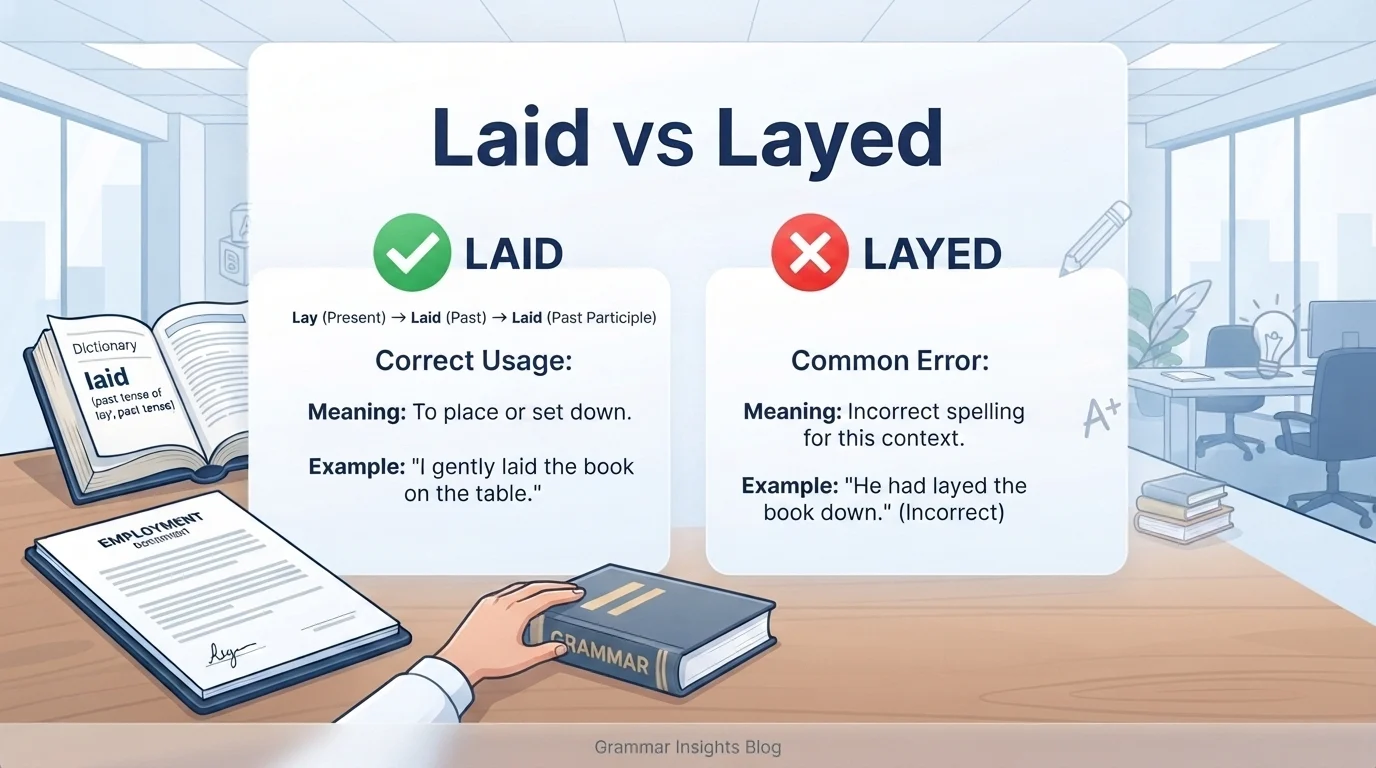
Have you ever wondered whether the correct word is “laid” or “layed”? You’re not alone. This is a common English spelling mistake because many verbs form their past tense by adding ed. However, lay is an irregular verb, so its past tense is laid, not layed.
The correct word in standard English is laid. Layed is generally considered incorrect when used as the past tense of lay. If you’re talking about placing something somewhere, putting something down, or using phrases such as laid off and laid out, understanding this difference will help you write more accurately.
Quick Answer
Laid is correct.
Layed is generally incorrect in standard English.
- ✅ Laid = The past tense and past participle of lay.
- ❌ Layed = Not the standard past form of lay.
Examples:
- She laid the book on the table.
- The company laid off several workers.
- ❌ She layed the book on the table.
What Does “Laid” Mean?
Laid is the past tense and past participle of the verb lay.
The basic meaning of lay is to put or place something somewhere.
Examples:
- She laid the keys on the desk.
- He laid the baby gently in the crib.
- They laid the books on the table.
Verb Forms of “Lay”
- Present: lay
- Past: laid
- Past participle: laid
Examples:
- I lay the book on the table. (present)
- I laid the book on the table. (past)
- I have laid the book on the table. (past participle)
What Does “Layed” Mean?
Layed is generally not the correct past tense of lay in standard English.
Many people write layed because they assume lay follows the regular verb pattern:
- walk → walked
- talk → talked
- play → played
However, lay is irregular:
- lay → laid
Therefore:
- ❌ layed
- ✅ laid
Laid vs Layed
| Word | Correct Standard English? | Meaning | Example |
|---|---|---|---|
| Laid | ✅ Yes | Past tense of lay | She laid the book down. |
| Layed | ❌ Generally no | Incorrect form of lay | ❌ She layed the book down. |
Whenever you’re deciding between laid vs layed, choose laid.
How to Use “Laid” Correctly
Placing Something Somewhere
- She laid the phone on the table.
- He laid the papers on the desk.
- I laid the clothes on the bed.
Putting Something Down
- She laid the baby in the crib.
- He laid the blanket on the floor.
- They laid the foundation for the building.
Using Common Phrasal Verbs
Laid off
- The company laid off several employees.
Laid out
- She laid out the documents on the desk.
Laid down
- He laid down the book.
Laid back
- He has a relaxed, laid back personality.
Common Mistakes
The most common mistake is treating lay like a regular verb.
Incorrect:
- ❌ She layed the book on the table.
- ❌ He layed the baby down.
- ❌ The company layed off workers.
Correct:
- ✅ She laid the book on the table.
- ✅ He laid the baby down.
- ✅ The company laid off workers.
Laid vs Lay vs Lie
This is where English can become especially confusing.
Lay
Lay means to put or place something. It usually takes an object.
- I lay the book on the table.
- Yesterday, I laid the book on the table.
Lie
Lie means to rest or recline. It does not normally take a direct object.
- I lie on the bed.
- Yesterday, I lay on the bed.
Quick Comparison
| Present | Past | Meaning |
|---|---|---|
| Lay | Laid | Put or place something |
| Lie | Lay | Rest or recline |
Examples:
- I lay the book down. → Yesterday, I laid it down.
- I lie on the bed. → Yesterday, I lay on the bed.
Easy Trick to Remember
Remember this simple rule:
Lay → Laid
Never add ed to create layed.
You can memorize the verb forms:
Lay Laid Laid
Examples:
- I lay the book down.
- I laid the book down yesterday.
- I have laid the book down.
American vs British English
There is no meaningful difference between American and British English in the standard use of laid and layed.
Both varieties use:
- lay as the present form
- laid as the past tense
- laid as the past participle
Layed is generally not accepted as the standard past tense of lay in either variety.
Related Words and Phrases
You may often see laid in these expressions:
- laid off
- laid out
- laid down
- laid back
- laid to rest
- laid the foundation
- laid an egg
- laid the groundwork
Examples:
- The company laid off employees.
- She laid out the plan.
- He laid down the rules.
- The team laid the groundwork for success.
Tips to Avoid This Mistake
Follow these simple strategies:
- Remember: lay → laid → laid.
- Never use layed as the normal past tense of lay.
- Use laid when you mean placed or put something somewhere.
- Be careful not to confuse lay with lie.
- Memorize common phrases such as laid off, laid out, and laid down.
Frequently Asked Questions
Which is correct: laid or layed?
Laid is correct in standard English. Layed is generally an incorrect form of the verb lay.
Is “layed” a real word?
It is generally not accepted as the standard past tense of lay. In standard English, the correct form is laid.
What is the past tense of lay?
The past tense of lay is laid.
What is the past participle of lay?
The past participle is also laid.
Example:
- She has laid the book on the table.
Is “laid off” correct?
Yes. Laid off is the correct phrase.
Example:
- The company laid off several employees.
What is the difference between lay and lie?
Lay means to put or place something, while lie means to rest or recline.
How can I remember laid vs layed?
Remember the verb pattern: lay → laid → laid. The standard past form is laid, not layed.
Summary
When comparing laid vs layed, the correct word in standard English is laid. It is the past tense and past participle of lay, which means to put or place something somewhere. For example, you can say, “She laid the book on the table.”
Layed is a common spelling mistake caused by treating lay like a regular verb. The easiest way to remember the correct form is lay → laid → laid. If you’re writing laid off, laid out, laid down, or simply describing something that was placed somewhere, use laid, not layed.
Actionable Takeaway
Before writing laid or layed, remember the simple rule: the past tense of lay is laid. If you mean “placed” or “put,” always choose laid.