The confusion between weeped or wept is common because English verbs often follow irregular grammar patterns. Many people assume the past tense of weep should simply add “-ed” and become weeped. However, standard English uses a different form.
If you’ve ever wondered whether to write weeped or wept in stories, essays, conversations, or emotional writing, this guide explains the correct past tense, meanings, grammar rules, examples, and easy memory tricks.
Quick Answer
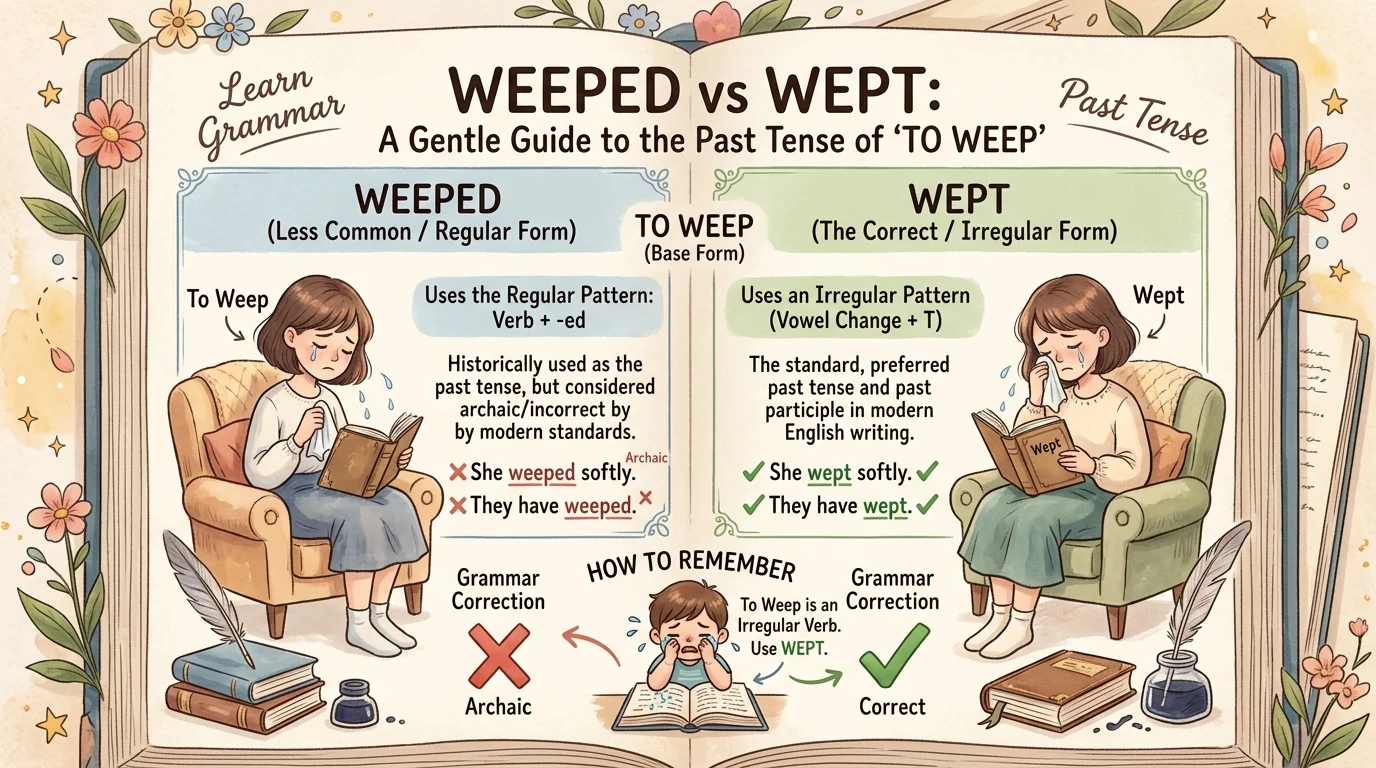
✅ Wept is the correct past tense of weep.
❌ Weeped is generally incorrect in standard English.
Correct example:
- “She wept after hearing the news.”
Incorrect example:
- “She weeped after hearing the news.”
The verb weep means:
- to cry
- to shed tears
- to express deep sadness emotionally
What Does Weep Mean?
English Grammar Weep is a verb that describes crying deeply or emotionally.
It is often used in:
- literature
- emotional storytelling
- formal writing
- poetry
Examples of Weep
- He began to weep quietly.
- They weeped? ❌
- They wept together after the ceremony.
- She weeps whenever she watches the movie.
Why “Wept” Is Correct
The verb weep is an irregular verb.
That means it does not form the past tense by simply adding:
- -ed
Instead:
- weep → wept
This follows the same pattern as several older English verbs.
Weeped vs Wept: Main Difference
| Word | Status | Meaning |
|---|---|---|
| Wept | Correct | Past tense of weep |
| Weeped | Incorrect in standard English | Common grammar mistake |
The Grammar Rule Behind Wept
Linguistics Some English verbs are irregular and change form completely in the past tense.
Examples of Irregular Verbs
| Present | Past |
|---|---|
| keep | kept |
| sleep | slept |
| weep | wept |
Notice the pattern:
- “eep” → “ept”
Why People Say “Weeped”
People often use weeped because:
- most English verbs add “-ed”
- irregular verbs can feel confusing
- learners naturally apply regular grammar rules
However, standard English dictionaries recognize:
✅ wept
❌ weeped
Common Uses of Wept
Literature
Literature
- Characters often wept during emotional scenes.
Religion
Bible
- Religious texts frequently describe people who wept in sorrow.
Movies
The Notebook
- Many viewers wept during the ending.
Personal Emotion
Psychology
- She wept with relief after the rescue.
Verb Forms of Weep
| Verb Form | Example |
|---|---|
| Base verb | weep |
| Present participle | weeping |
| Past tense | wept |
| Past participle | wept |
Example Sentence
- “He wept after weeping silently for hours.”
Common Mistakes People Make
Mistake 1: Adding “-ED”
Incorrect:
- “She weeped loudly.”
Correct:
- “She wept loudly.”
Mistake 2: Forgetting It’s Irregular
Many writers assume all verbs follow regular past tense rules.
Mistake 3: Mixing Spoken and Formal English
Some informal speech patterns incorrectly use weeped.
Synonyms for Weep
Using related vocabulary improves readability and writing variety.
Common Synonyms
- cry
- sob
- mourn
- grieve
- lament
Example
Instead of:
- “She wept.”
You could say:
- “She sobbed.”
Weep in Emotional Writing
Creative Writing The word weep often sounds:
- poetic
- emotional
- literary
- dramatic
Writers use it to express deeper sadness than the word cry.
American vs British English Differences
Both:
- United States American English
- United Kingdom British English
use the same past tense:
✅ wept
❌ weeped
There is no regional grammar difference.
Why Correct Grammar Matters
Professional Communication Correct verb forms improve:
- readability
- professionalism
- academic quality
- grammatical accuracy
Using incorrect forms like weeped may distract readers and weaken polished writing.
Easy Trick to Remember the Correct Form
A simple memory trick:
Weep Follows Keep
Think:
- keep → kept
- sleep → slept
- weep → wept
The pattern stays similar.
Related Word Forms
| Word Type | Example |
|---|---|
| Verb | weep |
| Present participle | weeping |
| Past tense | wept |
| Noun | weeping |
Example Sentence
- “The weeping child wept quietly.”
FAQs
Which is correct: weeped or wept?
Wept is the correct past tense of weep.
Is weeped a real word?
Weeped may appear informally, but it is generally considered incorrect in standard English.
What does weep mean?
It means to cry or shed tears emotionally.
Why is wept irregular?
Because weep is an irregular English verb that changes form in the past tense.
What is the past participle of weep?
The past participle is wept.
Do British and American English use different past tense forms?
No. Both use wept.
Is weep more formal than cry?
Yes. Weep often sounds more emotional or literary.
Can spell-check detect weeped?
Yes. Most grammar tools suggest wept instead.
Final Summary
The difference between weeped or wept comes from irregular English verb rules. Wept is the correct past tense and past participle of weep, while weeped is generally considered incorrect in standard English. The verb follows the same irregular pattern as words like keep → kept and sleep → slept.
Whenever you write about emotional crying or sadness in formal, academic, or literary English, always use wept. Remembering the “eep → ept” pattern can help you avoid this common grammar mistake and improve your writing accuracy.
Actionable Takeaway
Before writing the past tense, remember:
- weep → wept
- keep → kept
So:
- wept ✅
- weeped ❌
That quick grammar check will help you avoid the mistake every time.