Have you ever confused “relieving” and “reliving”? You’re not alone. These two words look and sound very similar, but they have completely different meanings. Using the wrong spelling can change the meaning of your sentence entirely.
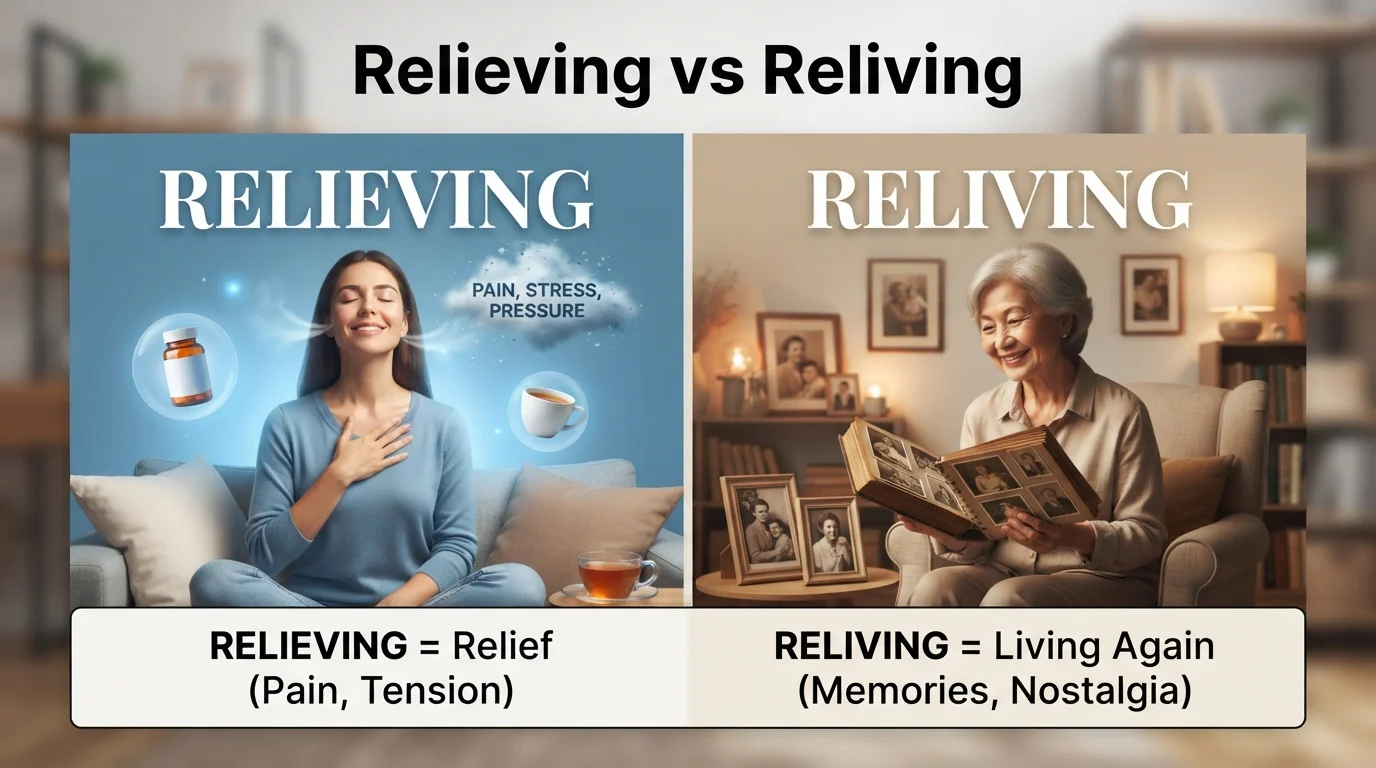
Relieving is related to relieve, meaning to reduce pain, stress, pressure, or difficulty. Reliving comes from relive, meaning to experience something again, usually in your memory or imagination.
This guide explains relieving vs reliving with clear definitions, examples, common mistakes, American and British English usage, and easy memory tips.
Quick Answer
- Relieving = Reducing pain, stress, pressure, or difficulty.
- Reliving = Experiencing something again, especially a past memory.
Examples:
- The medicine is relieving her pain.
- He is reliving his childhood memories.
What Does “Relieving” Mean?
Relieving is the present participle or gerund form of the verb relieve.
It means reducing or removing pain, stress, pressure, discomfort, or a problem.
Examples:
- The medicine is relieving my headache.
- She is relieving the pressure on the team.
- The massage was relieving his muscle tension.
- The new system is relieving employees of unnecessary paperwork.
Common Uses of “Relieving”
You may see relieving used with:
- pain
- stress
- pressure
- anxiety
- discomfort
- tension
- responsibility
- difficulty
Examples:
- relieving pain
- relieving stress
- relieving pressure
- relieving anxiety
- relieving tension
What Does “Reliving” Mean?
Reliving is the present participle or gerund form of the verb relive.
It means experiencing something again, often through memory, imagination, photographs, stories, or emotional reflection.
Examples:
- She is reliving her childhood memories.
- Looking at old photos made him relive the experience.
- The movie allowed fans to relive the excitement of the final match.
- He kept reliving the moment in his mind.
Common Uses of “Reliving”
You may see reliving used with:
- memories
- experiences
- moments
- childhood
- the past
- traumatic events
- special occasions
Examples:
- reliving memories
- reliving the past
- reliving an experience
- reliving a special moment
Relieving vs Reliving
| Word | Meaning | Example |
|---|---|---|
| Relieving | Reducing pain, stress, pressure, or difficulty | The treatment is relieving her pain. |
| Reliving | Experiencing something again | He is reliving his childhood. |
The key difference is:
Relieving = making something less difficult or painful
Reliving = living or experiencing something again
Common Mistakes
Mistake 1: Confusing Pain Relief with Memories
Incorrect:
- ❌ The medicine is reliving my headache.
Correct:
- ✅ The medicine is relieving my headache.
A medicine relieves pain; it does not relive pain.
Mistake 2: Using “Relieving” for Past Experiences
Incorrect:
- ❌ She is relieving her childhood memories.
Correct:
- ✅ She is reliving her childhood memories.
You relive a memory or experience because you experience it again.
The Difference Between “Relieve” and “Relive”
The easiest way to understand these words is to look at their base verbs.
Relieve → Relieving
Relieve means to reduce or remove something unpleasant.
- relieve pain
- relieve stress
- relieve pressure
Therefore:
- relieving pain
- relieving stress
- relieving pressure
Relive → Reliving
Relive means to experience something again.
- relive a memory
- relive an experience
- relive the past
Therefore:
- reliving a memory
- reliving an experience
- reliving the past
Spelling Rule
When adding -ing to relieve, the final e is dropped:
relieve → relieving
When adding -ing to relive, the final e is also dropped:
relive → reliving
This creates two very similar words, which is why they are often confused.
Compare:
- relieve → relieving
- relive → reliving
The important difference is the i:
- relieving = reducing something unpleasant
- reliving = experiencing something again
American vs British English
There is no significant difference between American and British English in the meaning or spelling of relieving and reliving.
Both varieties use:
- relieving for reducing pain, stress, or pressure
- reliving for experiencing something again
Easy Trick to Remember
Use this simple memory rule:
Relieving = Relief
The word relieving contains the idea of relief.
- relieving pain
- relieving stress
- relieving pressure
And:
Reliving = Living again
Reliving means experiencing or “living” something again.
- reliving a memory
- reliving the past
- reliving an experience
Examples in Everyday English
Relieving
- The medication is relieving her pain.
- Exercise can be relieving stress.
- The new employee is relieving some pressure from the team.
- The treatment is relieving his discomfort.
Reliving
- She is reliving her wedding day through old photographs.
- He kept reliving the accident in his mind.
- The documentary helped viewers relive an important historical event.
- They enjoyed reliving their childhood memories.
Tips to Avoid This Mistake
Follow these simple strategies:
- Use relieving when something is being reduced or eased.
- Use reliving when someone experiences something again.
- Remember relieving = relief.
- Remember reliving = living again.
- Think of pain and stress with relieving.
- Think of memories and experiences with reliving.
Frequently Asked Questions
What is the difference between relieving and reliving?
Relieving means reducing pain, stress, pressure, or difficulty. Reliving means experiencing something again, usually a memory or past event.
Is “relieving pain” correct?
Yes.
Example: The medicine is relieving my pain.
Is “reliving memories” correct?
Yes.
Example: She is reliving happy memories from her childhood.
Is “reliving stress” correct?
Usually, no. If you mean reducing stress, use relieving stress.
Is “relieving memories” correct?
Usually, no. If you mean experiencing memories again, use reliving memories.
Are relieving and reliving pronounced the same?
They are pronounced differently. Relieving is related to relief, while reliving is related to live.
Do American and British English spell these words differently?
No. The spelling and meanings are the same in both American and British English.
Summary
When comparing relieving vs reliving, remember that relieving means reducing or easing something unpleasant, such as pain, stress, pressure, or discomfort. For example, “The medicine is relieving her headache.” The word reliving, on the other hand, means experiencing something again, especially a memory or past event, as in “He is reliving his childhood memories.”
The easiest way to remember the difference is relieving = relief and reliving = living again. If something is becoming less painful or difficult, use relieving. If someone is experiencing a past event or memory again, use reliving.
Actionable Takeaway
Use relieving for pain, stress, pressure, and discomfort, and use reliving for memories, experiences, and past events. Remember: relieving brings relief; reliving means living something again.