Have you ever been confused about whether to use “farther” or “further”? You’re not alone. These two words are closely related and are often used in similar situations, which makes them one of the most common English word-choice mistakes.
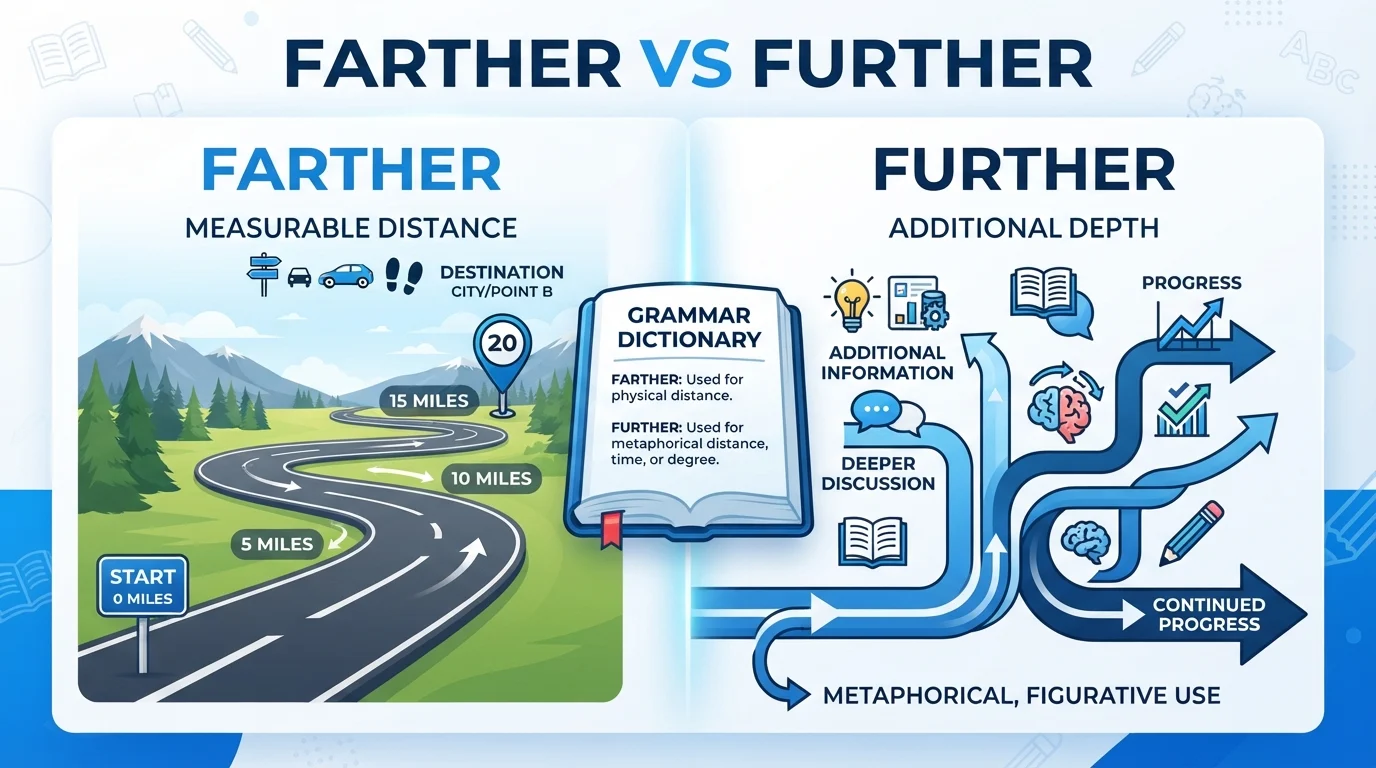
The traditional rule is simple: farther is generally used for physical distance, while further is used for additional information, greater progress, or figurative distance. However, modern English sometimes uses further for physical distance too.
In this guide, you’ll learn the difference between farther vs further, see clear examples, understand common mistakes, and learn an easy way to choose the right word.
Quick Answer
- Farther = Usually refers to measurable physical distance.
- Further = Usually means additional, more, or greater progress.
Examples:
- The next town is farther away.
- We need further information.
- Let’s discuss the matter further.
What Does “Farther” Mean?
Farther traditionally refers to physical distance. It is used when the distance can be measured in miles, kilometers, meters, or another unit.
Examples:
- How much farther is the train station?
- We walked farther than expected.
- The store is farther down the road.
- She threw the ball farther than her brother.
- The airport is farther from the city center.
A useful question to ask is:
Can I measure the distance?
If yes, farther is traditionally the preferred choice.
What Does “Further” Mean?
Further usually means additional, more, deeper, or to a greater extent.
It is commonly used for abstract or figurative ideas.
Examples:
- We need to investigate the matter further.
- Please provide further details.
- The issue requires further discussion.
- She wants to further her education.
- No further action is required.
Farther vs Further
| Word | Main Traditional Use | Example |
|---|---|---|
| Farther | Physical or measurable distance | The village is farther away. |
| Further | Additional, figurative, or abstract meaning | We need further information. |
The easiest distinction is:
Farther = physical distance
Further = additional or figurative meaning
Examples of “Farther”
Use farther when talking about actual physical distance.
- We drove farther than planned.
- The mountain is farther away than it looks.
- How much farther do we need to walk?
- The hotel is farther from the beach.
- She ran farther than anyone else.
Examples of “Further”
Use further when you mean more, additional, or deeper.
- We need further research.
- Do you have any further questions?
- The company needs further investment.
- Let’s discuss this further.
- The report requires further review.
“Further” as a Verb
Further can also be used as a verb meaning to promote, advance, or help something develop.
Examples:
- The project will further scientific research.
- She took the course to further her career.
- The program aims to further our understanding of the problem.
In these sentences, farther would not be correct.
Common Mistakes
One common mistake is using farther with abstract ideas.
Less appropriate:
- ❌ We need to investigate the issue farther.
Better:
- ✅ We need to investigate the issue further.
Another common mistake is believing that further can never refer to physical distance. In modern English, further is widely used for physical distance too.
For example:
- The town is further away.
This sentence is commonly accepted, although farther follows the traditional distinction more closely.
American vs British English
The traditional rule is generally taught in both American and British English:
- farther = physical distance
- further = additional or figurative meaning
However, modern usage has become more flexible. Further is commonly used for physical distance in both varieties of English, especially in everyday speech.
If you want to follow the traditional grammar rule, use farther for measurable physical distance and further for abstract or additional meanings.
Easy Trick to Remember
Remember this:
Farther contains “far,” so think of physical distance.
Examples:
- The store is farther away.
- How much farther is the destination?
Use further for:
- further information
- further research
- further discussion
- further details
- further education
- further action
Related Phrases
Common Phrases with “Farther”
- farther away
- farther down the road
- farther from home
- farther than expected
- farther into the distance
Common Phrases with “Further”
- further information
- further details
- further research
- further discussion
- further education
- further action
- further consideration
- further notice
Tips to Avoid This Mistake
Follow these simple strategies:
- Use farther for measurable physical distance.
- Use further for additional information or abstract ideas.
- Remember that farther contains far.
- Use further information, not farther information.
- Use further research, not farther research.
- In modern English, further may also be acceptable for physical distance.
Frequently Asked Questions
What is the difference between farther and further?
Farther traditionally refers to physical distance, while further usually refers to additional information, progress, or figurative distance.
Is “farther information” correct?
No. The standard phrase is further information.
Is “further information” correct?
Yes. Further information means additional information.
Which is correct: farther away or further away?
Both are used. Farther away follows the traditional physical-distance rule, while further away is also widely accepted in modern English.
Is “further research” correct?
Yes. Further research means additional or more research.
Can further refer to physical distance?
Yes. Although farther is traditionally preferred for measurable physical distance, further is commonly used for physical distance in modern English.
Do American and British English use farther and further differently?
The traditional distinction is similar in both varieties, but modern usage often allows further for physical distance as well.
Summary
When comparing farther vs further, the traditional rule is that farther is used for physical or measurable distance, while further is used for additional information, abstract ideas, or greater progress. For example, you can say, “The next town is farther away,” but “We need further information.”
Modern English is more flexible, and further is often used for physical distance as well. However, the easiest way to remember the traditional distinction is farther = physical distance and further = additional or figurative meaning.
Actionable Takeaway
Before choosing farther or further, ask yourself whether you are talking about measurable physical distance or additional information and progress. Use farther for physical distance and further for additional or abstract meanings.