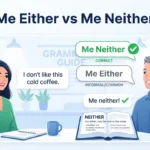
Have you ever wondered whether to say “me either” or “me neither” when agreeing with a negative statement? You’re not alone. Both expressions are commonly heard in everyday English, but their usage can depend on grammar, regional preferences, and the sentence that comes before them.
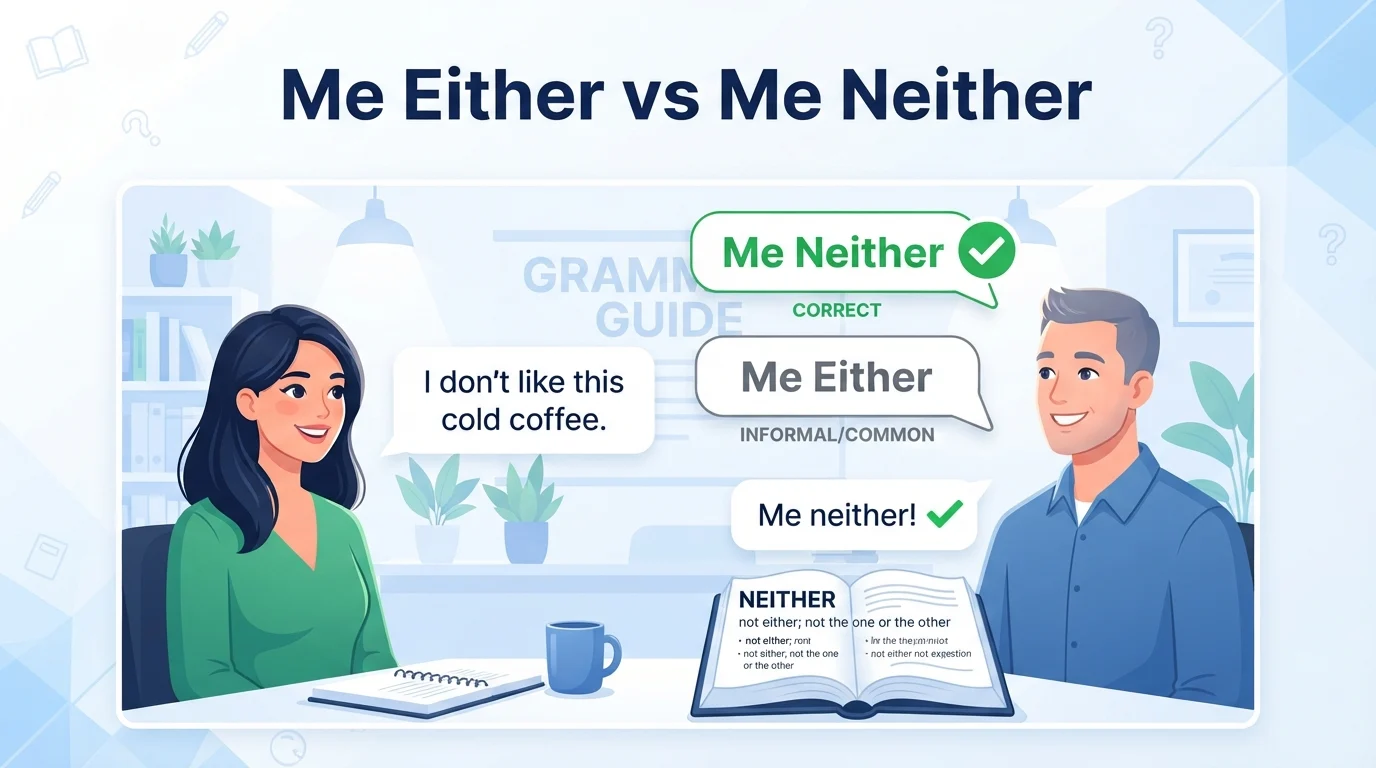
In general, “me neither” is the traditional and widely accepted expression for agreeing with a negative statement. “Me either” is also common, especially in informal American English, but some speakers consider it less grammatically formal. This guide explains me either vs me neither with clear examples, usage rules, common mistakes, and easy tips for choosing the right expression.
Quick Answer
- Me neither = The traditional and widely accepted way to agree with a negative statement.
- Me either = Common in informal speech, especially in American English, but less formal.
Examples:
- “I don’t like spinach.” Me neither.
- “I can’t swim.” Me neither.
- “I don’t like spinach.” Me either. (informal usage)
For formal or careful writing, neither do I or neither can I is usually the safest choice.
What Does “Me Neither” Mean?
Me neither means “I don’t either” or “Neither do I.”
It is used to agree with a negative statement.
Example:
- Person A: “I don’t like coffee.”
- Person B: “Me neither.”
This means:
I don’t like coffee either.
More examples:
- “I haven’t seen that movie.” Me neither.
- “I can’t understand this question.” Me neither.
- “I don’t want to go.” Me neither.
What Does “Me Either” Mean?
Me either is commonly used in informal conversation to agree with a negative statement.
Example:
- “I don’t like spicy food.”
- “Me either.”
Many native speakers use this expression naturally, especially in casual American English.
However, in traditional grammar, neither is often preferred because the statement is negative.
More formal alternatives include:
- Neither do I.
- Neither can I.
- Neither have I.
- I don’t either.
Me Either vs Me Neither
| Expression | Meaning | Usage |
|---|---|---|
| Me neither | I also do not | Traditional and widely accepted |
| Me either | I also do not | Informal, common in some varieties of English |
Examples:
- “I don’t like it.” — Me neither.
- “I don’t like it.” — Me either. (informal)
The safest choice in standard English is generally me neither or a complete structure such as neither do I.
When to Use “Me Neither”
Use me neither after a negative statement.
Examples:
- “I don’t eat meat.” Me neither.
- “I haven’t finished yet.” Me neither.
- “I won’t be attending.” Me neither.
- “I can’t solve this problem.” Me neither.
The expression agrees with the negative meaning of the previous statement.
When to Use “Me Either”
Me either is most appropriate in casual spoken English.
Examples:
- “I don’t want dessert.” Me either.
- “I don’t know the answer.” Me either.
- “I haven’t been there.” Me either.
Although many people use it naturally, some speakers prefer me neither because it follows the traditional negative-agreement pattern.
The More Formal Alternatives
Instead of using me either or me neither, you can use a grammatically complete response.
Neither Do I
- “I don’t like horror movies.”
- “Neither do I.”
Neither Can I
- “I can’t drive.”
- “Neither can I.”
Neither Have I
- “I haven’t visited London.”
- “Neither have I.”
I Don’t Either
- “I don’t like coffee.”
- “I don’t either.”
These forms are clear and widely accepted.
Common Mistakes
Using “Me Neither” After a Positive Statement
Incorrect:
- ❌ “I love pizza.” Me neither.
Correct:
- ✅ “I love pizza.” Me too.
Use me neither after a negative statement.
Using “Me Too” After a Negative Statement
Incorrect:
- ❌ “I don’t like broccoli.” — Me too.
Better:
- ✅ “I don’t like broccoli.” Me neither.
- ✅ “I don’t like broccoli.” I don’t either.
Confusing Either and Neither
Remember:
- either can appear in negative sentences: “I don’t like it either.”
- neither already expresses a negative meaning: “Neither do I.”
Me Either vs Me Neither in American and British English
Me neither is widely understood and accepted in both American and British English.
Me either is also heard in informal speech, particularly in American English, although some speakers consider it less standard or less formal.
For formal writing, use:
- Neither do I
- Neither can I
- I don’t either
These forms avoid any disagreement about the expression.
Easy Trick to Remember
Use this simple rule:
Positive statement → Me too.
Negative statement → Me neither.
Examples:
- “I like tea.” → Me too.
- “I don’t like coffee.” → Me neither.
You can also remember:
Neither = not either.
So, when agreeing with a negative statement, me neither is the traditional choice.
Frequently Asked Questions
Which is correct: me either or me neither?
Me neither is the traditional and widely accepted expression for agreeing with a negative statement. Me either is also common in informal speech.
Can I say “me either”?
Yes. Me either is commonly used in informal conversation, especially in American English. However, me neither or neither do I is generally safer in formal English.
Is “me neither” grammatically correct?
Yes. Me neither is a common and widely accepted way to agree with a negative statement.
What should I say after “I don’t like it”?
You can say:
- Me neither.
- I don’t either.
- Neither do I.
Is “me too” correct after a negative sentence?
Usually, no. After a negative statement, use me neither, I don’t either, or an appropriate neither construction.
What is the difference between “me neither” and “neither do I”?
They have the same basic meaning. Me neither is shorter and more conversational, while neither do I is a complete grammatical structure.
Do American and British English use “me either” differently?
Me either is common in informal speech, particularly in American English. Me neither is widely understood in both varieties and is generally the safer choice.
Summary
When comparing me either vs me neither, me neither is the traditional and widely accepted expression used to agree with a negative statement. For example, if someone says, “I don’t like coffee,” you can reply, “Me neither.” This means “I don’t like coffee either.”
Me either is also commonly heard in informal conversation, especially in American English, but some speakers consider it less formal. For formal or careful writing, use “Neither do I,” “Neither can I,” or “I don’t either.”
Actionable Takeaway
Use me neither after a negative statement when you want to agree. For the safest and most natural grammar, remember: “I don’t like it.” → “Me neither” or “Neither do I.”