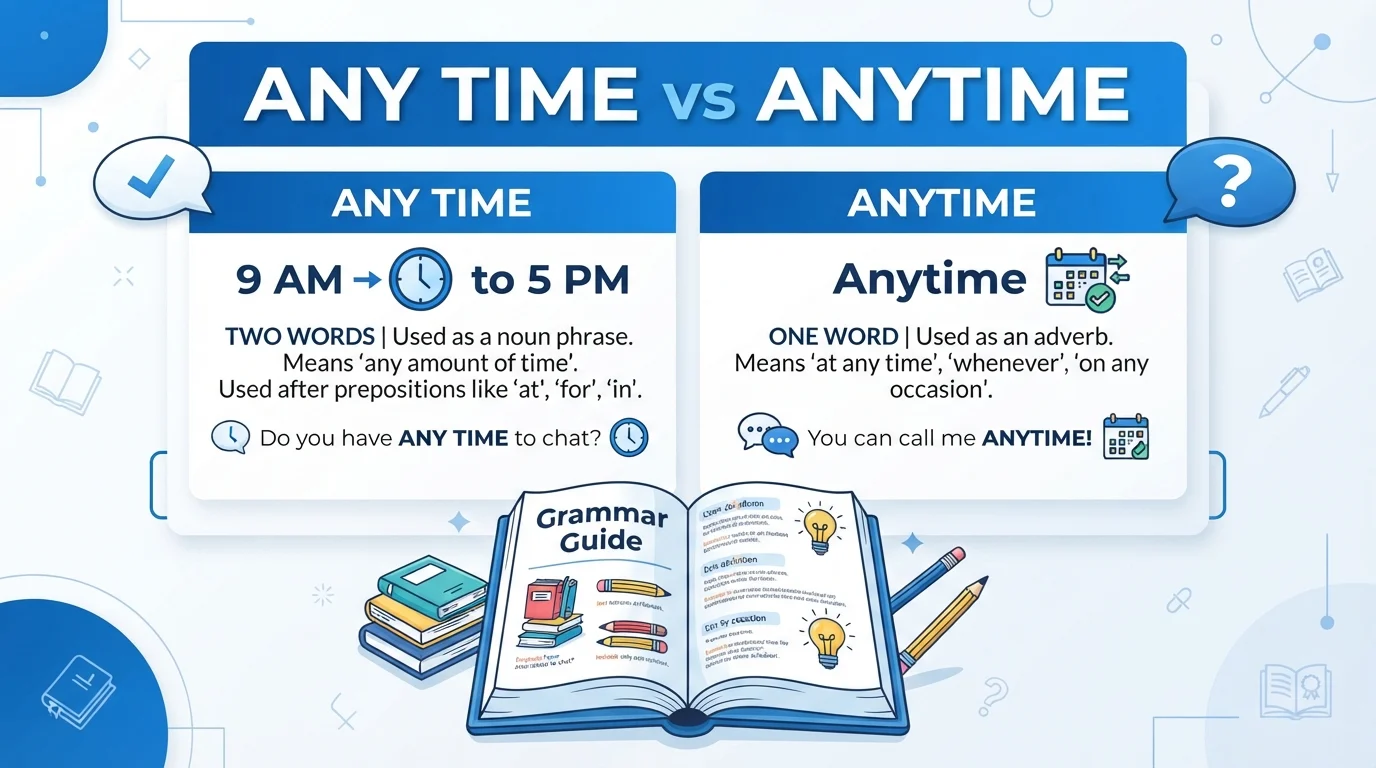
Have you ever wondered whether to write “any time” or “anytime”? You’re not alone. Both forms are correct, but they are not always used in exactly the same way. The difference depends mainly on how the word functions in a sentence.
In general, any time is usually used as a noun phrase, especially after prepositions such as at, while anytime is commonly used as an adverb meaning whenever. In modern English, especially American English, anytime is widely accepted in many contexts.
This guide explains any time vs anytime with clear meanings, examples, common mistakes, and simple grammar rules.
Quick Answer
- Any time = A noun phrase meaning “any amount of time” or “whenever,” often used after a preposition.
- Anytime = An adverb meaning “whenever” or “at any time.”
Examples:
- You can call me anytime.
- You can call me at any time.
- Do you have any time to help me?
What Does “Any Time” Mean?
Any time is written as two words when time functions as a noun.
Examples:
- Do you have any time this afternoon?
- I don’t have any time to waste.
- We can meet at any time.
- Have you spent any time studying?
In these sentences, time refers to an amount or period of time.
“At Any Time”
The phrase at any time is always written as two words.
Examples:
- You may leave at any time.
- The situation could change at any time.
- Please contact us at any time.
What Does “Anytime” Mean?
Anytime is usually an adverb meaning whenever or at any time.
Examples:
- Call me anytime.
- You can visit anytime.
- Come over anytime you like.
- I can help anytime.
A useful test is to replace anytime with whenever.
Example:
- Call me anytime.
- Call me whenever.
Both sentences make sense, so anytime is appropriate.
Any Time vs Anytime
| Form | Main Use | Example |
|---|---|---|
| Any time | Noun phrase; often follows a preposition | You can call me at any time. |
| Anytime | Adverb meaning “whenever” | You can call me anytime. |
Both forms can express a similar idea, but their grammatical roles are different.
Examples of “Any Time”
Use any time when time is acting as a noun.
- Do you have any time for a quick meeting?
- I don’t have any time today.
- She didn’t spend any time preparing.
- You can visit us at any time.
- The company may change its policy at any time.
Examples of “Anytime”
Use anytime as an adverb meaning whenever.
- You can call me anytime.
- Come by anytime.
- I am available anytime after lunch.
- You can ask me anytime.
- Visit us anytime you are in town.
The “At” Test
One of the easiest ways to choose between any time and anytime is to look for at.
If the sentence uses at, write:
at any time
Correct:
- You can contact me at any time.
- The rules may change at any time.
Do not write:
- ❌ at anytime
In standard usage, at anytime is generally avoided.
“Anytime” as a Conjunction
In modern informal English, anytime can also introduce a clause meaning whenever.
Examples:
- Anytime you need help, let me know.
- Anytime she visits, we have dinner together.
However, some traditional style guides prefer any time in this position:
- Any time you need help, let me know.
Both forms can be found in modern English, but any time may be preferred in more formal or traditional writing.
Common Mistakes
Writing “At Anytime”
Incorrect:
- ❌ You can call me at anytime.
Correct:
- ✅ You can call me at any time.
- ✅ You can call me anytime.
Using “Anytime” as a Noun
Incorrect:
- ❌ I don’t have anytime today.
Correct:
- ✅ I don’t have any time today.
Here, time is a noun referring to an amount of available time.
American vs British English
Anytime is especially common in American English, particularly as an adverb.
In British English, any time has traditionally been preferred in some contexts, although anytime is also increasingly recognized and used.
For formal writing in either variety, at any time is always a safe and clear choice.
Easy Trick to Remember
Use this simple rule:
At + any time = two words.
Examples:
- at any time
- at any point
- at any moment
Use anytime when you can replace it with whenever:
- Call me anytime.
- Call me whenever.
Related Phrases
Common expressions include:
- at any time
- any time soon
- any time now
- any time you want
- anytime you like
- anytime soon
Examples:
- I don’t expect him to arrive any time soon.
- You can visit anytime you like.
- The situation could change at any time.
Tips to Avoid This Mistake
Follow these simple strategies:
- Use any time when time is a noun.
- Use anytime when it means whenever.
- Always write at any time, not at anytime.
- Use the whenever test for anytime.
- When writing formally, at any time is a safe option.
Frequently Asked Questions
Which is correct: any time or anytime?
Both are correct, but they are used differently. Any time is usually a noun phrase, while anytime is commonly an adverb meaning “whenever.”
Is “at anytime” correct?
The standard form is at any time, written as two words.
Can I say “Call me anytime”?
Yes. Call me anytime is correct and means “Call me whenever you want.”
Is “anytime soon” correct?
Yes. Anytime soon is commonly used in modern English.
Example: I don’t expect the package to arrive anytime soon.
Is “any time you want” or “anytime you want” correct?
Both forms are used. Any time you want is traditionally preferred by some style guides, while anytime you want is common in modern informal English.
Do American and British English use “anytime” differently?
Yes, slightly. Anytime is especially common in American English, while British English has traditionally favored any time in some contexts.
How can I remember the difference?
Remember: at any time is always two words, while anytime can often be replaced with whenever.
Summary
When comparing any time vs anytime, both forms can be correct, but their usage depends on the sentence. Use any time when time acts as a noun, especially in phrases such as at any time. Use anytime as an adverb when it means whenever, as in “Call me anytime.”
The most important rule is to always write at any time as two words. If you can replace anytime with whenever, the one-word form is usually appropriate. When you’re unsure, at any time is a clear and safe choice for formal English.
Actionable Takeaway
Use anytime to mean whenever, but use any time when referring to an amount or period of time. Remember: Call me anytime, but You can call me at any time.