Have you ever wondered if to use either or whether in a sentence? These two words are often confused because they can both appear when discussing choices or possibilities. However, they serve different grammatical purposes and cannot always be used interchangeably.
The simplest way to understand either vs whether is this: either usually refers to one of two choices, while whether introduces alternatives, possibilities, or uncertainty. Once you understand the difference, choosing the correct word becomes much easier.
Quick Answer: Either vs Whether
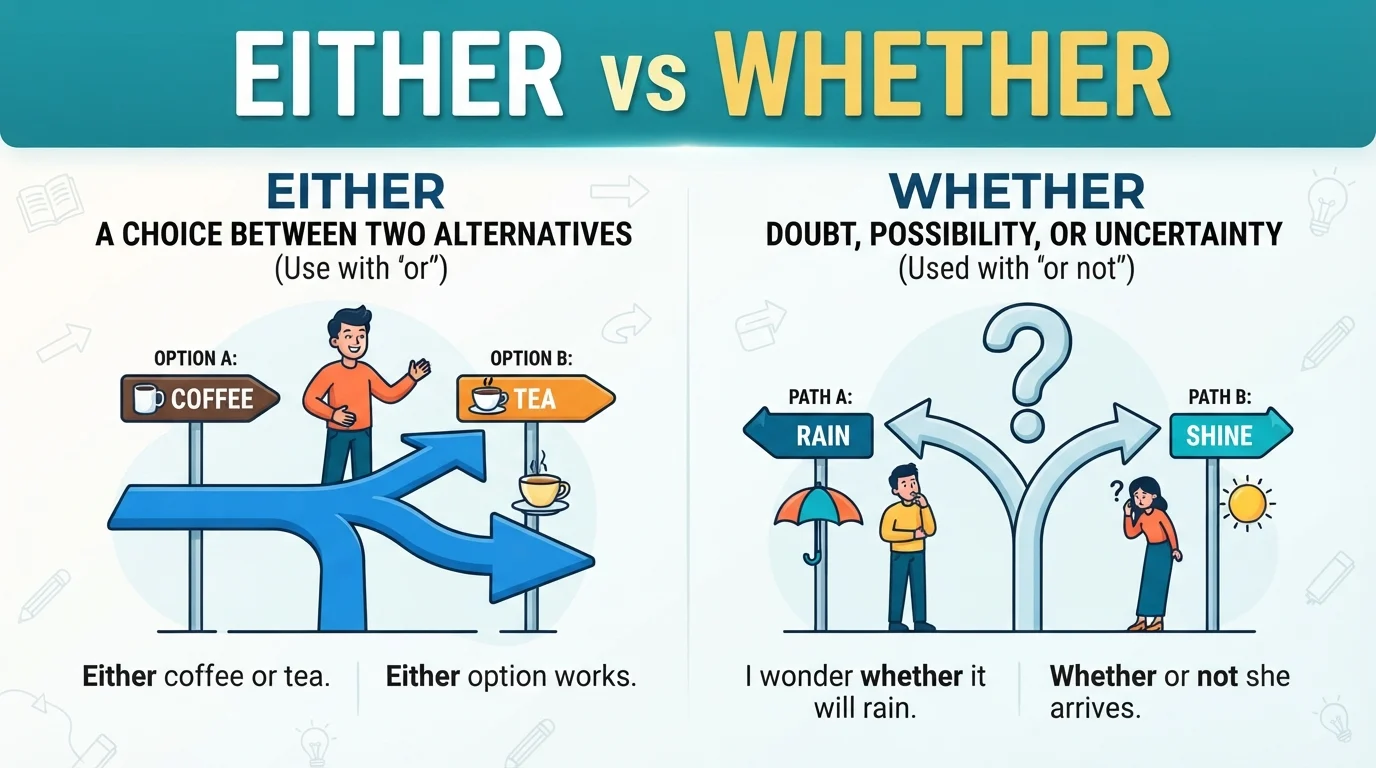
Either is used to refer to one of two choices or alternatives.
- You can choose either option.
Whether is used to introduce alternatives or express uncertainty.
- I don’t know whether he will come.
Easy memory trick
Either = choice.
Whether = uncertainty or alternatives.
Think:
- Either one is fine.
- I don’t know whether it is fine.
What Does “Either” Mean?
Either generally refers to one of two people, things, or choices.
It can be used as a:
- Determiner
- Pronoun
- Conjunction
- Adverb
Either meaning “one of two”
- You can take either road.
- Either answer is acceptable.
- I don’t like either option.
In these examples, either means one or the other of two possibilities.
Either…or
The structure either…or presents two alternatives.
- You can either stay or leave.
- We can either take the train or drive.
- Either John or Sarah will lead the meeting.
This structure clearly shows a choice between two options.
What Does “Whether” Mean?
Whether is used when discussing alternatives, possibilities, or uncertainty.
It often means if in situations involving two possible outcomes.
Examples of “whether”
- I don’t know whether she is coming.
- We need to decide whether to stay.
- Tell me whether you agree.
- He is unsure whether the plan will work.
In these sentences, the speaker is uncertain about the answer or outcome.
Whether…or
The structure whether…or introduces alternatives.
- I don’t know whether to stay or leave.
- We must decide whether to accept or reject the offer.
- Whether you agree or disagree, the decision has been made.
Either vs Whether: The Main Difference
| Word | Main Meaning | Example |
|---|---|---|
| Either | One of two choices | Either option is acceptable. |
| Whether | Expresses uncertainty or introduces alternatives | I don’t know whether to go. |
The simplest rule
Use either when selecting between two choices.
Use whether when you are uncertain about a choice or discussing two possible situations.
Either vs Whether Examples
Examples with “either”
- You can choose either colour.
- Either answer could be correct.
- We can go either today or tomorrow.
- I don’t want either of these options.
- Either you apologise or you leave.
Examples with “whether”
- I don’t know whether he is available.
- She asked whether I wanted tea.
- We need to determine whether the information is accurate.
- He is considering whether to accept the job.
- I wonder whether they will arrive on time.
Either vs Whether in Questions
This is where many learners become confused.
Use “either” when offering a choice
- Would you like either tea or coffee?
However, the more natural structure is often:
- Would you like tea or coffee?
- You can have either tea or coffee.
Use “whether” when asking about uncertainty
- I don’t know whether she will come.
- Do you know whether the shop is open?
The word whether is especially common in indirect questions.
Direct question
- Is the shop open?
Indirect question
- I don’t know whether the shop is open.
Either vs Whether After “To”
Both words can appear before to, but their uses are different.
Either to
Either is commonly used in the structure either…or.
- You can either stay or leave.
- We need to either repair the car or replace it.
Whether to
Whether to expresses uncertainty about a decision.
- I don’t know whether to stay.
- She is deciding whether to apply.
- He hasn’t decided whether to accept the offer.
Compare
You can either stay or leave.
This presents two choices.
I don’t know whether to stay or leave.
This expresses uncertainty about which choice to make.
Either vs Whether: Common Mistakes
Mistake 1: Using “either” for uncertainty
❌ I don’t know either he will come.
✅ I don’t know whether he will come.
Use whether after phrases such as:
- I don’t know…
- I wonder…
- I’m not sure…
- It is unclear…
Mistake 2: Using “whether” to mean one of two options
❌ You can choose whether option.
✅ You can choose either option.
When referring to one of two choices, use either.
Mistake 3: Forgetting “or” after “either”
❌ You can either stay leave.
✅ You can either stay or leave.
The usual paired structure is either…or.
Mistake 4: Using “if” when “whether” is more appropriate
In many situations, if and whether can both introduce uncertainty.
- I don’t know if she is coming.
- I don’t know whether she is coming.
However, whether is often preferred in formal writing and is necessary in some structures, especially when presenting explicit alternatives.
Whether or Not vs Either or
These expressions have different meanings.
Whether or not
This means regardless of which possibility is true.
- I will go whether or not you come.
- Whether or not he agrees, we must continue.
Either…or
This presents two alternatives.
- You can either come or stay home.
- We will either leave now or wait.
Compare
Whether or not you agree, we will proceed.
This means the decision will happen regardless of your agreement.
You can either agree or disagree.
This presents two possible choices.
Whether in American and British English
The basic use of either and whether is the same in American English and British English.
One small pronunciation difference is worth noting:
- Either may be pronounced EE-ther or EYE-ther in both varieties of English.
- Whether is usually pronounced WETH-er.
The grammar rules remain the same:
- Either = one of two choices
- Whether = uncertainty or alternatives
A Simple Memory Trick for Either vs Whether
Remember:
Either = choose
If you are choosing one of two options, use either.
You can choose either option.
Whether = wonder
If you are wondering about a possibility, use whether.
I wonder whether he will come.
Quick rule
Either gives a choice. Whether expresses a question or uncertainty.
Quick Practice: Either or Whether?
Choose the correct word:
- I don’t know ______ she will attend.
- You can choose ______ option.
- We can ______ stay ______ leave.
- She is unsure ______ to accept the offer.
- ______ you agree or disagree, the meeting will continue.
Answers
- whether
- either
- either / or
- whether
- whether
Why Are Either and Whether So Commonly Confused?
The confusion comes from the fact that both words can appear in sentences involving two possibilities.
For example:
- You can choose either option.
- I don’t know whether to choose the first option or the second.
The first sentence focuses on the available choice. The second focuses on uncertainty about the decision.
The best way to choose correctly is to ask yourself:
Am I selecting one of two options?
Use either.
Am I unsure about a possibility or discussing alternatives?
Use whether.
What is the difference between either and whether?
Either refers to one of two choices. Whether introduces uncertainty, alternatives, or two possible situations.
Is it “either you come or you stay”?
Yes. The correct paired structure is either…or.
Example: You can either come or stay home.
Is it “I don’t know either he will come”?
No. The correct sentence is: I don’t know whether he will come.
Can “whether” mean “if”?
Yes. In many sentences, whether can be used similarly to if.
Example: I don’t know whether she is ready.
What is the difference between “whether to” and “either…or”?
Whether to expresses uncertainty about a decision. Either…or presents two alternatives or choices.
Is “whether or not” correct?
Yes. Whether or not means regardless of which possibility is true.
Example: I will go whether or not you come.
Is either pronounced “ee-ther” or “eye-ther”?
Both pronunciations are accepted. The choice often depends on regional or personal preference.
Do American and British English use either and whether differently?
No. The basic grammar rules are the same in both varieties of English.
Final Summary: Either vs Whether
The difference between either vs whether becomes clear when you focus on the purpose of the word. Either is used for one of two choices or alternatives, especially in the structure either…or. For example, “You can either stay or leave.”
Whether is used to express uncertainty or introduce alternatives. For example, “I don’t know whether she will come.” It is also used in the expression whether or not, which means regardless of the outcome.
Actionable Takeaway
Remember this simple rule: Either = choice; whether = uncertainty or alternatives. If you are choosing between two options, use either. If you are wondering about a possibility or asking indirectly about two outcomes, use whether.