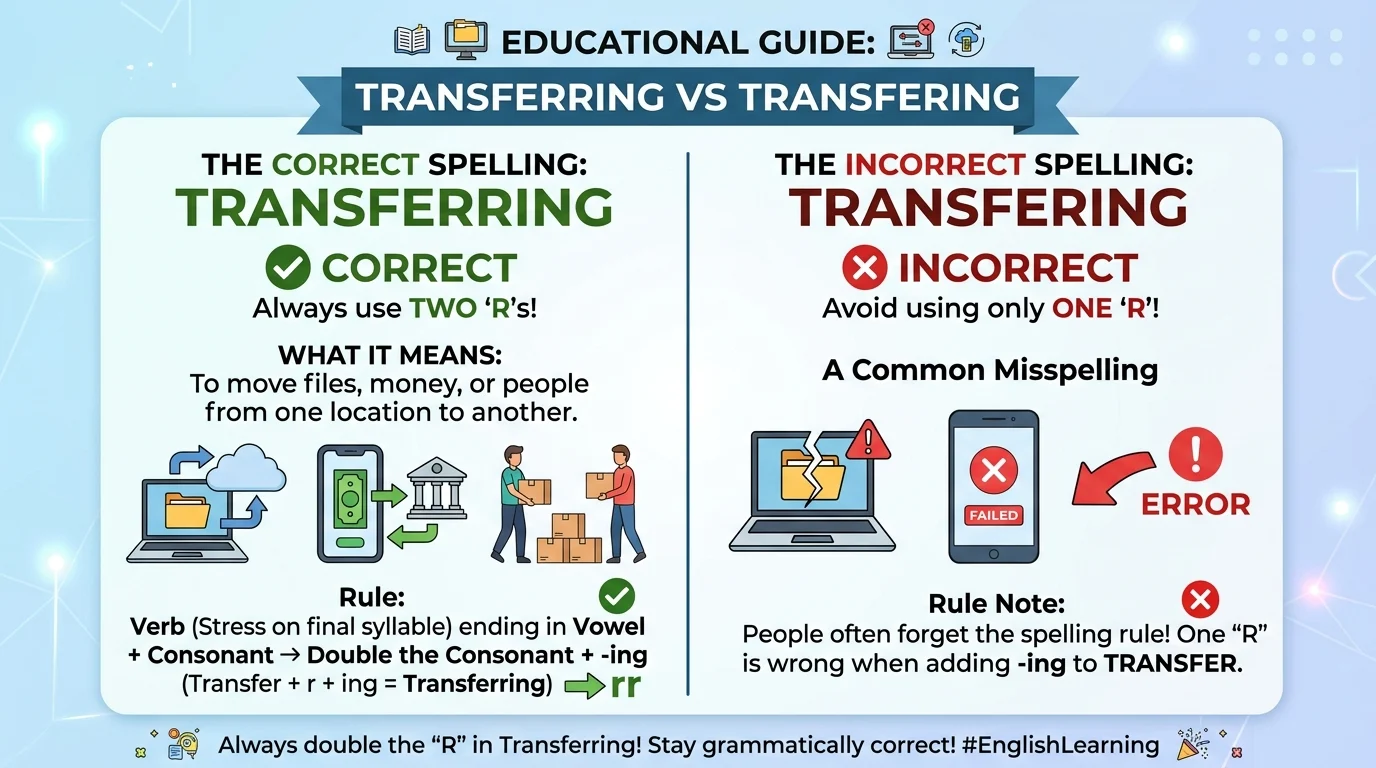
The confusion between transferring vs transfering is a common English spelling mistake. Since many English verbs change spelling when adding -ing, writers often become unsure whether transfer needs one “r” or two.
The correct answer depends on an important grammar rule involving stressed syllables and consonant doubling. In this guide, you’ll learn the correct spelling, meanings, grammar rules, examples, common mistakes, and easy memory tricks to remember the difference between transferring and transfering.
Quick Answer
✅ Transferring is the correct spelling.
❌ Transfering is incorrect.
Correct example:
- “She is transferring money to another account.”
Incorrect example:
- “She is transfering money to another account.”
The word transferring is the present participle form of the verb transfer.
What Does Transferring Mean?
English Grammar Transferring means:
- moving something from one place to another
- changing ownership
- shifting information, money, people, or objects
It comes from the verb:
- transfer
Examples of Transferring
- He is transferring files to a new computer.
- Students are transferring schools.
- The bank is transferring funds today.
- She is transferring ownership of the property.
Why “Transferring” Has Double R
English grammar follows a consonant-doubling rule when adding:
- -ing
- -ed
The Rule
If a verb:
- ends in vowel + consonant
- and the final syllable is stressed
the final consonant usually doubles before adding -ing.
The word:
- transfer
has stress on the final syllable:
- trans-FER
So:
- transfer → transferring
Similar Grammar Examples
| Base Verb | Correct Form |
|---|---|
| refer | referring |
| occur | occurring |
| begin | beginning |
| transfer | transferring |
Why “Transfering” Is Incorrect
The spelling transfering incorrectly uses only one “r.”
People often make this mistake because:
- the word already looks long
- consonant-doubling rules can feel confusing
- pronunciation may not clearly emphasize the double “r”
However, dictionaries recognize only:
✅ transferring
❌ transfering
Transferring vs Transfering: Main Difference
| Word | Status | Meaning |
|---|---|---|
| Transferring | Correct spelling | Moving or shifting something |
| Transfering | Incorrect spelling | Common typo |
Common Uses of Transferring
Banking
Finance
- Customers are transferring funds online.
Education
Education
- Many students are transferring universities.
Technology
Information Technology
- Files are transferring between devices.
Business
Business
- The company is transferring employees overseas.
Common Mistakes People Make
Mistake 1: Using One “R”
Incorrect:
- “They are transfering ownership.”
Correct:
- “They are transferring ownership.”
Mistake 2: Ignoring Stress Rules
Many writers forget that stressed final syllables usually trigger consonant doubling.
Mistake 3: Typing Quickly
Long words commonly cause spelling errors during fast typing.
Verb Forms of Transfer
| Verb Form | Example |
|---|---|
| Base verb | transfer |
| Present participle | transferring |
| Past tense | transferred |
| Past participle | transferred |
Example Sentence
- “She transferred the files while transferring data to the cloud.”
Real-Life Examples of Transferring
Banking Apps
PayPal
- Users are transferring payments instantly.
Universities
Higher Education
- Students sometimes consider transferring colleges.
Airlines
Emirates
- Passengers are transferring flights in Dubai.
American vs British English Differences
Both:
- United States American English
- United Kingdom British English
use the same spelling:
✅ transferring
❌ transfering
There is no regional spelling difference.
Synonyms for Transferring
Using related vocabulary improves readability and writing variety.
Common Synonyms
- moving
- shifting
- relocating
- sending
- transporting
- changing
Example
Instead of:
- “She is transferring files.”
You could say:
- “She is moving files.”
Why Correct Spelling Matters
Professional Communication Correct spelling improves:
- professionalism
- academic quality
- readability
- communication clarity
Misspellings like transfering may reduce writing credibility.
Easy Trick to Remember the Correct Spelling
A simple memory trick:
Transfer Stresses the Last Part
Think:
- trans-FER
Because the stress falls at the end, the “r” doubles.
So:
- transfer → transferring
Related Word Forms
| Word Type | Example |
|---|---|
| Verb | transfer |
| Present participle | transferring |
| Past tense | transferred |
| Noun | transfer |
Example Sentence
- “The transfer process involved transferring sensitive data.”
FAQs
Which spelling is correct: transferring or transfering?
Transferring is the correct spelling.
Why does transferring have double R?
Because the final syllable in transfer is stressed, which triggers consonant doubling before adding “-ing.”
Is transfering a real word?
No. Transfering is considered a spelling mistake.
What does transferring mean?
It means moving or shifting something from one place to another.
What is the past tense of transfer?
The past tense is transferred.
Do British and American English spell transferring differently?
No. Both use transferring.
What is the noun form of transfer?
The noun form is transfer.
Can spell-check detect transfering?
Yes. Most spell-check tools suggest transferring instead.
Final Summary
The difference between transferring vs transfering becomes simple once you understand consonant-doubling rules. Transferring is the correct spelling because the verb transfer ends with a stressed vowel-plus-consonant pattern, requiring the final “r” to double before adding “-ing.” The spelling transfering is incorrect and commonly appears because writers forget this grammar rule.
Whenever you write about moving money, files, students, ownership, or information, always use transferring with double “r.” Remembering the stress pattern in transfer can help you avoid this common spelling mistake and improve your writing accuracy.
Actionable Takeaway
Before writing the word, remember:
- transfer → transferring
- stressed ending = double consonant
So:
- transferring ✅
- transfering ❌
That simple grammar check will help you avoid the mistake every time.