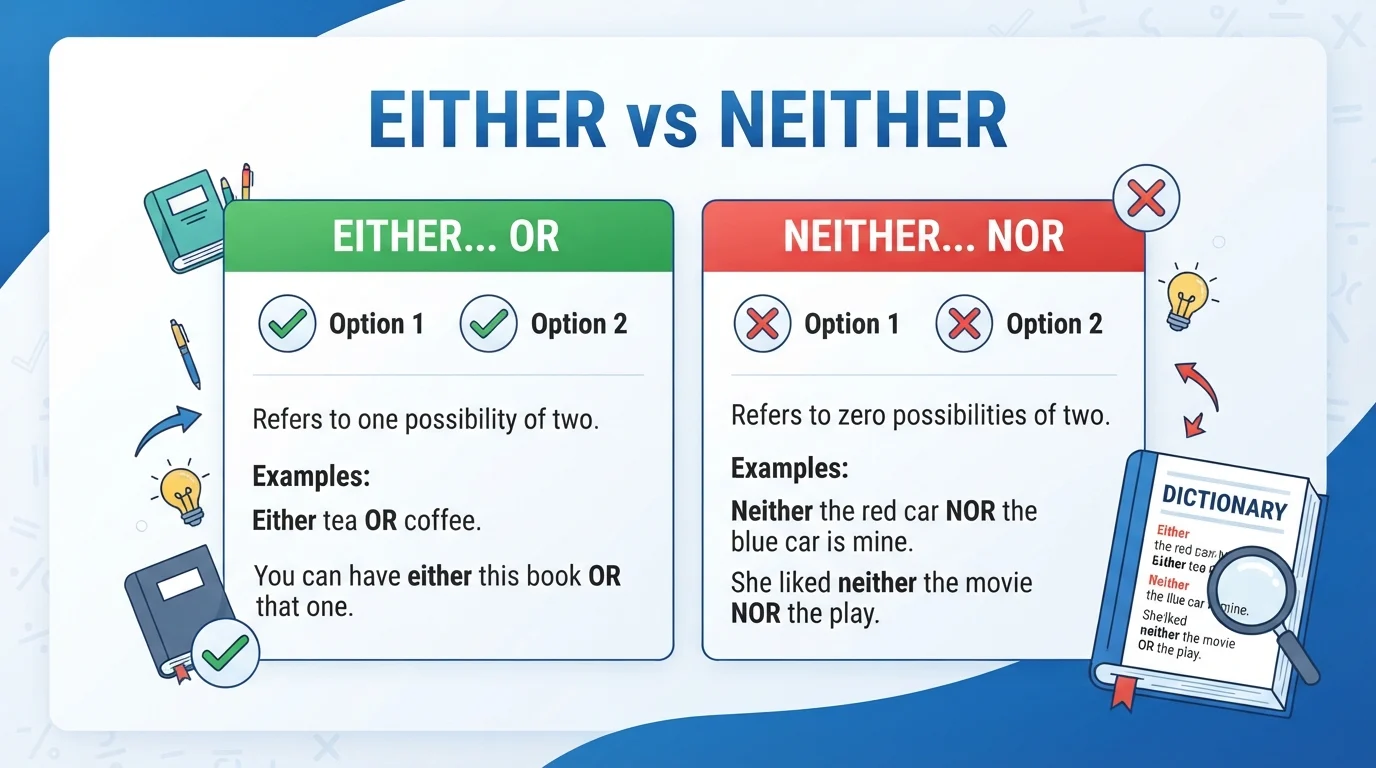
Have you ever been confused about whether to use “either” or “neither”? You’re not alone. These two words are closely related, but they express opposite ideas. Either is generally used when talking about one of two choices or both possibilities in a negative structure, while neither means not one and not the other.
Understanding the difference between either vs neither can make your English clearer and more natural. In this guide, you’ll learn the meanings, grammar rules, sentence patterns, examples, common mistakes, American and British English differences, and easy tips for remembering which word to use.
Quick Answer
- Either = One of two choices or possibilities.
- Neither = Not one and not the other of two choices.
Examples:
- You can choose either tea or coffee.
- Neither answer is correct.
- I don’t like either option.
- Neither John nor Sarah came.
What Does “Either” Mean?
Either is used when referring to one of two people or things.
Either…or
The most common structure is:
Either A or B
Examples:
- You can choose either tea or coffee.
- Either John or Maria will help you.
- We can travel either today or tomorrow.
In these examples, there are two choices or possibilities.
Either Meaning “One or the Other”
Examples:
- You can sit on either side of the table.
- Either answer may be correct.
- I can meet you on either day.
Here, either means one of two possibilities.
What Does “Neither” Mean?
Neither means not one and not the other of two people or things.
Neither…nor
The most common structure is:
Neither A nor B
Examples:
- Neither John nor Maria came.
- Neither answer is correct.
- Neither option works for me.
Neither Meaning “Not Either One”
Examples:
- Neither of the two answers is correct.
- Neither candidate received enough votes.
- Neither restaurant is open.
If there are exactly two choices and you reject both, use neither.
Either vs Neither
| Word | Meaning | Example |
|---|---|---|
| Either | One of two choices | You can choose either option. |
| Neither | Not one and not the other | Neither option is suitable. |
The simple difference is:
Either = one of the two
Neither = not one and not the other
Either…Or vs Neither…Nor
These paired conjunctions are opposites.
Either…Or
Use either…or to present two alternatives.
- Either call me or send me a message.
- We can either walk or take a taxi.
Neither…Nor
Use neither…nor to reject both alternatives.
- Neither the manager nor the assistant was available.
- She likes neither tea nor coffee.
“Either” in Negative Sentences
Either can also be used at the end of a negative sentence to mean “also.”
Examples:
- I don’t like coffee either.
- She isn’t coming either.
- He didn’t understand the question either.
This use of either is different from either…or.
Compare:
- You can choose either option. (one of two)
- I don’t like either option. (not one or the other)
- I don’t like coffee either. (also, in a negative sentence)
Common Mistakes
Double Negatives with “Neither”
Because neither already has a negative meaning, avoid using another negative word with it in standard English.
Incorrect:
- ❌ I don’t like neither option.
Correct:
- ✅ I like neither option.
- ✅ I don’t like either option.
Incorrect Pairing
Incorrect:
- ❌ Either John nor Sarah came.
Correct:
- ✅ Either John or Sarah came.
- ✅ Neither John nor Sarah came.
Remember:
- Either…or
- Neither…nor
Either vs Neither with “Of”
Both words can be followed by of.
Either of
- Either of the two answers could be correct.
- Either of them can help you.
Neither of
- Neither of the answers is correct.
- Neither of them came to the meeting.
In formal English, singular verb agreement is traditionally preferred:
- Neither of the students is ready.
- Either of the options is acceptable.
In informal English, plural verbs are also sometimes heard, especially with either of and neither of.
American vs British English
The basic meanings and grammar rules for either and neither are the same in American and British English.
One pronunciation difference is common:
- In American English, either is often pronounced EE-ther or EYE-ther.
- In British English, both pronunciations are also used.
The spelling and basic usage remain the same.
Easy Trick to Remember
Use this simple memory rule:
Either = one of two.
Neither = zero of two.
You can think of it like this:
- Either → Choice A or Choice B.
- Neither → Not A and not B.
Also remember the pairs:
- Either…or
- Neither…nor
Examples in Everyday English
Either
- You can take either bus.
- Either answer is acceptable.
- We can meet either Monday or Tuesday.
Neither
- Neither bus goes to the airport.
- Neither answer is correct.
- Neither Monday nor Tuesday works for me.
Tips to Avoid This Mistake
Follow these simple strategies:
- Use either for one of two choices.
- Use neither when both choices are rejected.
- Remember either…or.
- Remember neither…nor.
- Avoid double negatives with neither.
- Use either at the end of a negative sentence to mean also.
Frequently Asked Questions
What is the difference between either and neither?
Either refers to one of two choices or possibilities, while neither means not one and not the other.
What is the difference between either…or and neither…nor?
Either…or presents two alternatives. Neither…nor rejects both alternatives.
Can “either” mean “both”?
In some contexts, either can refer to one of two possibilities without specifying which one. It does not normally mean both at the same time.
Is “neither” a negative word?
Yes. Neither already expresses a negative meaning: not one and not the other.
Is “I don’t like neither” correct?
In standard English, no. Say “I like neither” or “I don’t like either.”
Can I say “either of them”?
Yes.
Example: Either of them can help you.
Can I say “neither of them”?
Yes.
Example: Neither of them was available.
Do American and British English use either and neither differently?
The basic grammar and meanings are the same, although pronunciation may vary.
Summary
When comparing either vs neither, remember that either means one of two choices or possibilities, while neither means not one and not the other. For example, “You can choose either tea or coffee” gives two choices, while “Neither tea nor coffee is available” rejects both choices.
The most useful grammar patterns are either…or and neither…nor. Also remember that either can be used at the end of a negative sentence to mean “also,” as in “I don’t like it either.” The key rule is simple: either = one of two; neither = zero of two.
Actionable Takeaway
When choosing between two options, use either for one choice and neither when both choices are rejected. Remember: Either…or = a choice; Neither…nor = no choice.