Choosing the right word can be tricky, especially when two words look and sound similar. One common question is whether “undecisive” or “indecisive” is the correct term. If you’ve seen both online, you may wonder if they’re interchangeable.
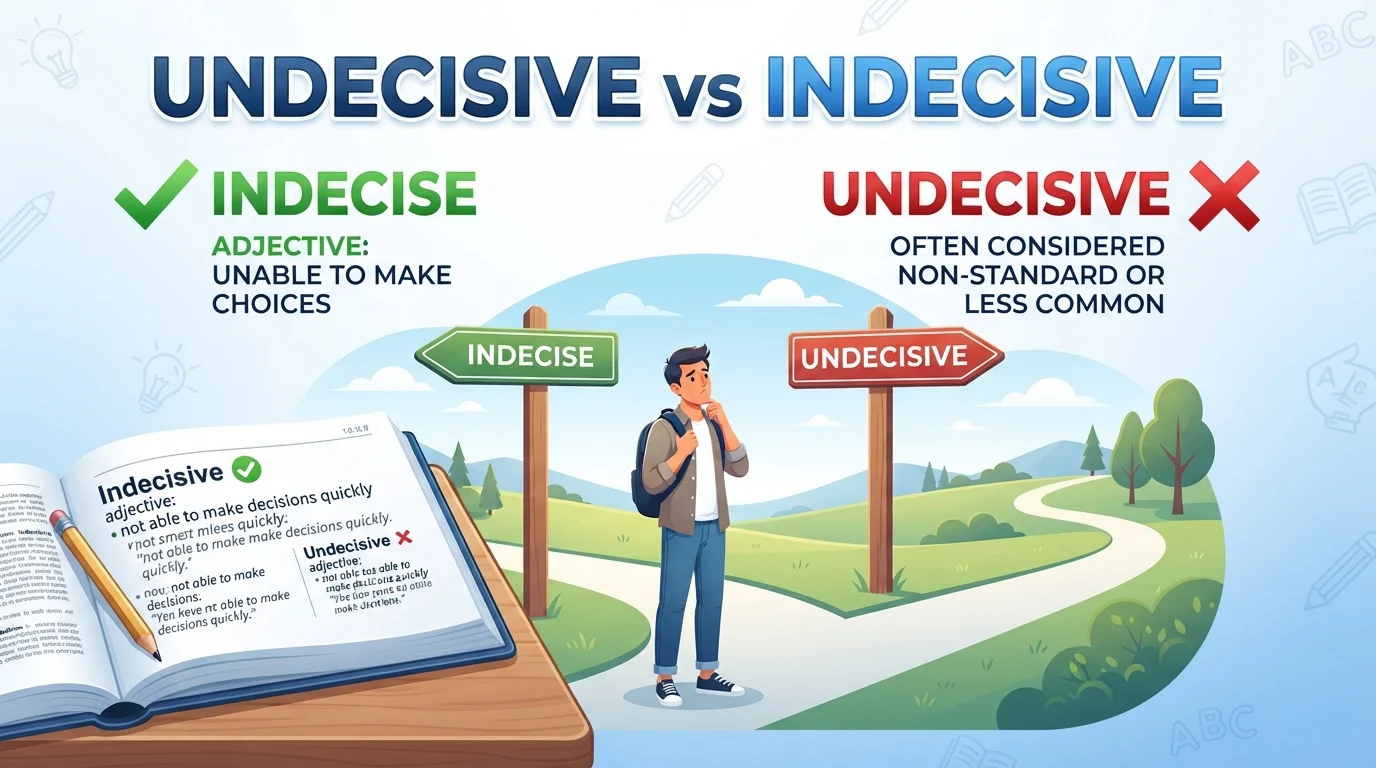
The answer is simple: “indecisive” is the correct and standard English word. “Undecisive” is generally considered a nonstandard or incorrect form and should be avoided in professional, academic, and everyday writing. This guide explains the difference between undecisive vs indecisive, their meanings, examples, common mistakes, and tips to remember the correct word.
Quick Answer
“Indecisive” is correct.
“Undecisive” is incorrect in standard English.
- ✅ Indecisive = Unable to make decisions quickly or confidently.
- ❌ Undecisive = A nonstandard and generally incorrect form.
Examples:
- ✅ She is indecisive when choosing a restaurant.
- ✅ His indecisive nature delayed the project.
- ❌ She is undecisive about what to wear.
What Does “Indecisive” Mean?
Indecisive is an adjective used to describe someone who has difficulty making decisions or choosing between options.
An indecisive person may hesitate, change their mind often, or struggle to commit to a choice.
Examples:
- I’m indecisive about which laptop to buy.
- The committee remained indecisive for hours.
- Her indecisive behavior frustrated the team.
Why “Undecisive” Is Incorrect
Many people assume that adding the prefix un- creates the opposite of decisive. While this pattern works for many English words (such as happy → unhappy), it does not apply here.
The accepted opposite of decisive is indecisive, not undecisive.
Modern dictionaries and style guides recognize indecisive as the standard word.
Undecisive vs Indecisive
| Feature | Undecisive | Indecisive |
|---|---|---|
| Correct spelling | ❌ No | ✅ Yes |
| Standard English | ❌ Incorrect | ✅ Correct |
| Dictionary recognized | ❌ Generally No | ✅ Yes |
| Used in formal writing | ❌ Never | ✅ Yes |
| Used in everyday English | ❌ Avoid | ✅ Yes |
Whenever you’re choosing between undecisive vs indecisive, always use indecisive.
How to Use “Indecisive” Correctly
Everyday Life
- He’s indecisive about what movie to watch.
- I’m too indecisive to pick just one option.
Workplace
- An indecisive manager can slow down a project.
- The client’s indecisive feedback delayed production.
Education
- She felt indecisive about choosing her major.
- Being indecisive made selecting a university difficult.
Relationships
- His indecisive personality sometimes causes misunderstandings.
- They were indecisive about moving to another city.
Common Mistakes
People often confuse indecisive with undecisive.
Incorrect:
- ❌ undecisive
- ❌ very undecisive
- ❌ undecisive person
- ❌ undecisive decision
Correct:
- ✅ indecisive
- ✅ very indecisive
- ✅ indecisive person
- ✅ indecisive behavior
Common Expressions with “Indecisive”
You’ll frequently hear indecisive in these phrases:
- indecisive person
- indecisive behavior
- indecisive leader
- feel indecisive
- become indecisive
- naturally indecisive
- extremely indecisive
- indecisive decision-maker
Examples:
- She’s an indecisive decision-maker.
- I felt indecisive all afternoon.
- His indecisive behavior confused everyone.
Easy Trick to Remember
A simple memory tip:
Think of the pair:
- decisive → indecisive
Many English words use the prefix in- to form the opposite:
- accurate → inaccurate
- complete → incomplete
- correct → incorrect
- decisive → indecisive
This pattern makes indecisive easy to remember.
American vs British English
There is no difference between American and British English.
Both varieties use:
- ✅ Indecisive
- ❌ Undecisive
The spelling is the same in all major English-speaking countries.
Related Words
If you’re expanding your vocabulary, these words are closely related:
- hesitant
- uncertain
- unsure
- wavering
- doubtful
- irresolute
- vacillating
- conflicted
- hesitant decision-maker
- uncertain person
These synonyms may fit better depending on the context.
Tips to Avoid This Mistake
Use these simple tips:
- Remember that the opposite of decisive is indecisive, not undecisive.
- Think of similar words like incorrect and incomplete, which also use the prefix in-.
- Proofread your writing carefully for this common error.
- Practice writing common phrases such as indecisive person and indecisive behavior.
- Use spell-check tools, but learn the correct spelling for long-term confidence.
Frequently Asked Questions
Is “undecisive” a real English word?
No. Undecisive is generally considered a nonstandard or incorrect form in modern English.
Which is correct: undecisive or indecisive?
Indecisive is the correct and standard English word.
What does “indecisive” mean?
It describes someone who has difficulty making decisions or choosing between options.
Is “indecisive” an adjective?
Yes. Indecisive is an adjective.
Example:
- She is indecisive about where to eat.
Why do people say “undecisive”?
Many people assume un- is the correct negative prefix, but standard English uses in- for this word.
Do American and British English spell it differently?
No. Both use indecisive.
What is the opposite of “decisive”?
The standard opposite is indecisive.
Summary
When comparing undecisive vs indecisive, indecisive is the only correct and widely accepted spelling. It describes someone who struggles to make decisions or commit to a choice. Undecisive is a nonstandard form that should be avoided in professional, academic, and everyday writing.
To remember the correct word, think of other common opposites like correct → incorrect and complete → incomplete. Following this pattern will help you choose indecisive with confidence and avoid a common English mistake.
Actionable Takeaway
Before submitting your writing, search for “undecisive.” If you find it, replace it with “indecisive.” This simple proofreading habit will make your writing more accurate, polished, and professional.