Have you ever wondered whether “alterior” or “ulterior” is the correct word? You’re not alone. Because the two words sound similar, many people mistakenly write “alterior” when they actually mean “ulterior.”
The correct spelling is “ulterior.” “Alterior” is a common misspelling and is not recognized as a standard English word. In this guide, you’ll learn the difference between alterior vs ulterior, understand the meaning of ulterior, see real-life examples, and discover simple tricks to remember the correct spelling.
Quick Answer
“Ulterior” is correct.
“Alterior” is incorrect in standard English.
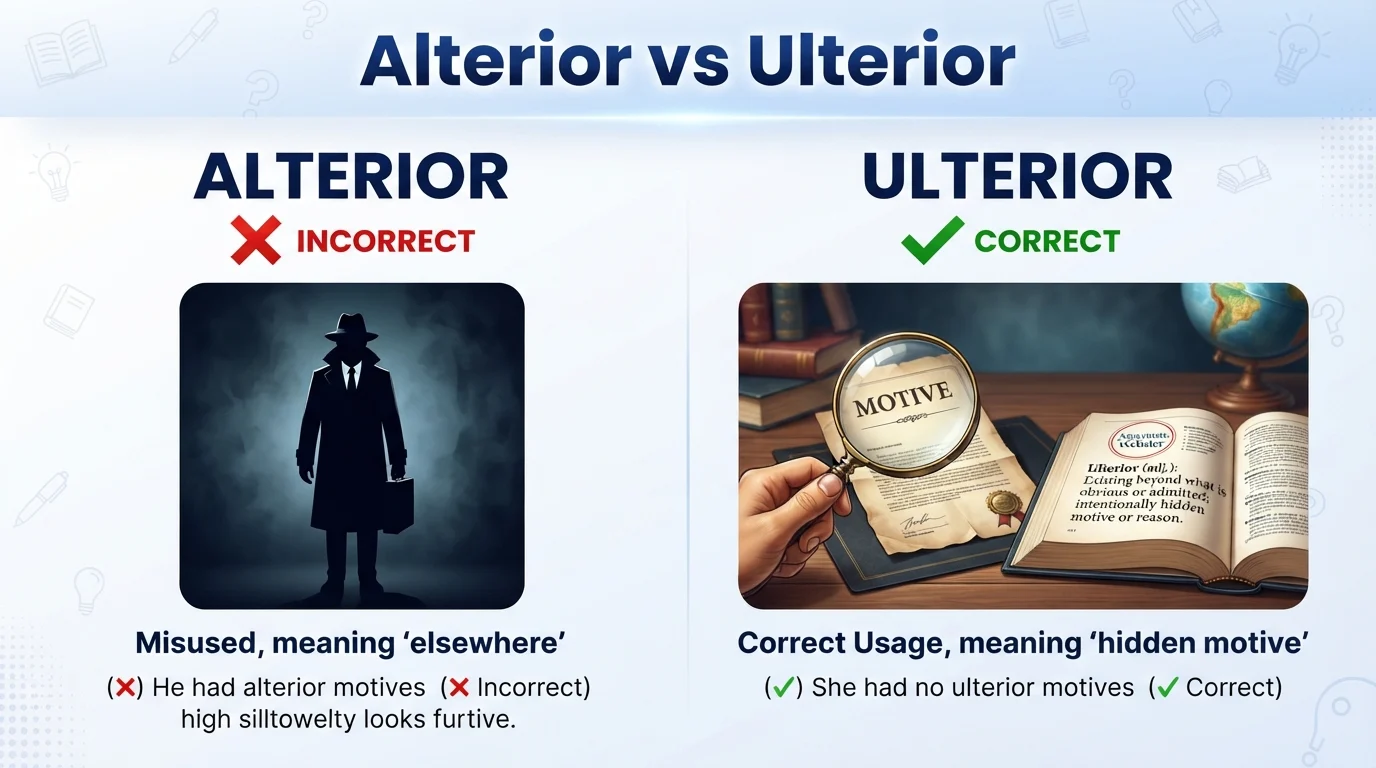
- ✅ Ulterior = Existing beyond what is obvious; hidden or secret, especially referring to motives or intentions.
- ❌ Alterior = A common misspelling of ulterior.
Examples:
- ✅ She suspected he had an ulterior motive.
- ✅ They helped us without any ulterior intentions.
- ❌ She suspected he had an alterior motive.
What Does “Ulterior” Mean?
Ulterior is an adjective that describes something hidden, concealed, or existing beyond what is openly stated. It is most commonly used with the word motive.
When someone has an ulterior motive, they appear to be acting for one reason but secretly have another purpose.
Examples:
- He donated money for ulterior reasons.
- I don’t think she has any ulterior motives.
- The proposal served an ulterior purpose.
Why “Alterior” Is Incorrect
Many people mistakenly replace the “u” in ulterior with an “a” because the pronunciation can make the first syllable sound unclear.
However, alterior is not recognized by standard English dictionaries and should be treated as a spelling error.
The only correct spelling is:
Ulterior
Alterior vs Ulterior
| Feature | Alterior | Ulterior |
|---|---|---|
| Correct spelling | ❌ No | ✅ Yes |
| Standard English | ❌ Incorrect | ✅ Correct |
| Dictionary recognized | ❌ No | ✅ Yes |
| Used in formal writing | ❌ Never | ✅ Yes |
| Used in everyday English | ❌ No | ✅ Yes |
Whenever you’re choosing between alterior vs ulterior, always use ulterior.
How to Use “Ulterior” Correctly
Hidden Motives
- I wondered if he had an ulterior motive.
- They questioned her ulterior intentions.
Business
- The company denied having any ulterior agenda.
- Investors suspected an ulterior reason behind the merger.
Politics
- Critics claimed the decision served ulterior interests.
- The announcement raised concerns about ulterior motives.
Everyday Conversations
- She offered to help without any ulterior motive.
- His kindness seemed genuine, with no ulterior purpose.
Common Mistakes
People often misspell ulterior in these ways.
Incorrect:
- ❌ alterior motive
- ❌ alterior purpose
- ❌ alterior intentions
- ❌ alterior agenda
Correct:
- ✅ ulterior motive
- ✅ ulterior purpose
- ✅ ulterior intentions
- ✅ ulterior agenda
Common Expressions with “Ulterior”
You’ll frequently encounter ulterior in these phrases:
- ulterior motive
- ulterior motives
- ulterior purpose
- ulterior intentions
- ulterior reason
- ulterior agenda
- ulterior objective
- ulterior interest
Examples:
- She had no ulterior motive.
- They suspected an ulterior agenda.
- His generosity came with ulterior intentions.
Easy Trick to Remember
A simple memory tip:
Think of the phrase:
“Ulterior motive.”
It’s one of the most common collocations in English.
Another trick:
Remember that ulterior starts with “U,” just like “underlying”—both refer to something hidden beneath the surface.
American vs British English
There is no difference between American and British English.
Both varieties use:
- ✅ Ulterior
- ❌ Alterior
The spelling and meaning are the same in all major English-speaking countries.
Related Words
If you’re expanding your vocabulary, these words are closely related to ulterior:
- hidden
- secret
- concealed
- underlying
- covert
- undisclosed
- deceptive
- suspicious
- motive
- agenda
These words often appear in similar contexts involving intentions or purposes.
Tips to Avoid This Mistake
Use these simple strategies:
- Remember that ulterior always begins with the letter U.
- Associate it with the common phrase ulterior motive.
- Proofread your writing carefully for this spelling error.
- Read examples in books and articles to reinforce the correct spelling.
- Use spell-check tools, but rely on memory for long-term improvement.
Frequently Asked Questions
Is “alterior” a real English word?
No. Alterior is not recognized as a standard English word. It is a misspelling of ulterior.
Which is correct: alterior or ulterior?
Ulterior is always the correct spelling.
What does “ulterior” mean?
Ulterior means hidden, secret, or existing beyond what is openly stated, especially regarding motives or intentions.
Is “ulterior” an adjective?
Yes. Ulterior is an adjective.
Example:
- They suspected an ulterior motive.
What is an “ulterior motive”?
An ulterior motive is a hidden reason for doing something that differs from the stated or apparent reason.
Do American and British English spell “ulterior” differently?
No. Both use the spelling ulterior.
Can “ulterior” have a positive meaning?
Usually, ulterior suggests hidden intentions and often carries a negative or suspicious tone. However, the context determines the exact meaning.
Summary
When comparing alterior vs ulterior, the correct spelling is always ulterior. The word alterior is a common misspelling and should not be used in standard English. Whether you’re discussing hidden motives, secret intentions, or concealed purposes, ulterior is the only accepted form.
To remember the correct spelling, think of the familiar phrase “ulterior motive.” Since it appears so frequently in English, associating the word with this expression will help you avoid spelling mistakes and write more confidently.
Actionable Takeaway
Before submitting an email, essay, or article, check for “alterior.” If you find it, replace it with “ulterior.” This simple proofreading step will make your writing more accurate, polished, and professional.