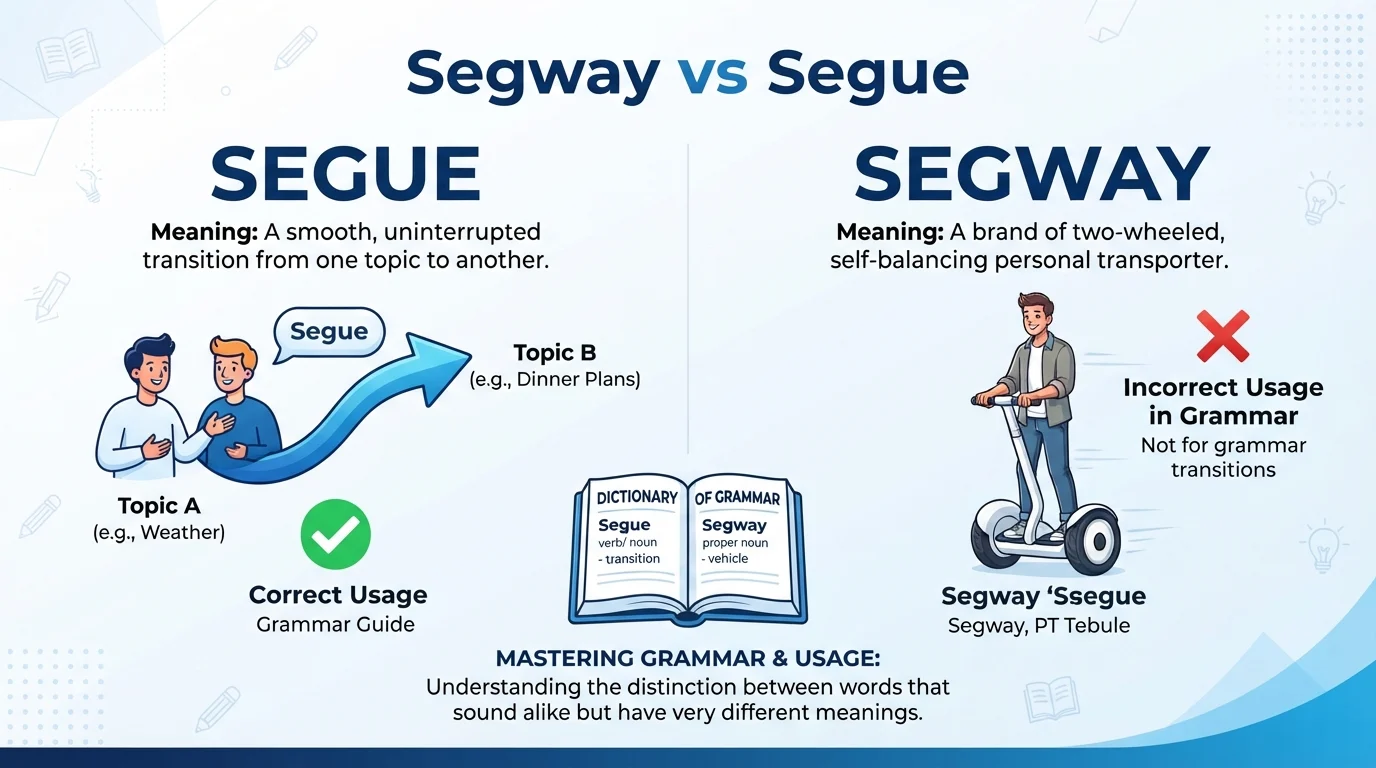
Have you ever wondered if the correct word is “segway” or “segue”? You’re not alone. These two words sound similar, but they have completely different meanings.
One refers to a type of two wheeled personal transportation device, while the other means a smooth transition from one topic, scene, or idea to another.
Understanding the difference between segway vs segue is important because confusing these words can change the meaning of your sentence.
In this guide, you’ll learn the definitions, pronunciation, examples, common mistakes, American and British English usage, and an easy way to remember the difference.
Quick Answer
- Segue = A smooth transition from one topic, idea, scene, or activity to another.
- Segway = A brand name associated with a self balancing personal transporter.
Examples:
- Let me segue into the next topic.
- We took a Segway tour around the city.
What Does “Segue” Mean?
Segue is a verb or noun that means a smooth transition from one thing to another.
It is commonly used in:
- conversations
- speeches
- presentations
- writing
- music
- films and television
Segue as a Verb
As a verb, segue means to move smoothly from one subject or activity to another.
Examples:
- The speaker segued from politics to economics.
- Let me segue into the next part of the presentation.
- The conversation segued into a discussion about travel.
Segue as a Noun
As a noun, a segue is the transition itself.
Examples:
- That was a smooth segue into the next topic.
- The presenter used a clever segue between the two subjects.
- The music created a natural segue into the next scene.
What Does “Segway” Mean?
Segway is a brand name associated with a self balancing, two wheeled personal transportation device.
Examples:
- We explored the city on a Segway.
- The tourists took a Segway tour.
- He learned how to ride a Segway.
Because Segway is a brand name, it is normally written with a capital S when referring to the trademarked product.
Segway vs Segue
| Word | Meaning | Example |
|---|---|---|
| Segue | A smooth transition between ideas or activities | She segued into a new topic. |
| Segway | A self balancing personal transportation device | We toured the city on a Segway. |
The key difference is:
Segue = transition
Segway = transportation device
Common Mistakes
Using “Segway” When You Mean “Segue”
Incorrect:
- ❌ Let me Segway into the next topic.
Correct:
- ✅ Let me segue into the next topic.
Using “Segue” for the Personal Transporter
Incorrect:
- ❌ We rode a segue through the city.
Correct:
- ✅ We rode a Segway through the city.
Why Are They So Often Confused?
The words segue and Segway are pronounced similarly, which makes them easy to confuse.
Segue is pronounced approximately:
SEG way
This pronunciation is unusual because the spelling does not clearly show how the word sounds.
Segway is pronounced:
SEG way
Because the pronunciation is nearly identical, the meaning and spelling must be learned separately.
American vs British English
The word segue is used in both American and British English with the same basic meaning: a smooth transition.
Segway is also understood internationally as the name of the personal transportation device.
There is no major American versus British spelling difference between the two words.
Easy Trick to Remember
Use this memory trick:
Segue = smoothly go from one idea to another.
Think of segue as a smooth transition.
For Segway, think of:
A vehicle you can ride.
You can remember:
- segue → conversation, presentation, music
- Segway → wheels, riding, transportation
Related Words and Phrases
Words related to segue:
- transition
- shift
- move smoothly
- lead into
- flow into
- change of subject
Examples:
- a smooth transition
- segue into a topic
- segue from one idea to another
Words related to Segway:
- personal transporter
- two-wheeled vehicle
- self balancing device
- city tour vehicle
Tips to Avoid This Mistake
Follow these simple strategies:
- Use segue when talking about a transition.
- Use Segway when talking about the personal transportation device.
- Remember: segue = smooth transition.
- Remember: Segway = something you ride.
- Pay attention to the context because the pronunciation is almost the same.
Frequently Asked Questions
What is the difference between segway and segue?
Segue means a smooth transition between ideas, topics, scenes, or activities. Segway refers to a self balancing personal transportation device.
Which is correct: “segue into” or “segway into”?
Segue into is correct when you mean to transition smoothly to another topic.
Example: Let me segue into the next point.
Is “segway” a word?
Yes. Segway is a brand name associated with a self balancing personal transporter.
How do you pronounce segue?
Segue is pronounced approximately “SEG way.”
Is segue a noun or a verb?
It can be both a noun and a verb.
- Verb: She segued into a new topic.
- Noun: That was a smooth segue.
Is Segway capitalized?
When referring to the brand or product, Segway is normally capitalized.
Do American and British English use segue differently?
No. The basic meaning and spelling of segue are the same in both American and British English.
Summary
When comparing segway vs segue, remember that these words have completely different meanings despite having nearly identical pronunciations. Segue means a smooth transition from one idea, topic, scene, or activity to another. Segway refers to a self balancing personal transportation device.
The easiest way to remember the difference is to connect segue with transition and Segway with transportation. If you are moving smoothly from one subject to another, use segue. If you are talking about something people ride, use Segway.
Actionable Takeaway
Use segue for a smooth transition and Segway for a rideable personal transporter. Remember: segue = transition; Segway = transportation.