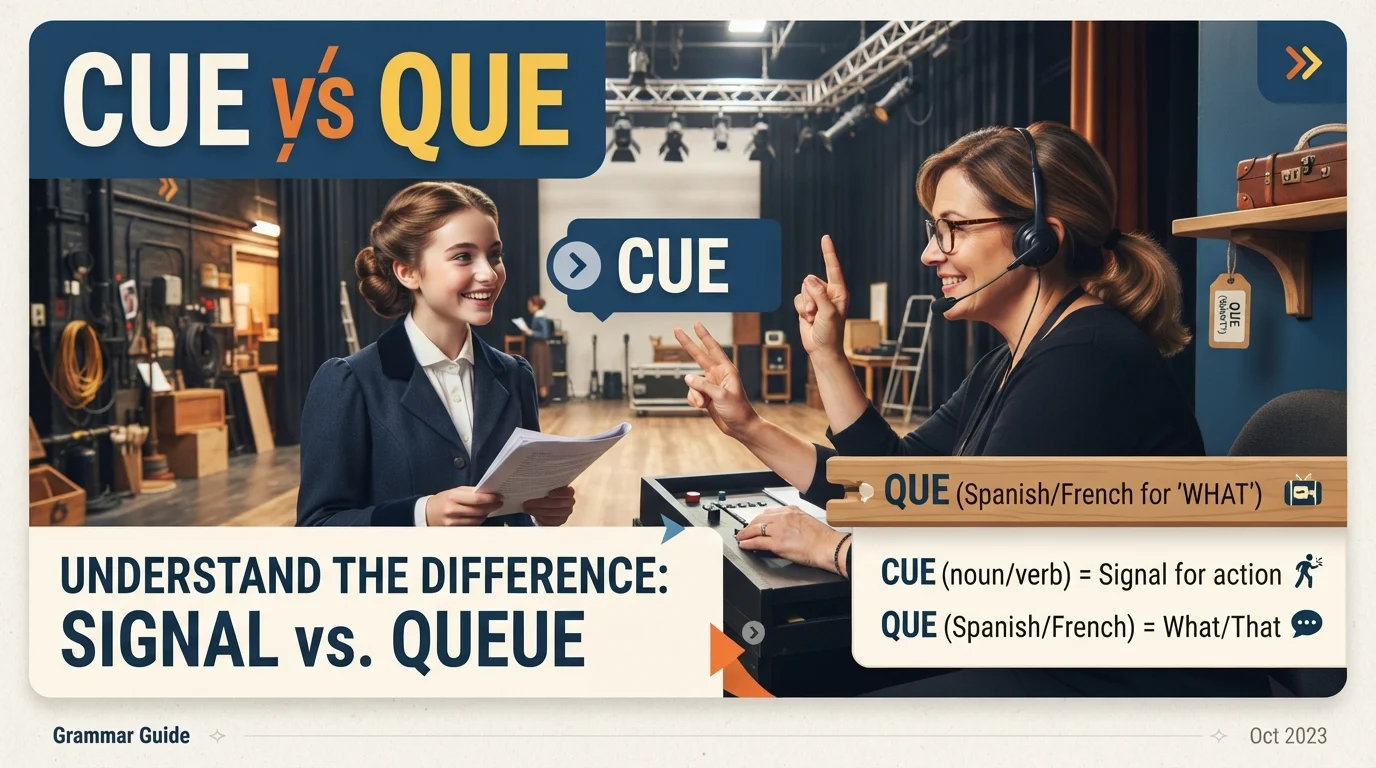
Have you ever wondered if the correct spelling is cue or que? These words can sound the same, but they do not have the same meaning.
Choosing the right spelling depends on the context and the language being used.
In standard English, cue is the correct word when you mean a signal, prompt, hint, or a stick used in games such as pool. Que is not normally used as an English spelling of cue, although it is a real word in languages such as Spanish and French.
Quick Answer: Cue vs Que
Cue is the standard English word.
- The actor waited for his cue.
- That was my cue to leave.
Que is generally not the correct English spelling when you mean a signal or prompt.
Easy memory trick
Cue = clue.
A cue gives you a clue about what to do next.
What Does “Cue” Mean?
Cue is a standard English word with several meanings.
Cue as a signal or prompt
A cue is a signal that tells someone when to speak, act, move, or do something.
Examples:
- The actor waited for his cue.
- The bell was a cue to leave.
- The music was her cue to begin dancing.
- The director gave the performer a cue.
- His smile was my cue to continue.
Cue as a hint or indication
A cue can also be a sign that helps you understand what to do or what is happening.
- The dark clouds were a cue to take an umbrella.
- Her worried expression was a cue that something was wrong.
- His silence was a cue that he did not want to continue the conversation.
Cue in pool or billiards
A cue is also the long stick used to hit the balls in pool or billiards.
- He picked up his cue.
- She bought a new pool cue.
What Does “Que” Mean?
Que is generally not the standard English spelling of cue.
However, que is a real word in other languages.
For example:
- In Spanish, que can mean “that,” “what,” or “which,” depending on the context.
- In French, que is also used as a grammatical word.
Therefore, que may be correct in a foreign-language sentence, but it is usually incorrect when you are writing standard English and mean a signal or prompt.
Cue vs Que: The Main Difference
| Word | Meaning | Example |
|---|---|---|
| Cue | A signal, prompt, hint, or pool stick | The actor waited for his cue. |
| Que | Mainly a word used in other languages | Spanish and French use “que” in different ways. |
The simplest rule
Use cue when you mean:
- A signal
- A prompt
- A hint
- An indication
- A pool or billiards stick
Do not use que as the standard English spelling of cue.
Cue vs Que Examples
Correct examples with “cue”
- The actor missed his cue.
- The music was the cue to start.
- That was my cue to leave.
- The director gave her a cue.
- He used a pool cue to hit the ball.
Incorrect examples
❌ The actor missed his que.
✅ The actor missed his cue.
❌ That was my que to leave.
✅ That was my cue to leave.
❌ The music was the que to start.
✅ The music was the cue to start.
Common Mistakes With Cue and Que
Mistake 1: Writing “que” instead of “cue”
Because cue sounds like the letter Q, some people assume que is an alternative spelling.
However:
❌ Wait for your que.
✅ Wait for your cue.
Mistake 2: Confusing “cue” with “queue”
Another common confusion is cue vs queue.
- Cue = a signal or prompt
- Queue = a line of people or vehicles waiting
Examples:
- The bell was my cue to leave.
- We waited in a queue for the bus.
Mistake 3: Confusing “cue” with “clue”
A cue is a signal or indication.
A clue is information that helps solve a mystery or understand a situation.
Examples:
- The actor waited for his cue.
- The detective found an important clue.
Cue vs Queue vs Que
These three spellings can be confusing because they look or sound similar.
| Word | Meaning | Example |
| Cue | A signal or prompt | That was my cue to speak. |
| Queue | A line or waiting list | We stood in a queue. |
| Que | Usually a foreign language word | “Que” has meanings in Spanish and French. |
Easy memory trick
- Cue tells you what to do.
- Queue is where you wait.
- Que is mainly used in other languages or specific names and expressions.
Cue vs Que in American and British English
The word cue has the same meaning and spelling in both American English and British English.
The word queue is particularly common in British English for a line of people. In American English, line is often more common.
However, this difference does not affect the spelling of cue:
- Signal or prompt → cue
- Line of people → queue or line, depending on regional usage
A Simple Memory Trick for Cue vs Que
Remember this phrase:
A cue gives you a clue.
If you mean a signal, prompt, or indication, use cue.
For example:
- The director gave the actor a cue.
- The detective discovered a clue.
The spelling cue is the one you need in standard English.
Quick Practice: Cue or Que?
Choose the correct word:
- The actor waited for his ______.
- The bell was a ______ to leave.
- The director gave the performer a ______.
- He bought a new pool ______.
- The music was her ______ to begin.
Answers
- cue
- cue
- cue
- cue
- cue
Why Are Cue and Que So Commonly Confused?
The main reason is pronunciation. Cue is pronounced like the letter Q, so some people assume that que may be another English spelling.
However, English spelling does not always follow pronunciation. In standard English, the word meaning a signal or prompt is spelled cue.
The best way to remember it is to focus on meaning:
- Signal or prompt → cue
- Line of people → queue
- Foreign-language word → que, depending on the language and context
Is “que” a correct English word?
Usually, not when you mean a signal or prompt. The standard English word is cue. Que may appear as a word in other languages or as part of a name or expression.
Is it “my cue to leave” or “my que to leave”?
The correct phrase is my cue to leave.
What does “cue” mean in acting?
In acting, a cue is a signal that tells a performer when to speak, enter, move, or begin an action.
What is the difference between cue and queue?
Cue means a signal or prompt. Queue means a line of people or vehicles waiting.
Is “cue” the same as “clue”?
No. A cue is a signal or indication, while a clue is information that helps someone solve a problem or mystery.
How do you remember the spelling of cue?
Remember: A cue gives you a clue.
Is “que” used in Spanish and French?
Yes. Que is a common word in both Spanish and French, but its meaning depends on the language and context.
Do American and British English use “cue” differently?
No. The basic meaning and spelling of cue are the same in both varieties of English.
Final Summary: Cue vs Que
The difference between cue vs que is simple. Cue is the standard English word for a signal, prompt, hint, or pool stick. For example, “The actor waited for his cue” or “The bell was my cue to leave.”
Que is generally not the standard English spelling of this word, although it is used in languages such as Spanish and French. The easiest way to remember the correct English spelling is: A cue gives you a clue.
Actionable Takeaway
Use cue when you mean a signal, prompt, hint, or pool stick. Use queue for a line of people, and use que only when it is correct in a foreign-language context or proper name.