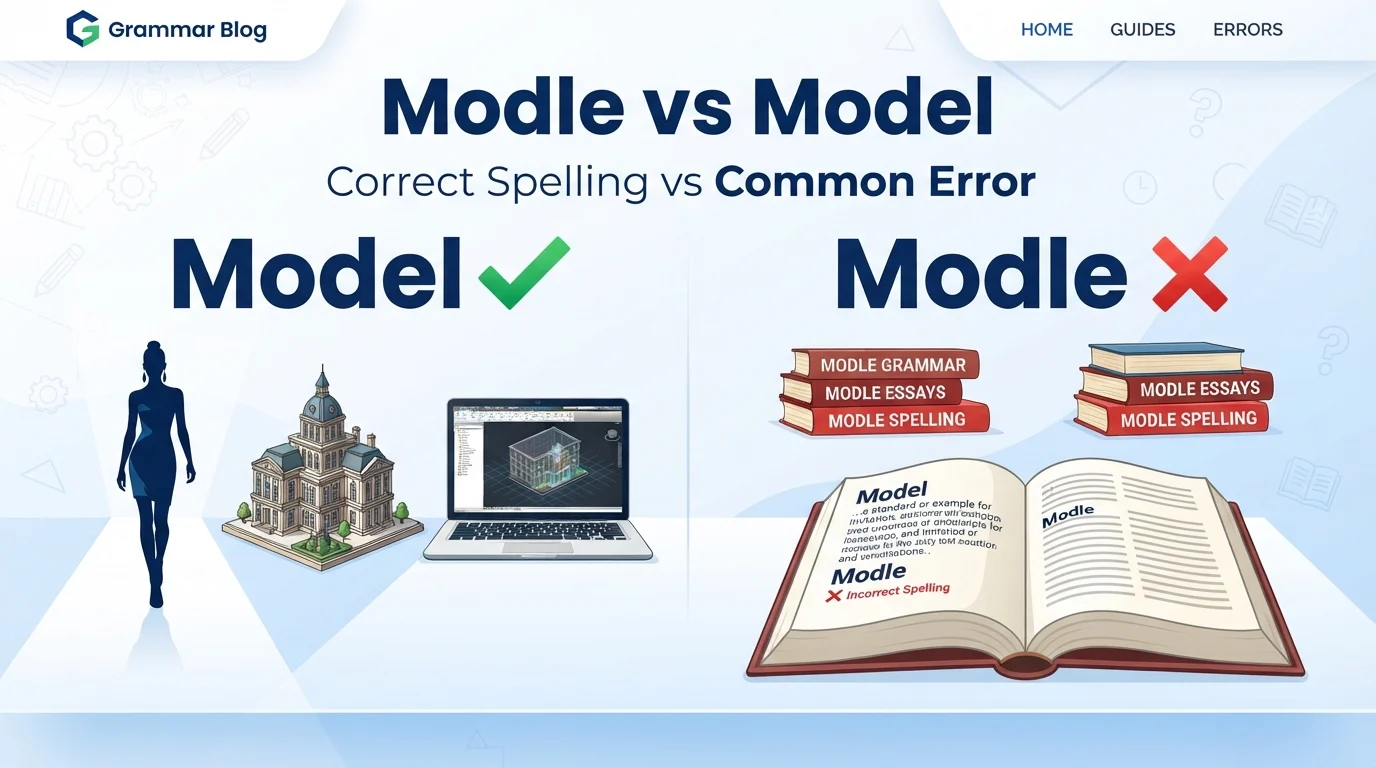
Have you ever typed “modle” instead of “model”? It’s a surprisingly common typo because the letters e and l are easy to switch while typing quickly. However, only one spelling is correct in standard English.
The correct word is “model.” “Modle” is simply a misspelling and should be avoided in academic, professional, and everyday writing. In this guide, you’ll learn the difference between modle vs model, understand the meaning of model, see practical examples, and discover simple tips to remember the correct spelling.
Quick Answer
“Model” is correct.
“Modle” is incorrect in standard English.
- ✅ Model = A person, object, design, example, or representation used for display, study, or imitation.
- ❌ Modle = A common misspelling of model.
Examples:
- ✅ She works as a model.
- ✅ This is the latest car model.
- ❌ She works as a modle.
What Does “Model” Mean?
Model is a versatile word that can be used as both a noun and a verb.
As a noun, it can mean:
- A person who displays clothing or products.
- A representation or miniature version of something.
- A design or type of a product.
- An example to follow.
As a verb, model means to create, shape, demonstrate, or display something.
Examples:
- She is a fashion model.
- The architect built a model of the new bridge.
- This smartphone is the newest model.
- The teacher modeled the correct way to solve the problem.
Why “Modle” Is Incorrect
Modle is not a recognized English word. It usually appears because of a typing error where the letters l and e are reversed.
Standard English dictionaries recognize only model.
Modle vs Model
| Feature | Modle | Model |
|---|---|---|
| Correct spelling | ❌ No | ✅ Yes |
| Standard English | ❌ Incorrect | ✅ Correct |
| Dictionary recognized | ❌ No | ✅ Yes |
| Used in formal writing | ❌ Never | ✅ Yes |
| Used in everyday English | ❌ No | ✅ Yes |
Whenever you’re choosing between modle vs model, always use model.
Common Uses of “Model”
Fashion
- She became a successful fashion model.
- The model walked confidently down the runway.
Products
- This laptop is the newest model.
- They released an updated model last year.
Education
- The teacher used a solar system model during the lesson.
- Students built a model volcano.
Business
- The company adopted a new business model.
- Their pricing model improved profitability.
Technology
- The AI model was trained on millions of examples.
- Engineers developed a predictive model for weather forecasting.
Common Mistakes
Here are mistakes people often make.
Incorrect:
- ❌ modle
- ❌ car modle
- ❌ business modle
- ❌ fashion modle
Correct:
- ✅ model
- ✅ car model
- ✅ business model
- ✅ fashion model
Common Expressions with “Model”
You’ll often see model in these phrases:
- role model
- business model
- fashion model
- 3D model
- scale model
- data model
- financial model
- model student
- latest model
- operating model
Examples:
- She is a great role model for young athletes.
- The startup created an innovative business model.
- They introduced the latest car model.
Easy Trick to Remember
A simple memory tip:
Think of the word model as ending with “el.”
Remember the phrase:
A model is excellent.
Both model and excellent contain “el” near the end, helping you avoid the typo modle.
Another tip: when typing, say the letters slowly in your mind—M-O-D-E-L.
American vs British English
There is no spelling difference between American and British English.
Both varieties use:
- ✅ Model
- ❌ Modle
The spelling remains the same worldwide.
Related Words
If you’re learning vocabulary related to model, you may also encounter:
- prototype
- design
- example
- pattern
- template
- representation
- mannequin
- blueprint
- simulation
- framework
These words are related depending on the context in which model is used.
Tips to Avoid This Mistake
Use these simple strategies:
- Remember the correct letter order: M-O-D-E-L.
- Proofread your writing before publishing or sending it.
- Pay extra attention when typing quickly.
- Use spell-check tools, but don’t rely on them completely.
- Practice writing common phrases like business model and role model.
Frequently Asked Questions
Is “modle” a real English word?
No. Modle is not recognized as a standard English word. It is a spelling mistake.
Which is correct: modle or model?
Model is always the correct spelling.
What does “model” mean?
Depending on the context, model can refer to a person who displays products, a representation of something, a product version, or an example to follow.
Is “model” a noun or a verb?
It can be both.
As a noun:
- She is a professional model.
As a verb:
- The artist modeled the sculpture.
Do American and British English spell “model” differently?
No. Both use the spelling model.
Why do people write “modle”?
It’s usually a typing error caused by reversing the final two letters.
What is a “role model”?
A role model is someone whose behavior, achievements, or character inspires others to follow their example.
Summary
When comparing modle vs model, the correct spelling is always model. Modle is simply a common typing or spelling error and should never be used in standard English. Whether you’re referring to a fashion model, a business model, a car model, or an AI model, model is the only accepted form.
To avoid this mistake, remember the correct letter order: M-O-D-E-L. A quick proofreading check can help you catch this typo before publishing your work, making your writing more polished and professional.
Actionable Takeaway
Before submitting an email, assignment, or blog post, search for “modle.” If you find it, replace it with “model.” This small correction will instantly improve the accuracy and credibility of your writing.