The words “wholistic” and “holistic” often create confusion because they sound nearly identical and are used in similar contexts. If you’re writing about healthcare, education, wellness, or personal development, you may wonder which spelling is correct.
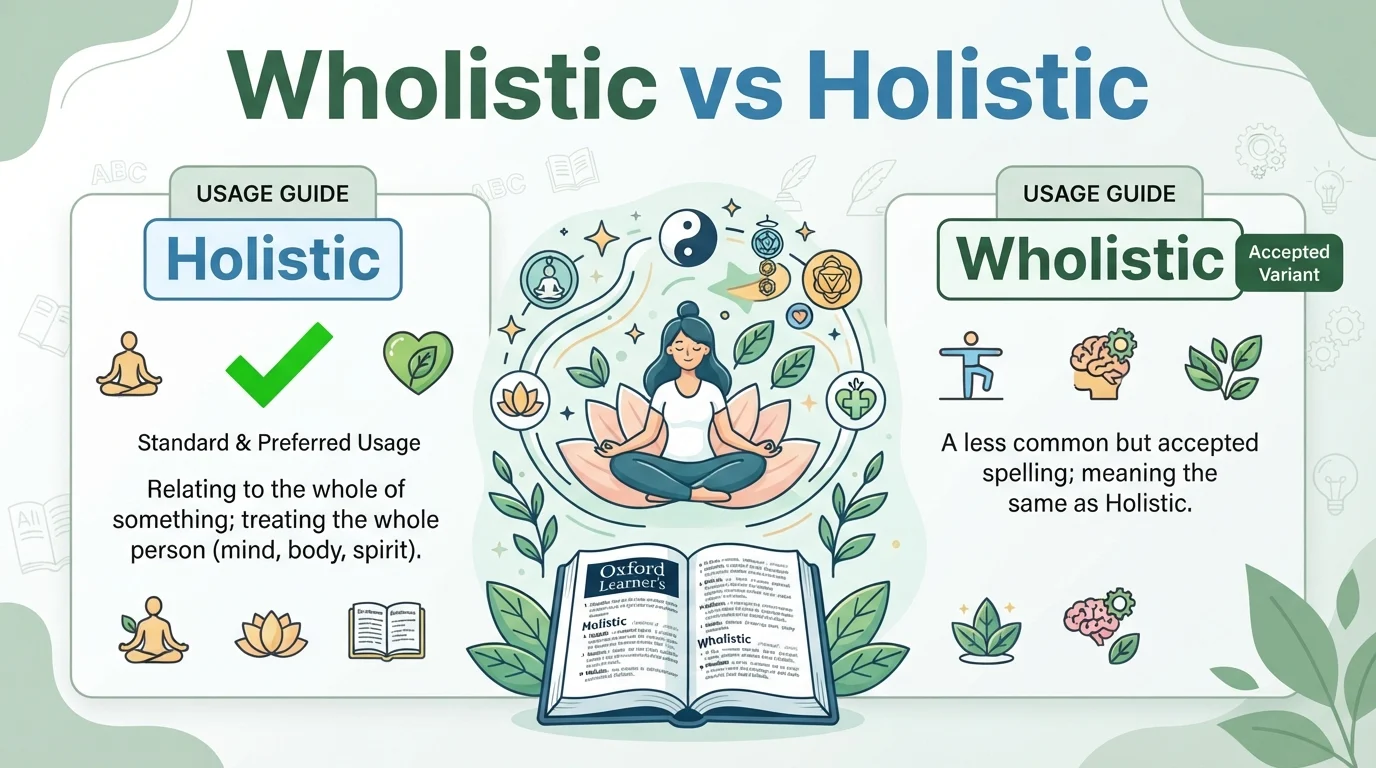
The short answer is that “holistic” is the standard and preferred spelling in modern English. “Wholistic” is a recognized variant, but it is much less common and is typically used by some organizations or practitioners to emphasize the idea of treating the “whole” person. In this guide, you’ll learn the difference between wholistic vs holistic, their meanings, examples, common mistakes, and when each spelling is appropriate.
Quick Answer
“Holistic” is the standard and most widely accepted spelling.
“Wholistic” is an accepted variant, but it is far less common.
- ✅ Holistic = The preferred spelling in dictionaries, academic writing, healthcare, and everyday English.
- ✅ Wholistic = A less common alternative used by some practitioners to emphasize the concept of “whole.”
Examples:
- ✅ She believes in a holistic approach to healthcare.
- ✅ The school promotes holistic development.
- ✅ Some wellness centers describe their services as wholistic care.
What Does “Holistic” Mean?
Holistic is an adjective that describes an approach that considers the whole person or the complete system rather than focusing on individual parts.
It is commonly used in fields such as:
- healthcare
- education
- psychology
- nutrition
- business
- personal development
Examples:
- The doctor recommended a holistic treatment plan.
- The company adopted a holistic business strategy.
- A holistic education develops both academic and life skills.
What Does “Wholistic” Mean?
Wholistic has essentially the same meaning as holistic.
Some writers and practitioners prefer wholistic because they believe it better highlights the word “whole.” However, its meaning does not differ from holistic in standard usage.
Examples:
- The clinic offers wholistic wellness programs.
- She follows a wholistic lifestyle focused on mind, body, and spirit.
Although acceptable in some contexts, wholistic is much less common than holistic.
Wholistic vs Holistic
| Feature | Wholistic | Holistic |
|---|---|---|
| Standard spelling | ❌ Less common | ✅ Yes |
| Dictionary recognized | ✅ Yes (variant) | ✅ Yes |
| Used in academic writing | ❌ Rarely | ✅ Yes |
| Used in healthcare | ⚠️ Sometimes | ✅ Yes |
| Common in everyday English | ❌ Less common | ✅ Yes |
| Preferred by style guides | ❌ Usually No | ✅ Yes |
For most writing, holistic is the recommended choice.
Why “Holistic” Is Preferred
Although wholistic is recognized by some dictionaries as a variant spelling, holistic is overwhelmingly more common in:
- academic publications
- medical literature
- professional writing
- journalism
- business communication
- educational materials
If you’re writing for a broad audience, holistic is the safer and more widely accepted option.
Examples of “Holistic” in Sentences
Healthcare
- The doctor recommended a holistic approach to recovery.
- Many patients prefer holistic treatments alongside conventional medicine.
Education
- The school focuses on holistic student development.
- A holistic curriculum includes academic and emotional growth.
Business
- The company adopted a holistic marketing strategy.
- Leaders need a holistic view of organizational challenges.
Personal Development
- Meditation is part of her holistic wellness routine.
- A holistic lifestyle emphasizes balance and well-being.
Examples of “Wholistic” in Sentences
Although less common, wholistic appears in some specialized settings.
- The wellness center promotes wholistic healing.
- She practices wholistic nutrition.
- The therapist describes her services as wholistic care.
These examples are acceptable when reflecting a specific organization’s branding or preferred terminology.
Common Mistakes
One of the biggest mistakes is assuming that wholistic is the standard spelling.
For general writing:
- ❌ Use wholistic in academic papers without checking style guidelines.
- ✅ Use holistic unless a specific organization or publication prefers wholistic.
Easy Trick to Remember
A simple memory tip:
Think of holistic as the standard dictionary word.
If you’re unsure which spelling to use, choose holistic. It is accepted almost everywhere and is the form most readers expect.
American vs British English
There is no significant difference between American and British English.
Both varieties:
- Prefer holistic
- Recognize wholistic as a less common variant
Whether you’re writing for readers in the United States, the United Kingdom, Canada, or Australia, holistic is generally the preferred spelling.
Related Words
If you’re exploring this topic, you may also encounter:
- whole-person care
- integrative medicine
- wellness
- comprehensive
- balanced
- interconnected
- mind-body health
- natural healing
- preventive care
- overall well-being
These related terms often appear alongside holistic in health and education content.
Tips to Choose the Right Spelling
Follow these guidelines:
- Use holistic in professional, academic, and general writing.
- Use wholistic only if you’re following an organization’s branding or preferred terminology.
- Stay consistent throughout your document.
- Check publication or employer style guides if applicable.
Frequently Asked Questions
Which is correct: wholistic or holistic?
Both are recognized, but holistic is the standard and more widely accepted spelling.
Is “wholistic” a real word?
Yes. Wholistic is a recognized variant spelling, although it is much less common than holistic.
Why do some people use “wholistic”?
Some practitioners prefer wholistic to emphasize treating the whole person, but its meaning is essentially the same as holistic.
Is “holistic” more common?
Yes. Holistic is far more common in dictionaries, academic writing, healthcare, journalism, and business.
Do American and British English spell it differently?
No. Both American and British English generally prefer holistic.
Should I use “wholistic” in professional writing?
Unless you’re following a specific organization’s preferred spelling, holistic is the better choice.
Do the two words have different meanings?
Not really. In modern English, wholistic and holistic are used with the same meaning, but holistic is the standard spelling.
Summary
When comparing wholistic vs holistic, holistic is the standard and preferred spelling in modern English. It is widely used in healthcare, education, business, psychology, and wellness, making it the best choice for most professional and everyday writing. While wholistic is a recognized variant, it is much less common and is mainly used by certain organizations or practitioners to emphasize the concept of treating the “whole” person.
To avoid confusion and meet the expectations of most readers, use holistic unless you have a specific reason to use wholistic. Choosing the standard spelling will make your writing clearer, more consistent, and more professional.
Actionable Takeaway
If you’re unsure whether to write wholistic or holistic, choose holistic. It’s the preferred spelling in both American and British English and the one most dictionaries, style guides, and readers expect.