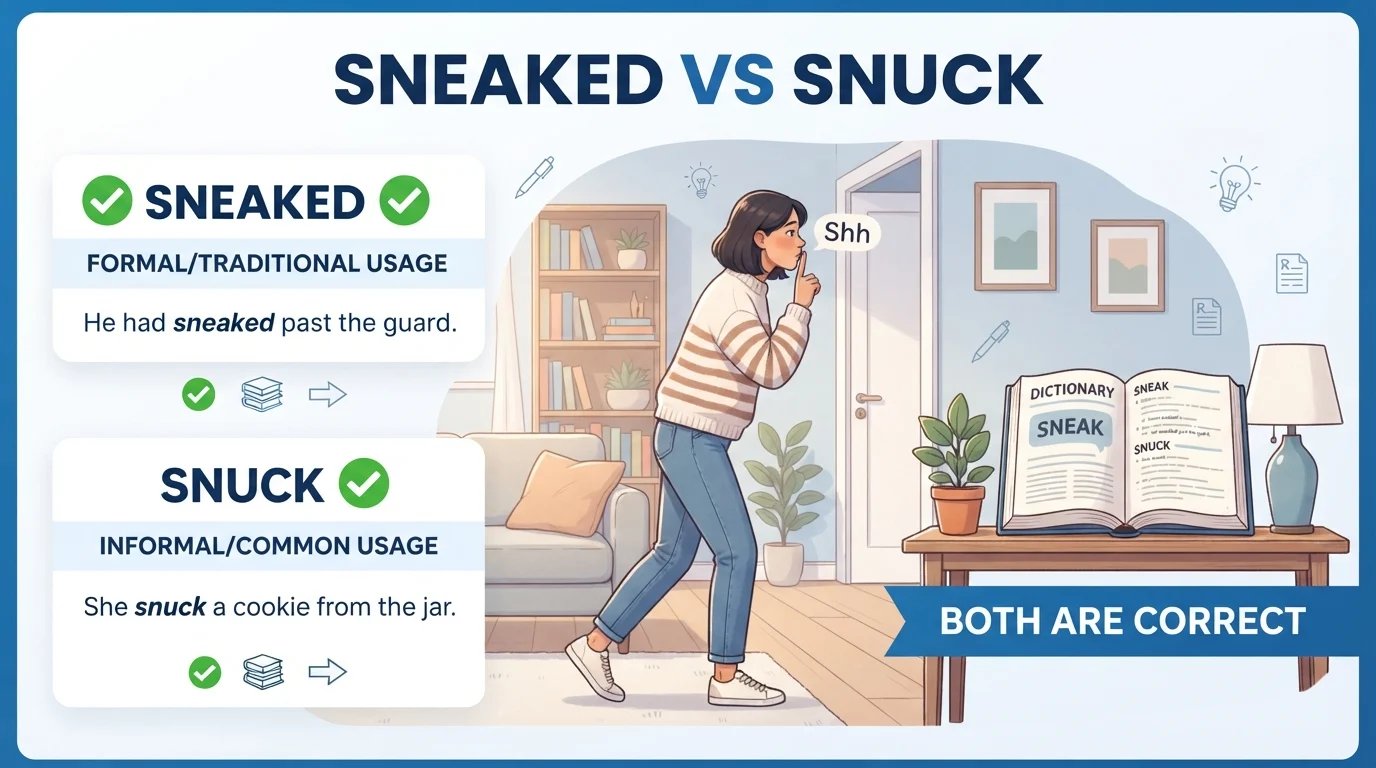
Have you ever wondered if the correct past tense of “sneak” is “sneaked” or “snuck”? You’re not alone. Both forms are widely used, but their history and usage differ depending on regional English and style.
The good news is that both “sneaked” and “snuck” are correct. Sneaked is the traditional regular past tense, while snuck is an irregular form that is especially common in American English.
This guide explains the difference between sneaked vs snuck, with clear meanings, examples, American and British English usage, common mistakes, and easy tips.
Quick Answer
- Sneaked = Correct regular past tense of sneak.
- Snuck = Also correct, especially common in American English.
Examples:
- She sneaked out of the house.
- She snuck out of the house.
Both sentences are correct.
What Does “Sneaked” Mean?
Sneaked is the traditional past tense and past participle of sneak.
It means moving quietly, secretly, or carefully to avoid being noticed.
Examples:
- The cat sneaked into the room.
- He sneaked out after everyone went to sleep.
- She sneaked a look at the answer.
- They sneaked through the back door.
Sneaked follows the regular verb pattern:
sneak → sneaked → sneaked
What Does “Snuck” Mean?
Snuck is an irregular past tense and past participle of sneak.
Examples:
- He snuck out of the house.
- She snuck into the kitchen.
- The child snuck a cookie before dinner.
- They snuck past the security guard.
Although snuck was once considered informal or nonstandard by some speakers, it is now widely accepted in standard English, especially in American English.
Sneaked vs Snuck
| Word | Correct? | Common Usage |
|---|---|---|
| Sneaked | ✅ Yes | Traditional and regular form |
| Snuck | ✅ Yes | Very common, especially in American English |
The key point is:
Both “sneaked” and “snuck” are correct past tense forms of “sneak.”
Examples of “Sneaked”
- She sneaked quietly into the room.
- He sneaked out during the meeting.
- The dog sneaked into the garden.
- I sneaked a quick look at the message.
Examples of “Snuck”
- She snuck quietly into the room.
- He snuck out during the meeting.
- The dog snuck into the garden.
- I snuck a quick look at the message.
The meaning is essentially the same in each pair.
American vs British English
The biggest difference between sneaked and snuck is regional preference.
American English
Snuck is extremely common in American English.
Examples:
- He snuck out of the house.
- She snuck a cookie from the kitchen.
Sneaked is also correct but may sound slightly more formal or traditional to some American speakers.
British English
Sneaked has traditionally been more common in British English.
Examples:
- He sneaked out of the room.
- She sneaked a look at the letter.
However, snuck is also increasingly recognized and used in British English.
Common Mistakes
Thinking “Snuck” Is Always Incorrect
Some people believe that snuck is not a real word.
That is incorrect. Snuck is a recognized and widely accepted past tense of sneak.
Thinking “Sneaked” Is Incorrect
This is also incorrect.
Sneaked is a perfectly correct regular past tense form.
Using “Sneak” as the Past Tense
Incorrect:
- ❌ Yesterday, he sneak out of the room.
Correct:
- ✅ Yesterday, he sneaked out of the room.
- ✅ Yesterday, he snuck out of the room.
Sneaked vs Snuck in Formal Writing
Both forms are accepted, but your choice may depend on your audience and style.
Sneaked may sound more traditional or formal.
Snuck is very natural in everyday American English.
For example:
- More traditional: The suspect sneaked out through the back door.
- More conversational: The suspect snuck out through the back door.
Neither is automatically wrong.
Easy Trick to Remember
Remember:
Sneak has two accepted past tense forms: sneaked and snuck.
You can use:
- sneak → sneaked
- sneak → snuck
Unlike many irregular verbs, sneak has both a regular and an irregular past form.
Related Forms of “Sneak”
Present:
- I sneak out.
Past:
- I sneaked out.
- I snuck out.
Present perfect:
- I have sneaked out.
- I have snuck out.
Present participle:
- I am sneaking out.
Examples:
- She is sneaking around.
- They have snuck into the building.
- He sneaked past the sleeping dog.
Tips to Avoid This Mistake
Follow these simple strategies:
- Remember that both sneaked and snuck are correct.
- Use snuck freely in everyday American English.
- Use sneaked if you prefer the regular or more traditional form.
- Consider your audience and regional English preferences.
- Never use sneak as the past tense in standard English.
Frequently Asked Questions
Which is correct: sneaked or snuck?
Both sneaked and snuck are correct past tense forms of sneak.
Is “snuck” a real word?
Yes. Snuck is a recognized and widely accepted past tense and past participle of sneak.
Is “sneaked” grammatically correct?
Yes. Sneaked is the regular past tense form of sneak.
Which is more common in American English: sneaked or snuck?
Snuck is generally very common in American English, especially in informal and everyday speech.
Which is more common in British English?
Sneaked has traditionally been more common in British English, although snuck is also used and understood.
Can I use “snuck” in formal writing?
Yes. Snuck is accepted in standard English, although sneaked may sometimes sound more traditional depending on the context.
What is the past tense of sneak?
Both sneaked and snuck can be used as the past tense of sneak.
Summary
When comparing sneaked vs snuck, both words are correct. Sneaked is the regular and traditional past tense of sneak, while snuck is an irregular form that is especially common in American English. Both mean moving secretly, quietly, or without being noticed.
The best choice depends largely on regional preference and writing style. If you prefer a traditional form, use sneaked. If you want a natural, everyday American English expression, snuck is perfectly acceptable.
Actionable Takeaway
You do not have to choose only one: sneaked and snuck are both correct. Use the form that best fits your audience, region, and tone.