Have you ever wondered if to use “farther” or “further”? You’re not alone. These two words are often confused because both can relate to distance and progress. Although many people use them interchangeably, understanding their traditional difference can make your writing more precise and polished.
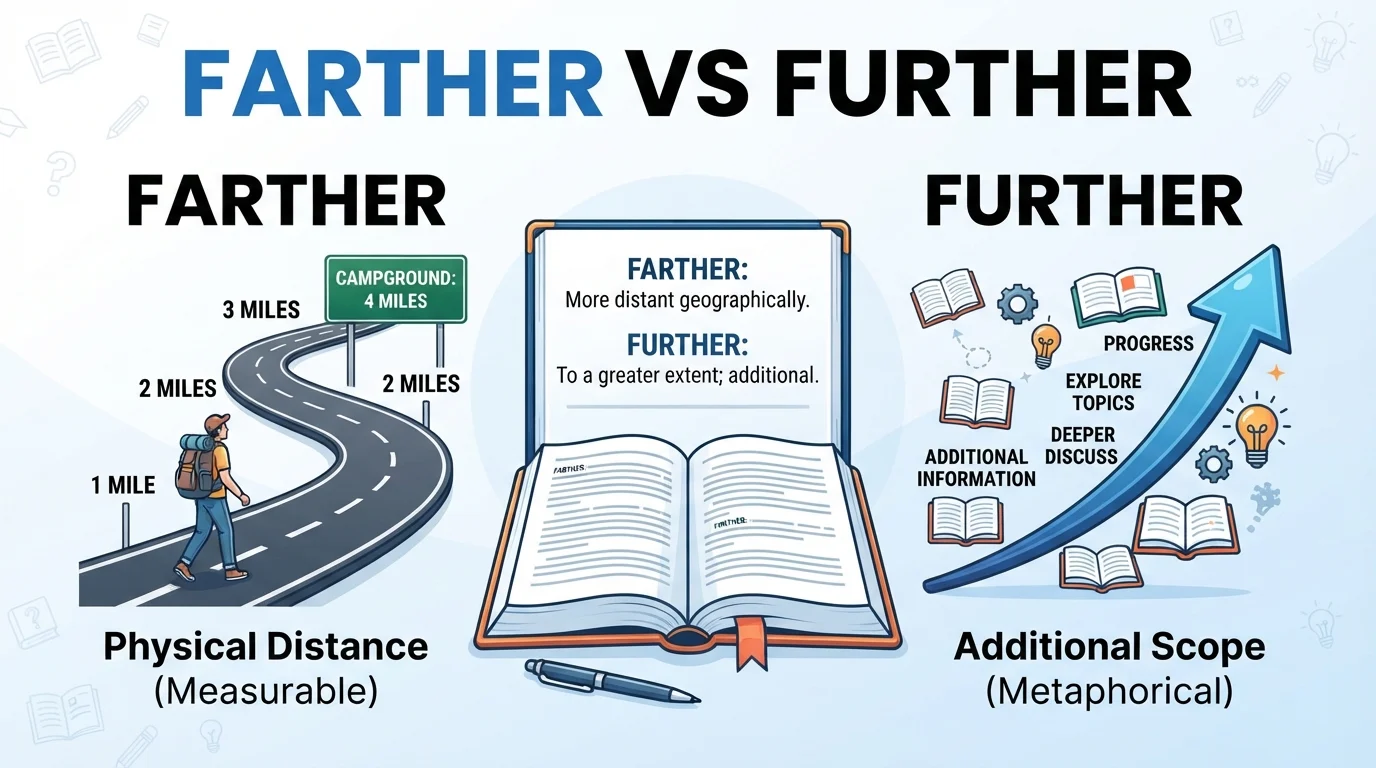
The simple rule is that farther is traditionally used for physical distance, while further is commonly used for figurative distance, additional information, or greater progress. In modern English, especially in American English, further is also frequently used for physical distance. This guide explains farther vs further with clear meanings, examples, common mistakes, American and British English differences, and easy memory tips.
Quick Answer
- Farther = Usually refers to measurable physical distance.
- Further = Usually means additional, more, or to a greater extent.
Examples:
- The store is farther down the road.
- We need to discuss this further.
- For further information, contact the office.
What Does “Farther” Mean?
Farther traditionally refers to physical distance something that can be measured in miles, kilometers, meters, or another unit.
Examples:
- How much farther is the station?
- We walked farther than we expected.
- The hotel is farther from the airport.
- She ran farther than anyone else.
A useful test is to ask:
Can I measure the distance?
If the answer is yes, farther is often the best choice.
What Does “Further” Mean?
Further usually refers to figurative distance, additional information, progress, or a greater degree.
Examples:
- We need to investigate the matter further.
- The discussion requires further consideration.
- Do you have any further questions?
- The company made further improvements.
It can also mean more or additional.
Examples:
- Please provide further details.
- No further action is required.
- We need further evidence.
Farther vs Further
| Word | Traditional Meaning | Example |
|---|---|---|
| Farther | Greater physical distance | The mountain is farther away. |
| Further | Additional, more, or figurative progress | We need to investigate further. |
The simple distinction is:
Farther = physical distance
Further = additional or figurative distance
Examples of “Farther”
Use farther when talking about measurable physical distance.
- The next town is farther than I thought.
- We drove farther into the countryside.
- She threw the ball farther than her brother.
- How much farther do we have to walk?
- The house is farther from the road.
Examples of “Further”
Use further when talking about additional information, progress, discussion, or a figurative idea.
- We need to discuss the issue further.
- The research requires further study.
- I have no further questions.
- The company plans to expand further.
- For further information, please contact us.
“Further” as a Verb
Further can also be used as a verb meaning to advance, promote, or help something progress.
Examples:
- The program aims to further scientific research.
- She worked hard to further her career.
- The project will further our understanding of the issue.
In these examples, farther would not be correct.
Common Mistakes
A common mistake is using farther for figurative ideas.
Less appropriate:
- ❌ We need to investigate the issue farther.
Better:
- ✅ We need to investigate the issue further.
Another common mistake is using further when referring to a measurable physical distance.
Traditional usage:
- ✅ The store is farther down the road.
However, further is also widely used for physical distance in modern English, so the distinction is not always strict.
American vs British English
The traditional distinction between farther and further is taught in both American and British English:
- farther for physical distance
- further for figurative distance or additional information
However, modern usage especially in American English often uses further for both physical and figurative distance.
For example, “The town is further away” is widely accepted. If you want to follow the traditional distinction, use farther for measurable physical distance.
“Farther” and “Further” as Comparatives
Both words are related to far.
- far → farther
- far → further
Examples:
- The second house is farther away.
- We need further discussion.
In many contexts, further can mean more or additional.
Examples:
- further information
- further education
- further research
- further discussion
- further details
Easy Trick to Remember
Use the physical distance rule:
Farther has “far” in it, so think physical distance.
Examples:
- How much farther?
- The mountain is farther away.
For everything meaning more, additional, or deeper, use further:
- further information
- further discussion
- further research
- further explanation
Related Expressions
Common phrases with farther:
- farther away
- farther down the road
- farther from home
- farther than expected
Common phrases with further:
- further information
- further details
- further research
- further discussion
- further notice
- further action
- further education
- further consideration
Tips to Avoid This Mistake
Follow these simple strategies:
- Use farther for measurable physical distance.
- Use further for additional information or figurative progress.
- Remember: farther = far.
- Use further information and further discussion.
- When in doubt about a figurative meaning, further is usually the safer choice.
Frequently Asked Questions
What is the difference between farther and further?
Farther traditionally refers to physical distance, while further usually refers to additional information, progress, or figurative distance.
Is farther only used for physical distance?
Traditionally, yes. However, modern English sometimes uses farther and further interchangeably.
Is “further information” correct?
Yes. Further information is the standard phrase.
Is “farther information” correct?
No. The standard phrase is further information.
Which is correct: farther away or further away?
Both are used. Farther away follows the traditional physical distance rule, while further away is also common in modern English.
Is “further research” correct?
Yes. Further research means additional or more research.
Do American and British English use farther and further differently?
The basic traditional distinction is similar, but modern usage often allows further for physical distance as well.
Summary
When comparing farther vs further, the traditional rule is simple: use farther for measurable physical distance and further for additional information, figurative distance, or progress. For example, you might say, “The next town is farther away,” but “We need further information.”
However, modern English is flexible, and further is often used for physical distance too. To write clearly and traditionally, remember farther = physical distance and further = additional or figurative meaning.
Actionable Takeaway
Before choosing farther or further, ask if you are talking about measurable physical distance or additional information/progress. Use farther for the first and further for the second.