Have you ever wondered whether to write “awhile” as one word or “a while” as two words? You’re not alone. This is a common English grammar confusion because both forms refer to a short period of time, but they are used differently in a sentence.
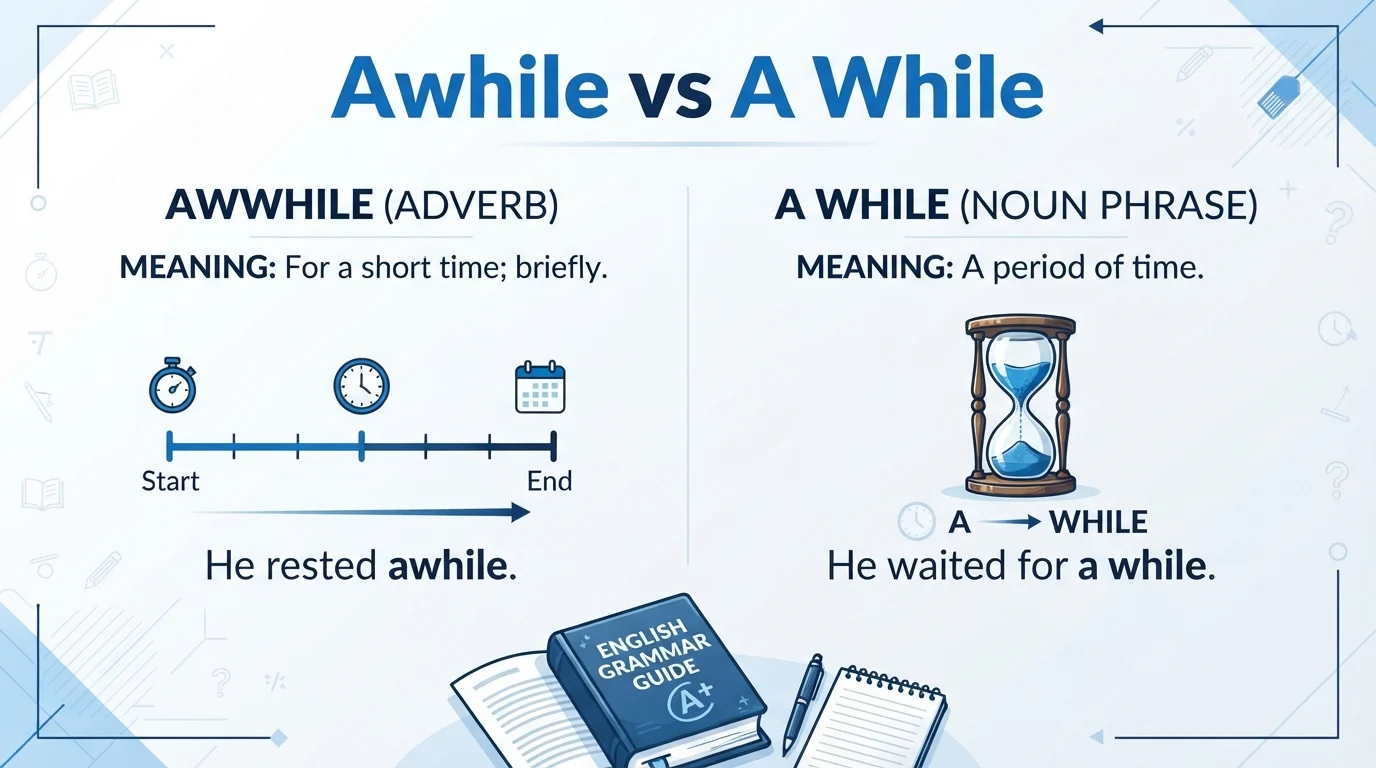
The key difference is grammatical. Awhile is an adverb meaning “for a short time,” while a while is a noun phrase meaning “a period of time.”
In this guide, you’ll learn the difference between awhile vs a while, see clear examples, understand common mistakes, and discover an easy trick to choose the correct form every time.
Quick Answer
Both awhile and a while are correct, but they are used differently.
- Awhile = for a short time.
- A while = a period of time.
Examples:
- Stay awhile. ✅
- Stay for a while. ✅
- I haven’t seen her in a while. ✅
- I haven’t seen her in awhile. ❌ (In traditional grammar, use “a while” after “in.”)
What Does “Awhile” Mean?
Awhile is an adverb that means for a short time.
It usually appears directly after a verb and does not normally need the preposition for before it.
Examples:
- Please stay awhile.
- Sit awhile and relax.
- She waited awhile.
- Let’s rest awhile.
You can often replace awhile with for a short time.
Example:
- Please stay awhile.
- Please stay for a short time.
What Does “A While” Mean?
A while is a noun phrase that means a period of time.
Because it functions as a noun, it can be used after prepositions such as for, in, and after.
Examples:
- We waited for a while.
- I haven’t seen him in a while.
- After a while, she felt better.
- It will take a while.
Awhile vs A While
| Form | Part of Speech | Meaning | Example |
|---|---|---|---|
| Awhile | Adverb | For a short time | Stay awhile. |
| A while | Noun phrase | A period of time | Stay for a while. |
The key difference is:
Awhile = for a short time
A while = a period of time
How to Use “Awhile” Correctly
Use awhile when you can replace it with for a short time.
Examples:
- Sit awhile.
- Wait awhile.
- Stay awhile.
- Rest awhile.
A helpful pattern is:
Verb + awhile
Examples:
- Stay awhile.
- Wait awhile.
- Relax awhile.
- Think awhile.
How to Use “A While” Correctly
Use a while when it functions as a noun phrase.
Common patterns include:
“For a While”
- Let’s sit for a while.
- She stayed for a while.
- I haven’t talked to him for a while.
“In a While”
- I haven’t seen you in a while.
- It will be ready in a while.
- We haven’t visited there in a while.
“After a While”
- After a while, the rain stopped.
- After a while, he became tired.
Common Mistakes
One common mistake is using awhile after for.
Incorrect in traditional standard grammar:
- ❌ Stay for awhile.
Correct:
- ✅ Stay awhile.
- ✅ Stay for a while.
Another mistake is using awhile after a preposition.
Incorrect:
- ❌ I haven’t seen her in awhile.
Correct:
- ✅ I haven’t seen her in a while.
However, in modern informal English, awhile is sometimes used after prepositions, especially in casual writing. Still, a while is the clearest and safest choice in formal or careful writing.
Easy Trick to Remember
Use this simple test:
Can You Add “For”?
If the sentence already includes for, use a while.
- Stay for a while. ✅
If there is no for and you mean for a short time, awhile may be correct.
- Stay awhile. ✅
Remember:
Awhile = for a short time
A while = a period of time
American vs British English
Both American and British English use awhile and a while with essentially the same distinction.
In both varieties:
- awhile is traditionally used as an adverb.
- a while is used as a noun phrase.
Modern informal usage can sometimes blur the distinction, but using a while after prepositions such as for and in remains the safest choice in standard writing.
Related Expressions
You may also see these phrases:
- for a while
- in a while
- after a while
- once in a while
- every once in a while
- stay awhile
- wait awhile
- rest awhile
Examples:
- I visit my hometown once in a while.
- She stayed awhile.
- We talked for a while.
Tips to Avoid This Mistake
Follow these simple strategies:
- Use awhile to mean for a short time.
- Use a while to mean a period of time.
- After for, choose a while.
- After in, choose a while.
- If you can replace the word with for a short time, awhile may work.
Frequently Asked Questions
What is the difference between awhile and a while?
Awhile is an adverb meaning for a short time. A while is a noun phrase meaning a period of time.
Which is correct: stay awhile or stay a while?
Both can be correct, but stay awhile is the traditional one-word adverbial form, while stay a while is less common without for. Stay for a while is also correct.
Is “for awhile” correct?
In traditional standard grammar, use for a while. However, for awhile appears in informal modern usage.
Is “in awhile” correct?
In careful standard writing, in a while is preferred.
Can “awhile” be used after a verb?
Yes.
Examples:
- Wait awhile.
- Sit awhile.
- Stay awhile.
What does “a while” mean?
A while means a period of time, usually an unspecified but relatively short period.
Do American and British English use these words differently?
The basic grammar distinction is the same in both varieties of English.
Summary
When comparing awhile vs a while, both forms are correct, but they have different grammatical roles. Awhile is an adverb meaning for a short time, as in “Please stay awhile.” A while is a noun phrase meaning a period of time, as in “Please stay for a while.”
The easiest way to remember the difference is to look at the surrounding words. If you already have for or another preposition, a while is usually the safest choice. If you can replace the word with for a short time, awhile may be correct.
Actionable Takeaway
Before choosing awhile or a while, ask: Do I mean “for a short time,” or “a period of time”? Use awhile for the first meaning and a while for the second especially after prepositions like for and in.