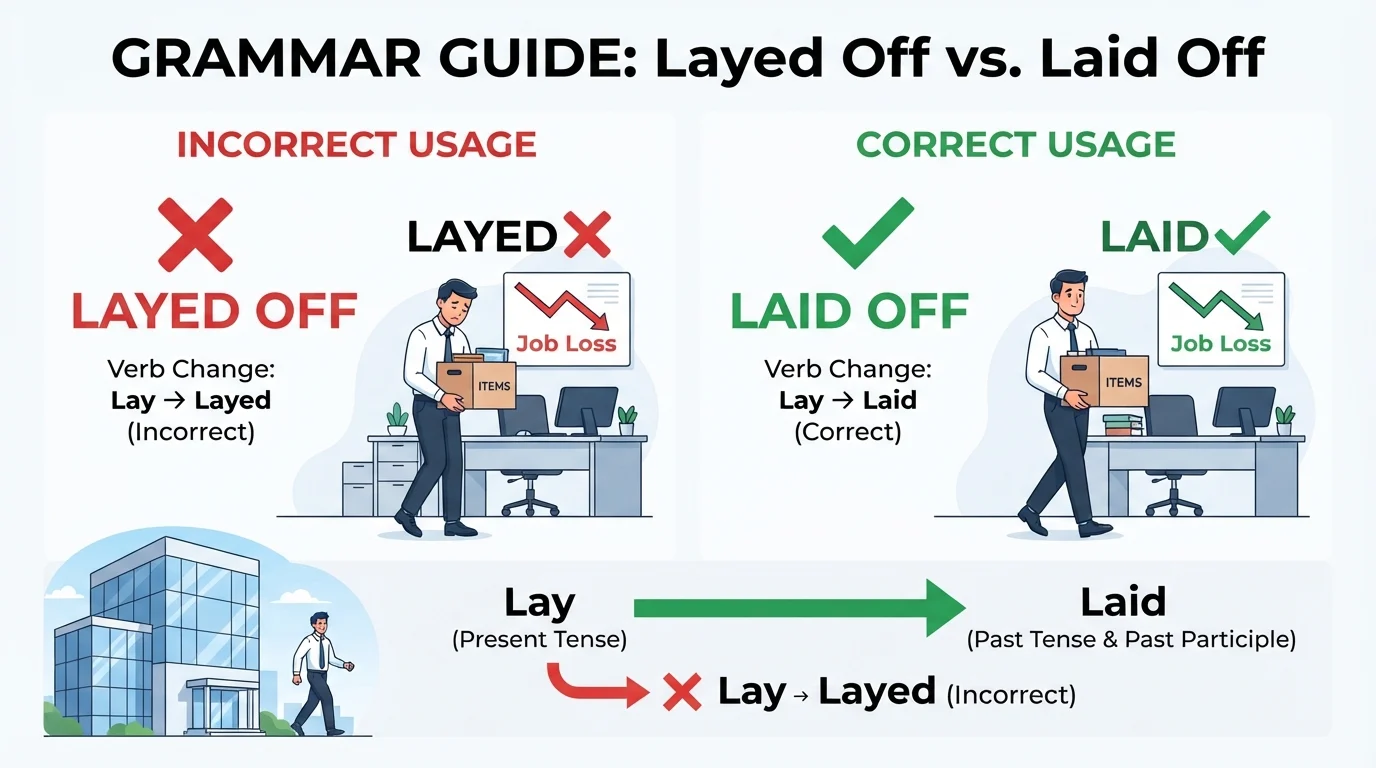
Have you ever wondered whether layed off or laid off is the correct phrase? This is a common question because the verb lay has an irregular past tense, and many people mistakenly add -ed to form layed. As a result, the phrase often appears with the wrong spelling in emails, social media posts, and even online articles.
If you’re searching for layed off vs laid off, this guide will explain the correct phrase, its meaning, practical examples, common mistakes, and simple memory tricks. Whether you’re discussing employment, temporary job loss, or business restructuring, you’ll know exactly which form to use.
Quick Answer
Laid off is the correct phrase.
Layed off is an incorrect spelling and should not be used in standard English.
✅ Correct: The company laid off 50 employees.
❌ Incorrect: The company layed off 50 employees.
If you’re deciding between layed off vs laid off, always use laid off.
What Does Laid Off Mean?
Laid off is the past tense of the phrasal verb lay off. It usually means an employee has lost their job because of business reasons, such as downsizing, restructuring, financial difficulties, or a lack of available work. It does not necessarily mean the employee was fired for poor performance or misconduct.
The phrase can also have other meanings depending on the context, such as stopping an activity or reducing something, but the employment-related meaning is the most common.
Definition
Laid off (phrasal verb): Dismissed from employment because an employer no longer needs the position or cannot continue employing the worker.
Examples of Laid Off
- The company laid off 100 employees during the restructuring.
- She was laid off after the factory closed.
- Many workers were laid off because of budget cuts.
- He was laid off but quickly found another job.
- Several departments were laid off as part of the merger.
Is Layed Off Correct?
No. Layed off is not correct.
The verb lay is irregular, so its past tense is laid, not layed.
Whenever you’re referring to someone who lost their job due to business reasons, always write laid off.
Layed Off vs Laid Off: Comparison Table
| Feature | Layed Off | Laid Off |
|---|---|---|
| Correct English spelling | ❌ No | ✅ Yes |
| Standard business English | ❌ No | ✅ Yes |
| Used in employment context | ❌ No | ✅ Yes |
| Accepted in formal writing | ❌ No | ✅ Yes |
| Past tense of “lay off” | ❌ No | ✅ Yes |
The comparison clearly shows that laid off is the only correct phrase.
Why Do People Write Layed Off?
Several factors contribute to this common mistake:
- Assuming lay follows the regular -ed pattern
- Confusing the verbs lay and lie
- Typing too quickly
- Lack of familiarity with irregular verbs
Since lay is an irregular verb, the correct past tense is laid, making laid off the proper phrase.
Common Uses of Laid Off
Employment
- Hundreds of workers were laid off last month.
- She was laid off because the company reduced staff.
Business News
- The manufacturer laid off employees after declining sales.
- Several companies announced layoffs this year.
Economic Reports
- Thousands of workers were laid off during the recession.
- The industry laid off seasonal employees.
Everyday Conversation
- My neighbor was recently laid off.
- Being laid off can be stressful, but new opportunities often follow.
Laid Off vs Fired
People often confuse these terms, but they have different meanings.
| Term | Meaning |
| Laid Off | Employment ends because of business reasons, such as downsizing or lack of work. |
| Fired | Employment ends because of performance, misconduct, or disciplinary reasons. |
Example
- She was laid off when the company closed its office.
- He was fired for repeatedly violating company policy.
Common Mistakes
Mistake 1: Writing Layed Off
❌ The company layed off several workers.
✅ The company laid off several workers.
Mistake 2: Confusing Lay and Lie
Remember:
- Lay → Laid
- Lie → Lay → Lain
Mistake 3: Assuming All Verbs Add -ed
Incorrect:
❌ Lay → Layed
Correct:
✅ Lay → Laid
Easy Trick to Remember the Correct Spelling
Here’s a simple memory trick:
Think of the common phrase:
“The hen laid eggs.”
Since laid is the past tense of lay, the phrase is also:
Laid off
Never:
Layed off
Another reminder:
- Lay → Laid
- Lay off → Laid off
American vs British English
There is no spelling difference between American and British English.
Both use:
- Laid off
Neither variety accepts layed off.
The meaning remains the same, although employment laws and workplace practices may differ between countries.
Example
Instead of writing:
- She was laid off.
You could also write:
- She lost her job due to company downsizing.
- Her position was eliminated during restructuring.
- She became unemployed after workforce reductions.
Why Correct Spelling Matters
Using laid off instead of layed off helps you:
- Improve grammar accuracy
- Build professional credibility
- Create polished business writing
- Avoid common spelling mistakes
- Improve SEO performance
- Communicate clearly with readers
Correct spelling is especially important in resumes, business reports, HR documents, and employment-related content.
Frequently Asked Questions
Is layed off correct?
No. Layed off is incorrect. The proper phrase is laid off.
Which is correct: layed off or laid off?
Laid off is the correct spelling.
What does laid off mean?
It means someone lost their job because of business reasons, such as downsizing, restructuring, or a lack of work.
Is being laid off the same as being fired?
No. Being laid off usually happens because of business needs, while being fired typically results from performance or conduct issues.
Is laid off used in both American and British English?
Yes. Both American and British English use laid off.
What is the base verb of laid off?
The base phrasal verb is lay off.
Example: The company may lay off additional workers.
What is the noun form?
The noun is layoff.
Example: The company announced several layoffs.
Summary
The difference between layed off vs laid off is simple. Laid off is the correct phrase because laid is the irregular past tense of lay. Layed off is a common spelling mistake and should never be used in standard English. Whether you’re discussing business news, employment, or economic conditions, laid off is always the correct choice.
Using the correct spelling improves your grammar, professionalism, and credibility. Remember that being laid off usually refers to losing a job because of business circumstances rather than employee performance. Mastering this distinction will help you communicate more accurately in both personal and professional writing.
Actionable Takeaway
Before publishing or sending any employment-related content, search for layed off and replace it with laid off if it appears. This simple proofreading step will eliminate a common grammar mistake and ensure your writing follows standard Engli