Have you ever paused while writing and wondered whether you should use “layed out” or “laid out”? You’re not alone. This is one of the most common English grammar mistakes because the verbs lay and lie often confuse both native and non-native English speakers.
The good news is that the answer is simple once you understand how the verb works. In this guide, you’ll learn the correct usage, see plenty of real-life examples, discover common mistakes to avoid, and understand whether American and British English treat these words differently.
Quick Answer
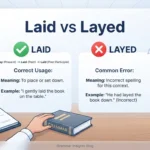
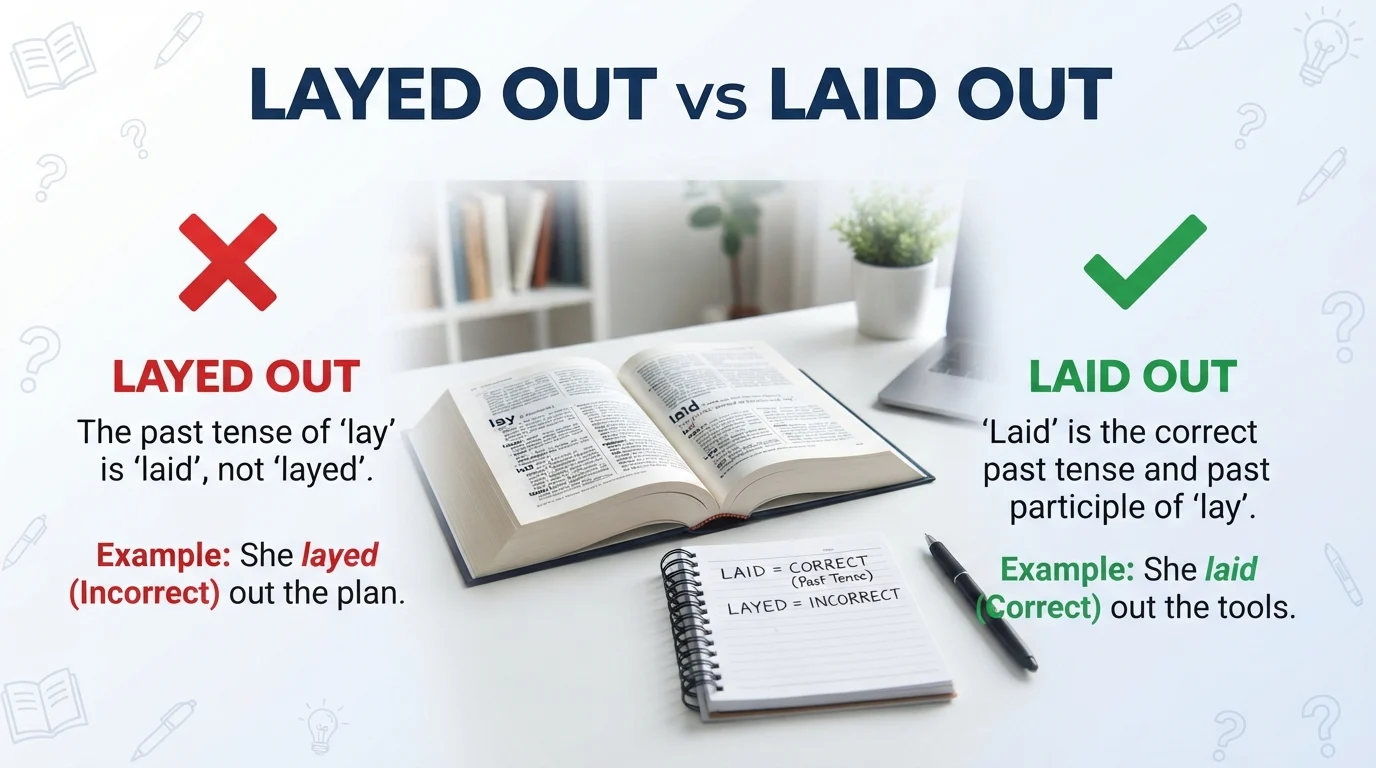
“Laid out” is correct.
“Layed out” is incorrect in standard English grammar.
- ✅ Laid out = Correct past tense and past participle of lay
- ❌ Layed out = Incorrect spelling and should be avoided in formal and informal writing
Example:
- ✅ She laid out the clothes for tomorrow.
- ✅ The architect laid out the building plans carefully.
- ❌ She layed out the clothes.
What Does “Laid Out” Mean?
The phrase “laid out” is the past tense or past participle form of the verb lay out.
Depending on the context, laid out can mean:
- To arrange something neatly
- To explain something clearly
- To spend money
- To design or organize something
- To stretch someone out flat (especially in medical or informal contexts)
Because it has several meanings, it appears frequently in everyday conversations, business writing, education, and professional communication.
Why “Layed Out” Is Incorrect
Many people assume that adding -ed to lay creates the past tense.
That isn’t how this irregular verb works.
The verb forms are:
| Base Form | Past Tense | Past Participle |
|---|---|---|
| Lay | Laid | Laid |
Therefore:
- Lay → Laid
- Lay out → Laid out
There is no accepted English verb form called “layed.”
Examples of “Laid Out” in Sentences
Here are examples showing the correct usage.
Arranging Objects
- She laid out the books on the table.
- The teacher laid out all the supplies before class.
- We laid out the picnic blanket by the lake.
Explaining Information
- The manager laid out the project timeline.
- The lawyer laid out every possible option.
- The professor laid out the research findings clearly.
Spending Money
- They laid out thousands of dollars on renovations.
- We laid out extra money for better equipment.
Designing or Planning
- The city planners laid out the new neighborhood.
- The engineer laid out the blueprint carefully.
Layed Out vs Laid Out
| Feature | Layed Out | Laid Out |
|---|---|---|
| Correct spelling | ❌ No | ✅ Yes |
| Standard English | ❌ Incorrect | ✅ Correct |
| Used in formal writing | ❌ Never | ✅ Yes |
| Accepted in American English | ❌ No | ✅ Yes |
| Accepted in British English | ❌ No | ✅ Yes |
| Dictionary recognized | ❌ No | ✅ Yes |
The comparison is straightforward.
Whenever you’re choosing between layed out vs laid out, always choose laid out.
Understanding the Verb “Lay”
To understand why laid out is correct, it helps to know how lay changes.
| Verb Form | Word |
|---|---|
| Base Verb | Lay |
| Past Tense | Laid |
| Past Participle | Laid |
| Present Participle | Laying |
Examples:
- I lay the documents on the desk every morning.
- Yesterday I laid the documents there.
- I have laid everything out already.
- I am laying the papers out now.
Notice that layed never appears.
Common Mistakes People Make
Many writers accidentally create incorrect verb forms because they expect regular grammar patterns.
Common mistakes include:
- ❌ Layed out the clothes
- ❌ Layed the foundation
- ❌ Layed everything on the table
- ❌ Have layed the plans
Correct versions:
- ✅ Laid out the clothes
- ✅ Laid the foundation
- ✅ Laid everything on the table
- ✅ Have laid the plans
Easy Trick to Remember
Use this simple memory tip:
If the base verb is lay, the past form is always laid.
Think:
- Pay → Paid
- Say → Said
- Lay → Laid
This pattern makes remembering much easier.
Is There Any Difference Between American and British English?
No.
Both American English and British English use laid out as the correct form.
Neither variety accepts layed out as standard English.
Whether you’re writing for readers in the United States, the United Kingdom, Canada, Australia, or other English-speaking countries, laid out remains the correct choice.
When Is “Laid Out” Used?
The phrase appears in many everyday situations.
Organizing Items
- She laid out dinner on the table.
- They laid out the decorations.
Giving Instructions
- The coach laid out the training plan.
- The supervisor laid out the expectations.
Financial Context
- The company laid out a large budget.
- We laid out extra cash for premium materials.
Design and Planning
- The landscape architect laid out the garden.
- They laid out the road network.
Related Grammar Tips
Many learners confuse these similar words.
- Lay vs Lie
- Laying vs Lying
- Laid vs Lain
- Layed vs Laid
- Laying out vs Laying down
- Past tense of lay
- Correct form of lay out
- English irregular verbs
Learning these together helps improve overall grammar accuracy.
Why This Grammar Mistake Happens
English contains many irregular verbs.
Since many regular verbs simply add -ed, writers mistakenly assume:
- Play → Played
- Stay → Stayed
- Lay → Layed
However, lay is irregular.
The correct progression is:
Lay → Laid → Laid
Understanding this rule eliminates the confusion.
Tips to Avoid This Mistake
Keep these simple habits in mind:
- Always remember that laid is the past tense of lay.
- Never write layed in professional or academic writing.
- Proofread documents for this common spelling error.
- Use grammar-checking tools, but also understand the rule yourself.
- Practice writing sentences using laid out until it feels natural.
Frequently Asked Questions
Is “layed out” ever correct?
No. Layed out is not considered correct in standard English grammar.
Why do people write “layed out”?
People often assume lay follows regular verb rules and simply adds -ed, but lay is an irregular verb whose past tense is laid.
Is “laid out” grammatically correct?
Yes. Laid out is the correct past tense and past participle of lay out.
Do American and British English both use “laid out”?
Yes. Both American and British English use laid out and reject layed out.
What is the past tense of “lay out”?
The correct past tense is laid out.
Example:
“We laid out the presentation yesterday.”
Can I use “have laid out”?
Yes.
Examples:
- I have laid out the documents.
- They have laid out the project schedule.
Is “layed” a real English word?
No. Modern standard English dictionaries do not recognize layed as the correct past tense of lay.
Summary
Choosing between layed out vs laid out is easier once you know the grammar rule. Laid out is the only correct form because it comes from the irregular verb lay, whose past tense and past participle are both laid. The spelling layed out is considered a grammatical error and should be avoided in every type of writing.
Whenever you’re arranging items, explaining a plan, designing a layout, or describing money spent, use laid out with confidence. Remember the simple pattern Lay → Laid → Laid, proofread your work, and you’ll avoid one of the most common English grammar mistakes.
Actionable Takeaway
If you’re ever unsure whether to write layed out or laid out, choose laid out every time. Save the rule Lay → Laid → Laid in your memory, practice it in everyday writing, and you’ll improve both your grammar accuracy and writing confidence.