Have you ever wondered whether the correct past tense of pay is “payed” or “paid”? You’re not alone. This is a common spelling mistake because many English verbs form their past tense by adding ed. However, pay is an irregular verb, so its standard past tense is paid.
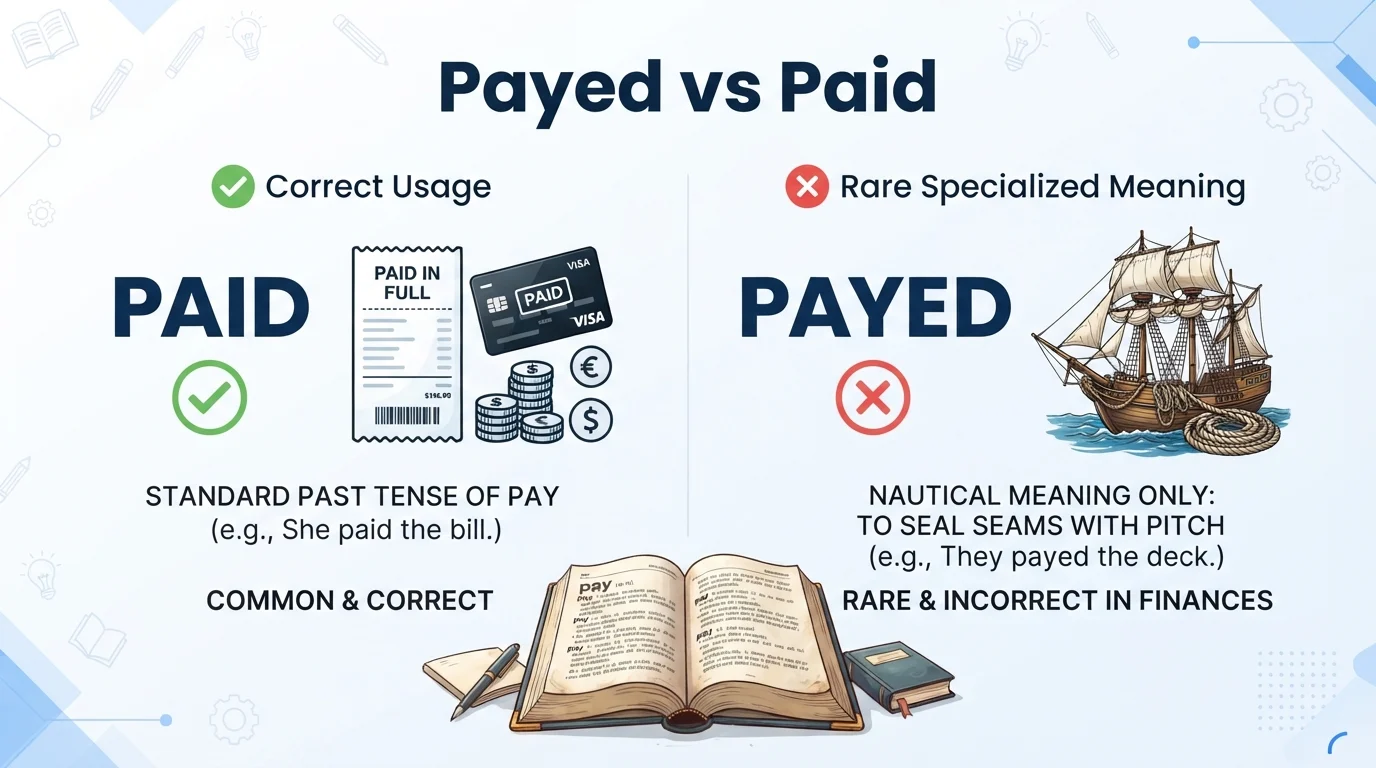
The correct word in almost all everyday situations is paid. Payed is a rare word used mainly in specific nautical contexts, such as sealing the deck of a ship with tar or letting out a rope.
In this guide, you’ll learn the difference between payed vs paid, see clear examples, understand common mistakes, and discover an easy way to remember the correct form.
Quick Answer
- ✅ Paid = The past tense and past participle of pay in normal financial and everyday contexts.
- ⚠️ Payed = A rare nautical term used in specialized contexts.
Examples:
- I paid the bill yesterday.
- She paid for the groceries.
- The company paid its employees on Friday.
- The sailors payed out the rope. (specialized nautical usage)
What Does “Paid” Mean?
Paid is the past tense and past participle of the verb pay.
It is used when talking about:
- money
- bills
- salaries
- debts
- purchases
- fees
- attention
- compliments
- visits
Examples:
- I paid the rent yesterday.
- He paid for dinner.
- She paid her credit card bill.
- The company paid its employees.
- We paid close attention.
What Does “Payed” Mean?
Payed is a rare and specialized word. It is mainly used in nautical language.
It can mean:
- to let out or release a rope
- to seal or coat a ship’s deck or seams with tar or other material
Examples:
- The sailors payed out the rope.
- The crew payed the seams of the ship.
For everyday writing, however, paid is almost always the correct choice.
Payed vs Paid
| Word | Meaning | Common Usage | Example |
|---|---|---|---|
| Paid | Past tense of pay | Money and everyday situations | I paid the bill. |
| Payed | Specialized nautical term | Rare technical usage | They payed out the rope. |
The key difference is:
Paid = normal past tense of pay
Payed = rare nautical term
How to Use “Paid” Correctly
Paying Money
- I paid the bill.
- She paid for the meal.
- They paid the rent.
Receiving Money
- He was paid on Friday.
- The workers were paid fairly.
- She paid the employees.
Paying Attention
- Please pay attention. (present)
- He paid attention during the meeting. (past)
Paying a Visit
- We paid our grandparents a visit.
- She paid a visit to the museum.
Paying a Price
- The company paid a high price for the mistake.
- He paid the price for his actions.
Common Mistakes
The most common mistake is adding ed to pay.
Incorrect:
- ❌ I payed the bill.
- ❌ She payed for the food.
- ❌ He payed his rent.
Correct:
- ✅ I paid the bill.
- ✅ She paid for the food.
- ✅ He paid his rent.
Remember that pay is an irregular verb:
- Present: pay
- Past: paid
- Past participle: paid
Easy Trick to Remember
Use this simple rule:
Money is paid.
If you’re talking about a bill, salary, purchase, debt, fee, or payment, use paid.
Examples:
- paid the bill
- paid the rent
- paid the fee
- paid for lunch
- paid the employee
You can remember:
Pay → Paid → Paid
American vs British English
There is no meaningful difference between American and British English in everyday use.
Both varieties use:
- pay = present tense
- paid = past tense
- paid = past participle
The word payed remains a rare technical term, especially in nautical contexts, in both varieties of English.
Related Words
Words related to paid include:
- payment
- paycheck
- salary
- wages
- bill
- fee
- debt
- cost
- price
- expense
- purchase
Common phrases include:
- get paid
- paid in full
- paid off
- paid back
- paid for
- paid attention
Examples:
- The loan has been paid off.
- She paid back the money.
- The bill was paid in full.
Tips to Avoid This Mistake
Follow these simple strategies:
- Use paid for almost all everyday meanings of pay.
- Remember: pay → paid → paid.
- Use payed only in rare nautical or technical contexts.
- Think: Money is paid.
- Proofread words such as payed the bill and replace them with paid the bill.
Frequently Asked Questions
Which is correct: payed or paid?
Paid is correct in almost all everyday situations. Payed is a rare nautical term.
Is “payed” a real word?
Yes, but it is uncommon. It is mainly used in specialized nautical contexts involving ropes or sealing a ship.
Is “I payed the bill” correct?
No. The correct sentence is: I paid the bill.
What is the past tense of pay?
The past tense of pay is paid.
What is the past participle of pay?
The past participle is also paid.
Example:
- She has paid the bill.
Is “paid” used in American and British English?
Yes. Paid is the standard past tense in both American and British English.
How can I remember paid vs payed?
Remember: Money is paid. For normal financial and everyday situations, always use paid.
Summary
When comparing payed vs paid, the correct word for almost all everyday situations is paid. It is the past tense and past participle of pay, and it is used for money, bills, salaries, fees, purchases, debts, attention, and many other common expressions.
Payed is a rare specialized word mainly found in nautical language. To avoid mistakes, remember the simple verb form: pay → paid → paid. Whenever you’re talking about a payment, use paid.
Actionable Takeaway
Before using payed or paid, ask yourself if you are talking about an ordinary payment. If you are, choose paid: “I paid the bill.”