Have you ever wondered if to use discrete or discreet? These two words are commonly confused because they look and sound very similar. However, they have completely different meanings. Using the wrong one can change the meaning of your sentence.
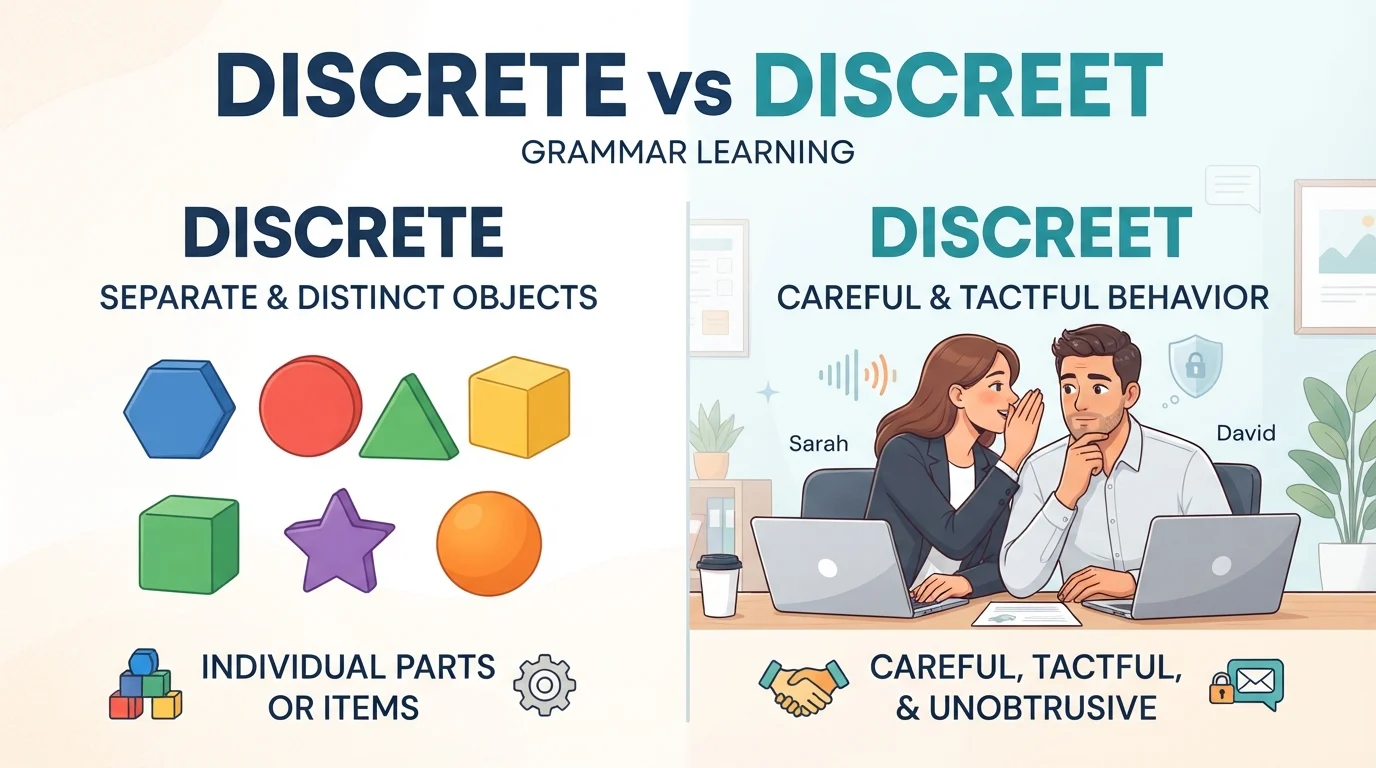
The easiest way to remember the difference is this: discrete means separate or distinct, while discreet means careful, tactful, or private. Once you connect each word with its meaning, the difference between discrete vs discreet becomes much easier to remember.
Quick Answer: Discrete vs Discreet
Discrete means separate, distinct, or individual.
- The company has three discrete departments.
Discreet means careful, tactful, or intentionally private.
- Please be discreet about the situation.
Easy memory trick
Discrete = distinct.
Both words begin with dis and relate to separation or difference.
Discreet = secret.
The word discreet contains the same “-creet” sound as secret in this memory trick, helping you remember that it can relate to privacy and confidentiality.
What Does “Discrete” Mean?
Discrete is an adjective that means separate, distinct, or individually identifiable.
When things are discrete, they are separate from one another rather than forming one continuous whole.
Examples of “discrete”
- The report is divided into five discrete sections.
- The machine has several discrete components.
- The study examined three discrete groups.
- These are discrete events, not parts of one continuous process.
- The data was divided into discrete categories.
In each example, the things being described are separate or distinct.
Simple example
Imagine three separate boxes:
📦 📦 📦
They are individual units. They are discrete.
What Does “Discreet” Mean?
Discreet is an adjective that means careful, tactful, subtle, or respectful of privacy.
A discreet person knows how to avoid attracting unnecessary attention or revealing confidential information.
Examples of “discreet”
- She was discreet about her friend’s personal problems.
- The hotel provided a discreet service.
- Please be discreet when discussing the matter.
- He made a discreet inquiry.
- The security team kept a discreet watch over the building.
In these examples, discreet relates to privacy, good judgement, or avoiding unwanted attention.
Discrete vs Discreet: The Main Difference
| Word | Meaning | Example |
|---|---|---|
| Discrete | Separate, distinct, or individual | The project has three discrete stages. |
| Discreet | Careful, tactful, or private | She was discreet about the information. |
The simplest rule
Use discrete for things that are separate.
Use discreet for people or actions that are careful and private.
Discrete Examples in Sentences
Here are more examples of discrete used correctly:
- The survey contained several discrete questions.
- The system is made up of multiple discrete units.
- The scientist studied each variable as a discrete category.
- The project was divided into four discrete phases.
- The two issues should be treated as discrete problems.
Discrete in mathematics and science
Discrete is also an important technical term.
In mathematics, discrete objects are separate and countable rather than continuous.
For example:
- The number of students in a class is a discrete value.
- Whole numbers are often studied in discrete mathematics.
This is different from something continuous, such as temperature or distance, which can change gradually.
Discreet Examples in Sentences
Here are more examples of discreet:
- The assistant gave him a discreet signal.
- She asked a discreet question.
- The detective conducted a discreet investigation.
- He was discreet about his business plans.
- The staff handled the sensitive situation in a discreet manner.
In all these examples, the idea is caution, privacy, tact, or subtlety.
Common Mistakes With Discrete and Discreet
Mistake 1: Using “discreet” to mean separate
❌ The experiment consisted of three discreet stages.
✅ The experiment consisted of three discrete stages.
The stages are separate, so discrete is correct.
Mistake 2: Using “discrete” to mean private
❌ Please be discrete about my personal information.
✅ Please be discreet about my personal information.
The sentence asks someone to be careful and private, so discreet is correct.
Mistake 3: Confusing discreet behaviour with discrete objects
❌ He tried to be discrete while discussing the confidential matter.
✅ He tried to be discreet while discussing the confidential matter.
A person’s behaviour can be tactful or private, so use discreet.
A Simple Memory Trick for Discrete vs Discreet
Remember:
Discrete = separate
Think:
Discrete → distinct
Both words begin with dis and relate to things being separate or different.
Discreet = careful
Think:
Discreet → secret
This is not a direct spelling rule, but it is a useful memory aid. If you need to keep information private or avoid drawing attention, choose discreet.
Quick phrase to remember
Discrete things are separate. Discreet people are careful.
Discrete vs Discreet: Common Collocations
Learning common word combinations can make the difference easier to remember.
Common phrases with “discrete”
- Discrete categories
- Discrete units
- Discrete groups
- Discrete stages
- Discrete events
- Discrete components
- Discrete variables
- Discrete data
- Discrete mathematics
Common phrases with “discreet”
- Discreet inquiry
- Discreet conversation
- Discreet service
- Discreet investigation
- Discreet manner
- Discreet approach
- Discreet signal
- Discreet behaviour
- Discreet observation
Discrete vs Discreet in American and British English
The meanings and spellings of discrete and discreet are the same in American English and British English.
However, British English commonly uses the spelling behaviour, while American English generally uses behavior. This spelling difference does not affect the distinction between discrete and discreet.
The key rule remains the same in both varieties:
- Discrete = separate or distinct
- Discreet = careful, tactful, or private
Discrete vs Discreet Pronunciation
These words are pronounced differently, although they can sound very similar.
Discrete
Usually pronounced like:
dis-KREET
Discreet
Usually pronounced like:
dis-KREET
In many accents, they are pronounced almost identically or even exactly the same. This is why spelling and context are especially important.
When you are writing, focus on the meaning rather than the sound.
Quick Practice: Discrete or Discreet?
Choose the correct word:
- Please be ______ about the confidential information.
- The data was divided into five ______ groups.
- The manager made a ______ inquiry.
- The machine contains several ______ components.
- The investigator worked in a ______ manner.
Answers
- discreet
- discrete
- discreet
- discrete
- discreet
Why Are Discrete and Discreet So Commonly Confused?
The main reason is that the two words are pronounced very similarly. They also share most of the same letters, making spelling mistakes common.
Their meanings are completely different, however:
- Discrete describes things that are separate.
- Discreet describes behaviour that is careful or private.
The best way to avoid confusion is to connect each word with a simple synonym:
Discrete = distinct.
Discreet = tactful.
What is the difference between discrete and discreet?
Discrete means separate, distinct, or individual. Discreet means careful, tactful, subtle, or private.
Is it “discrete parts” or “discreet parts”?
The correct phrase is discrete parts when you mean separate or individual parts.
Is it “be discrete” or “be discreet”?
If you mean “be careful or private,” the correct phrase is be discreet.
What is an example of discrete?
The machine is made up of several discrete components. Here, discrete means separate and distinct.
What is an example of discreet?
She was discreet about the confidential conversation. Here, discreet means careful and private.
Are discrete and discreet pronounced the same?
They are often pronounced the same or very similarly, depending on the speaker’s accent.
Is discreet a synonym for secretive?
Sometimes, but not always. Discreet usually suggests being tactful and careful about privacy, while secretive can suggest deliberately hiding information.
Do American and British English use discrete and discreet differently?
No. The basic meanings and spellings are the same in both American and British English.
Final Summary: Discrete vs Discreet
The difference between discrete vs discreet is simple once you focus on meaning. Discrete means separate, distinct, or individually identifiable. You might talk about discrete categories, discrete units, or discrete stages.
Discreet means careful, tactful, subtle, or private. You might be discreet about confidential information, make a discreet inquiry, or handle a sensitive situation in a discreet manner.
Actionable Takeaway
Remember this simple rule: Discrete = distinct and separate. Discreet = tactful and private. If you can replace the word with separate, choose discrete. If you can replace it with careful or private, choose discreet.