Have you ever wondered if the correct phrase is passed away or past away? This is a common English spelling mistake because passed and past sound very similar in many accents. However, only one of these phrases is correct when referring to someone’s death.
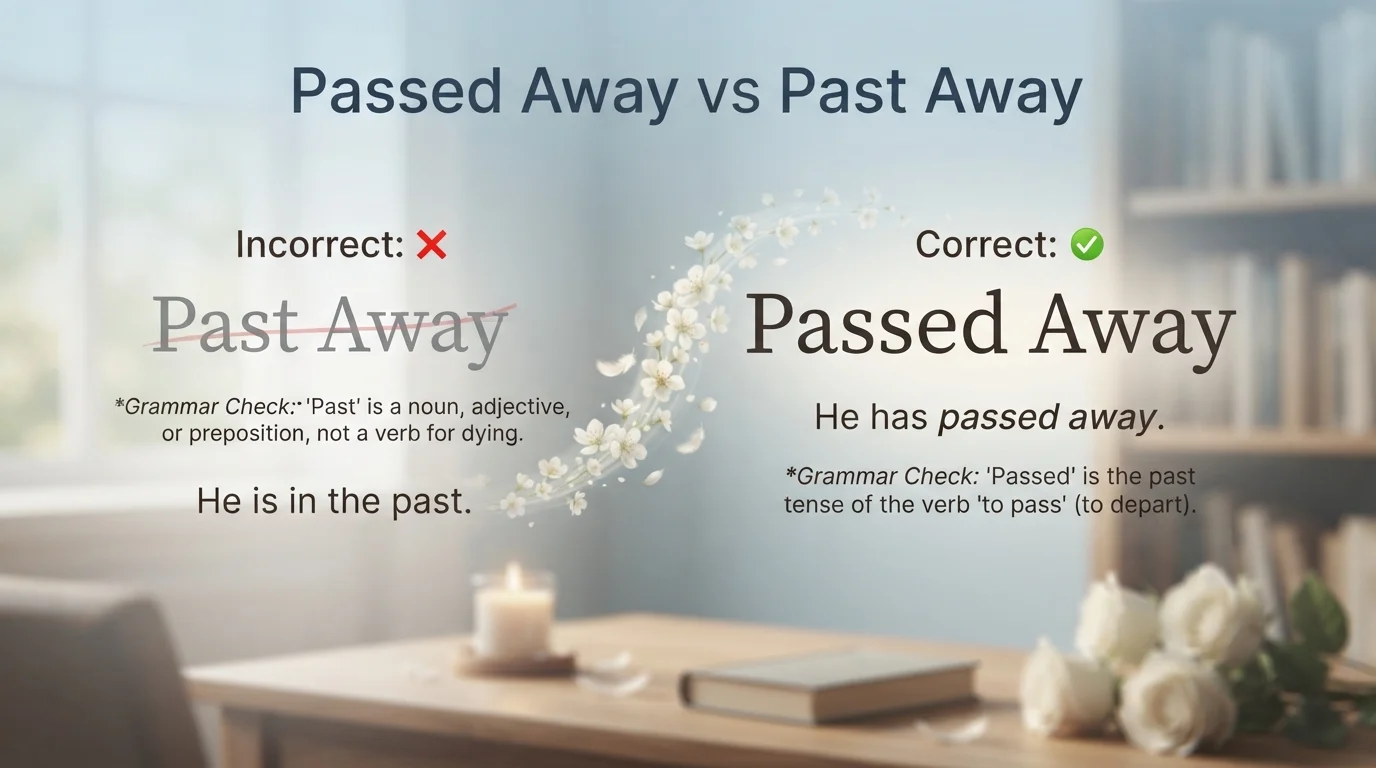
The correct expression is passed away. It is a gentle and respectful way to say that someone has died. Past away is incorrect in standard English when used with this meaning.
Understanding the difference between these two words can help you avoid a common grammar and spelling mistake.
Quick Answer: Passed Away vs Past Away
Passed away is the correct phrase.
It is a polite or softer way to say that someone has died.
Example:
- Sadly, her grandfather passed away last year.
❌ Past away is incorrect when referring to death.
Easy memory trick
Passed away = someone passed from life away.
Or simply remember:
People pass away; time passes.
What Does “Passed Away” Mean?
Passed away is a euphemism for died.
A euphemism is a softer or more indirect way of expressing something that may be difficult, painful, or sensitive.
For example:
- Her father passed away peacefully.
- My neighbour passed away last month.
- We were saddened to hear that he had passed away.
- She passed away after a long illness.
The phrase is often used in conversations, obituaries, sympathy messages, and formal announcements.
What Does “Past Away” Mean?
Past away is not the standard English phrase used to mean that someone has died.
For example:
❌ My uncle past away last year.
✅ My uncle passed away last year.
The confusion happens because past and passed are often pronounced similarly.
However, past usually relates to earlier time or movement beyond something, while passed is the past tense of the verb pass.
Passed vs Past: The Basic Difference
| Word | Meaning | Example |
|---|---|---|
| Passed | Past tense of “pass” | She passed away peacefully. |
| Past | Earlier time or beyond a point | We walked past the house. |
In passed away, the word passed comes from the verb pass.
The phrase passed away has developed a figurative meaning: a person has gone from life.
Why Is “Passed Away” Correct?
The phrase comes from the idea of someone passing from one state or condition to another.
In modern English, passed away is widely understood as a respectful expression meaning died.
The word passed is needed because it is the past tense of pass:
- Present: He passes away.
- Past: He passed away.
The phrase is not spelled past away.
Examples of “Passed Away” in Sentences
Here are some natural examples:
- Her grandmother passed away peacefully.
- His father passed away several years ago.
- We were very sorry to hear that your mother passed away.
- The actor passed away at the age of 82.
- She passed away surrounded by her family.
- My beloved pet passed away last winter.
The phrase can be used in both personal and formal communication.
Common Mistakes With Passed Away and Past Away
Mistake 1: Writing “past away”
❌ He past away last year.
✅ He passed away last year.
The correct phrase is passed away.
Mistake 2: Confusing “passed away” with “past”
❌ We are sorry to hear that your father past away.
✅ We are sorry to hear that your father passed away.
Remember that passed is the verb form needed in this expression.
Mistake 3: Writing “has past away”
❌ She has past away.
✅ She has passed away.
After has, use the past participle passed.
Passed Away vs Died
Both expressions are correct, but they have different tones.
Died
Died is direct and straightforward.
- The patient died peacefully.
Passed away
Passed away is softer and more sensitive.
- The patient passed away peacefully.
The phrase passed away is often preferred when speaking to someone who is grieving or when writing a sympathy message.
Other gentle alternatives include:
- Passed on
- Lost their life
- Left us
- Is no longer with us
The appropriate choice depends on the situation and the tone you want to use.
Passed Away in American and British English
Passed away is standard in both American English and British English.
The meaning is the same in both varieties: to die.
The spelling is also the same:
- Passed away ✅
- Past away ❌
Pronunciation can vary slightly by accent, but passed and past often sound very similar, which explains the common confusion.
A Simple Memory Trick
Remember this sentence:
People pass away, but they do not past away.
You can also connect passed away with the verb pass:
- Pass → passed
- Passed away → died
If you are talking about someone’s death, always use passed away.
Quick Practice: Passed Away or Past Away?
Choose the correct phrase:
- Her grandfather ______ peacefully.
- We were sad to hear that he had ______.
- My neighbour ______ last month.
- She ______ after a long illness.
Answers
- passed away
- passed away
- passed away
- passed away
Why Are “Passed Away” and “Past Away” So Commonly Confused?
The main reason is pronunciation. In many accents, past and passed sound the same or almost the same.
People may also confuse the words because past relates to something that has already happened, while passed away describes a death that has already happened.
However, the grammar is different:
- Passed = a verb form
- Past = usually a noun, adjective, preposition, or adverb
When referring to death, the correct expression is always passed away.
Is “past away” correct?
No. Past away is not the standard English expression for referring to someone’s death.
Is “passed away” the correct phrase?
Yes. Passed away is the correct and commonly used phrase meaning died.
What does “passed away” mean?
Passed away is a polite or gentle way of saying that someone has died.
Is “passed away” more polite than “died”?
Often, yes. Passed away is generally considered softer and more sensitive than died, especially in condolences and conversations about someone’s death.
Can I say “has passed away”?
Yes.
Example: Her grandfather has passed away.
Is “passed away” used in American and British English?
Yes. The phrase is standard in both American and British English.
What is the difference between “past” and “passed”?
Past usually refers to earlier time or something beyond a point. Passed is the past tense of pass.
How do you remember “passed away”?
Remember: Passed away = died. The word is passed with -ed, not past.
Final Summary: Passed Away vs Past Away
The correct phrase is passed away, not past away, when referring to someone’s death. Passed away is a gentle and respectful expression that means died. For example: “Her grandmother passed away peacefully.”
The confusion comes from the fact that past and passed sound very similar in many English accents. However, the correct spelling is easy to remember: people pass away. Whenever you are talking about death, use passed away.
Actionable Takeaway
Use passed away when you mean died. Never write past away in standard English for this meaning.