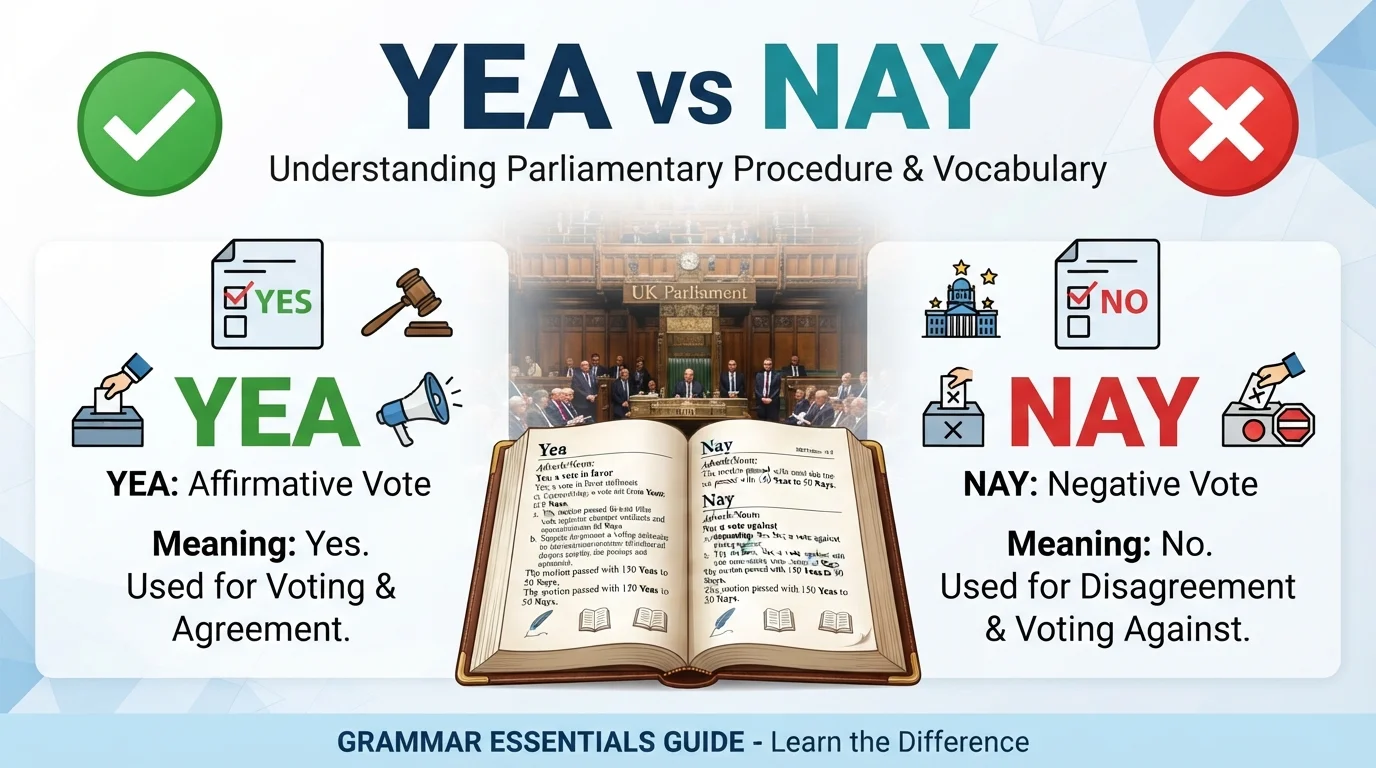
Have you ever wondered about the difference between “yea” and “nay”? These two words are often used in formal voting, parliamentary debates, historical writing, and old-fashioned English. Although yea generally means yes and nay generally means no, their usage can be more specific depending on the context.
Understanding yea vs nay is especially useful when reading about elections, legislative votes, official decisions, and traditional expressions. In this guide, you’ll learn the meaning of each word, see clear examples, understand the difference between yea, yeah, yes, nay, and no, and learn how to use these terms correctly.
Quick Answer
- Yea = Yes or a vote in favor.
- Nay = No or a vote against.
Examples:
- The motion passed with 80 yeas and 20 nays.
- The final vote was yea.
- The committee voted nay.
What Does “Yea” Mean?
Yea is an old-fashioned or formal word meaning yes or in favor of something.
It is commonly used in:
- formal voting
- parliamentary language
- historical writing
- religious or literary language
Examples:
- The motion received 50 yeas and 10 nays.
- The senator voted yea.
- The members were asked to vote yea or nay.
“Yea” in Formal Voting
In a voting context, yea means a vote in favor.
Example:
The proposal passed with 75 yeas and 25 nays.
This means 75 people voted yes, while 25 voted no.
What Does “Nay” Mean?
Nay means no or a vote against something.
Examples:
- The proposal received 30 yeas and 40 nays.
- The senator voted nay.
- The motion was rejected by a majority of nays.
Nay can also have an old-fashioned meaning similar to “indeed” or “more than that.”
Example:
- He was not merely successful, nay, he became one of the best in his field.
This use is literary and uncommon in everyday conversation.
Yea vs Nay
| Word | Meaning | Common Use | Example |
|---|---|---|---|
| Yea | Yes or in favor | Formal voting | She voted yea. |
| Nay | No or against | Formal voting | He voted nay. |
The basic difference is:
Yea = Yes
Nay = No
Yea vs Yeah
These two words are often confused because they sound similar.
Yea
Yea means yes and is mainly used in formal or traditional contexts.
- The vote was yea.
- The members voted yea or nay.
Yeah
Yeah is an informal way to say yes.
- Yeah, I’ll come with you.
- Yeah, that sounds good.
Yes
Yes is the standard word used in normal formal and informal English.
| Word | Meaning | Style |
|---|---|---|
| Yea | Yes or a favorable vote | Formal, traditional |
| Yeah | Yes | Informal |
| Yes | Yes | Standard |
Common Mistakes
Using “Yea” in Everyday Conversation
Although yea means yes, it can sound formal, old-fashioned, or unusual in everyday speech.
Unusual in casual conversation:
- Yea, I want some pizza.
More natural:
- Yeah, I want some pizza.
- Yes, I want some pizza.
Confusing “Yea” with “Yeah”
Incorrect for a casual conversation:
- ❌ Yea, I’ll call you later.
Better:
- ✅ Yeah, I’ll call you later.
However, in a formal voting context:
- ✅ The member voted yea.
“Yea or Nay” Meaning
The expression “yea or nay” means yes or no.
Examples:
- The members were asked to vote yea or nay.
- Give me a yea or nay on the proposal.
- The decision requires a simple yea or nay.
This expression is often used in formal, humorous, or old-fashioned language.
“Yea” as a Number
In some voting systems, especially parliamentary contexts, yea can refer to a vote in favor.
The plural is usually:
- yeas
- nays
Example:
- The bill passed with 220 yeas and 180 nays.
“Nay” as an Old Fashioned Word
In older English, nay could mean more than simply no.
It could also mean:
- indeed
- rather
- on the contrary
- more accurately
Example:
He was not just talented; nay, he was extraordinary.
This use is uncommon in modern everyday English but may appear in literature or historical writing.
American vs British English
The words yea and nay are understood in both American and British English.
However, they are most commonly associated with:
- formal voting
- legislative procedures
- traditional expressions
- historical language
In everyday American and British conversation, people generally use yes, no, yeah, or nope instead.
Easy Trick to Remember
Remember the simple pair:
Yea = Yes
Nay = No
You can also remember:
- yea = vote in favor
- nay = vote against
The phrase “yea or nay” is a useful memory aid because the two words are opposites.
Related Words and Expressions
Words related to yea:
- yes
- approval
- agreement
- affirmative
- in favor
Words related to nay:
- no
- rejection
- opposition
- negative
- against
Related expressions include:
- yea or nay
- yeas and nays
- vote yea
- vote nay
- yes or no
Tips to Avoid This Mistake
Follow these simple strategies:
- Use yea for a formal “yes” or a favorable vote.
- Use nay for a formal “no” or a vote against something.
- Use yeah in casual conversation.
- Use yes in standard everyday and formal English.
- Remember: yea = yes; nay = no.
Frequently Asked Questions
What is the difference between yea and nay?
Yea means yes or a vote in favor, while nay means no or a vote against.
Is yea the same as yeah?
No. Yea is a formal or traditional word meaning yes, while yeah is an informal way to say yes.
Is “yea or nay” correct?
Yes. Yea or nay is a traditional expression meaning yes or no.
What does “yea” mean in voting?
In voting, yea means a vote in favor of a proposal, motion, or bill.
What does “nay” mean in voting?
In voting, nay means a vote against a proposal, motion, or bill.
Is “yea” commonly used in everyday conversation?
No. It is mainly used in formal, historical, literary, or voting contexts.
What is the plural of yea and nay?
The plural forms are yeas and nays.
Example: The bill passed with 60 yeas and 40 nays.
Summary
When comparing yea vs nay, the difference is simple: yea means yes or in favor, while nay means no or against. These words are most commonly used in formal voting, parliamentary discussions, historical writing, and traditional expressions such as “yea or nay.”
Do not confuse yea with yeah. Yea is formal or old-fashioned, while yeah is an informal way to say yes. For everyday communication, yes and no are usually the best choices. Remember the simple rule: yea = yes; nay = no.
Actionable Takeaway
Use yea when you mean yes or in favor in a formal or voting context, and use nay when you mean no or against. For casual conversation, choose yeah or yes instead of yea.