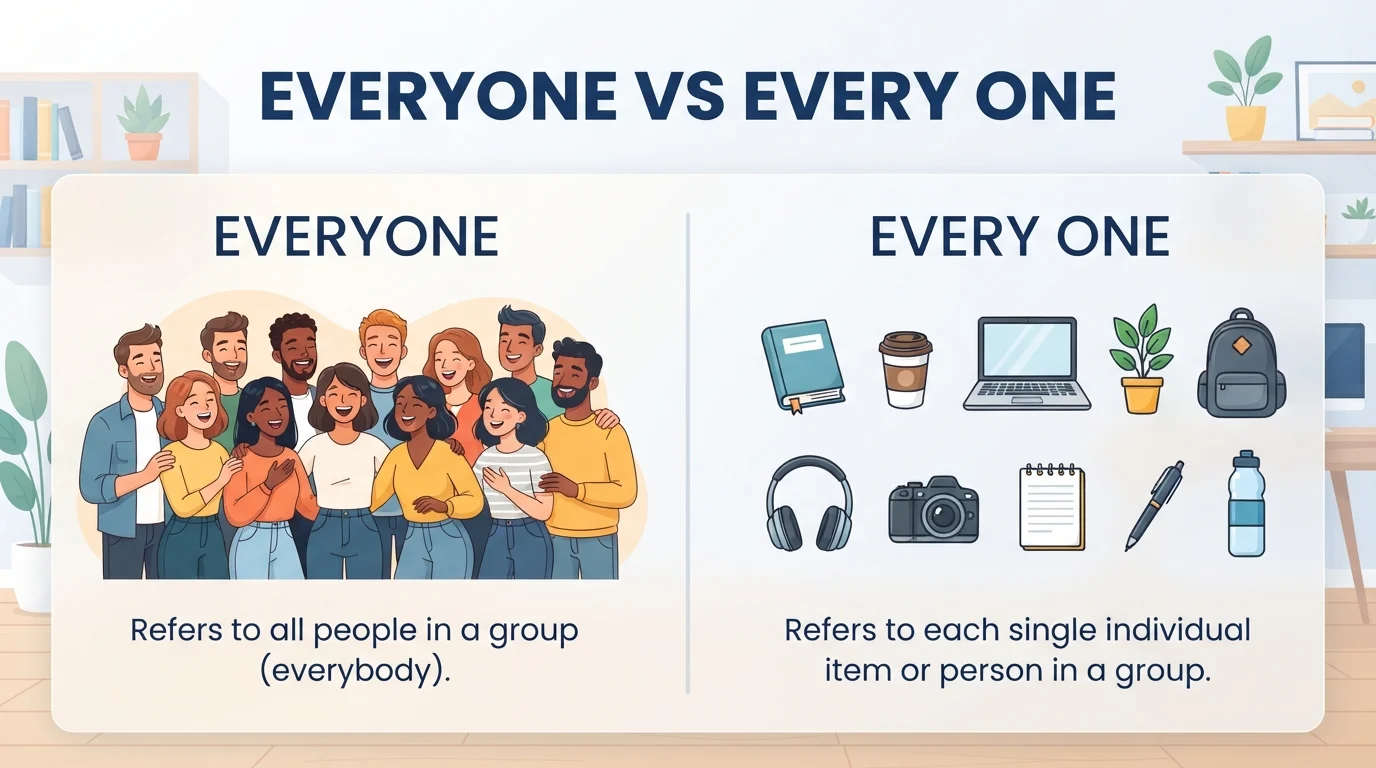
Have you ever wondered if to write everyone or every one? These two expressions look almost identical, but they are used differently. The difference can be small in appearance yet important in meaning.
The simplest rule is this: everyone means all people, while every one means each individual person or thing. Once you understand this distinction, choosing between everyone vs every one becomes much easier.
Quick Answer: Everyone vs Every One
Everyone is a pronoun meaning all people or everybody.
- Everyone enjoyed the party.
Every one means each individual person or thing.
- Every one of the books was carefully checked.
Easy memory trick
Everyone = everybody.
Every one = each one.
If you can replace the phrase with everybody, use everyone.
If you mean each individual one, use every one.
What Does “Everyone” Mean?
Everyone is an indefinite pronoun. It means all people in a group or every person.
Examples:
- Everyone is welcome.
- Everyone enjoyed the concert.
- Everyone needs a little encouragement sometimes.
- Everyone in the class completed the assignment.
- Everyone was excited about the news.
In each sentence, everyone refers to people as a group.
Everyone means “everybody”
You can usually replace everyone with everybody without changing the meaning.
For example:
Everyone is ready.
means:
Everybody is ready.
This is a useful test when you are unsure which form to use.
What Does “Every One” Mean?
Every one is made up of two separate words: every and one.
It means each individual person or thing in a group.
Examples:
- Every one of the students passed the test.
- I read every one of the articles.
- Every one of these paintings is unique.
- She checked every one of the documents.
- We examined every one of the options.
The phrase often appears before of:
- Every one of the books
- Every one of the students
- Every one of the questions
- Every one of the items
Everyone vs Every One: The Main Difference
| Expression | Meaning | Example |
|---|---|---|
| Everyone | All people or everybody | Everyone was invited. |
| Every one | Each individual person or thing | Every one of the guests was invited. |
Compare these examples
Everyone enjoyed the meal.
This means all the people enjoyed the meal.
Every one of the dishes was delicious.
This means each individual dish was delicious.
The first sentence refers to people as a group. The second focuses on individual items.
Everyone vs Every One Examples
Examples with “everyone”
- Everyone deserves respect.
- Everyone in the office received an email.
- Everyone was asked to remain calm.
- Everyone knows that practice is important.
- Everyone seemed happy with the decision.
Examples with “every one”
- Every one of the students received a certificate.
- I checked every one of the answers.
- Every one of these houses has a garden.
- She remembered every one of her childhood friends.
- We tested every one of the machines.
Common Mistakes With Everyone and Every One
Mistake 1: Using “every one” when you mean all people
❌ Every one is welcome to join us.
✅ Everyone is welcome to join us.
Here, the sentence means all people, so everyone is correct.
Mistake 2: Using “everyone” before “of”
❌ Everyone of the students completed the test.
✅ Every one of the students completed the test.
When the phrase is followed by of + a specific group, every one is usually correct.
Mistake 3: Confusing people and things
❌ I inspected everyone of the products.
✅ I inspected every one of the products.
Everyone refers to people. Every one can refer to individual people or things.
A Simple Memory Trick for Everyone vs Every One
Remember these two replacements:
Everyone = everybody
- Everyone is invited.
- Everybody is invited.
Both sentences mean the same thing.
Every one = each one
- Every one of the apples was fresh.
- Each one of the apples was fresh.
If each one makes sense, use every one.
The easiest rule
Everyone means all people. Every one means each individual one.
Everyone vs Every One in Formal Writing
Both forms are correct, but choosing the right one depends on meaning.
Use everyone when referring generally to all people:
- Everyone should follow the rules.
Use every one when emphasizing each individual member or item:
- Every one of the participants received feedback.
In formal writing, this distinction can be especially important because it makes your meaning more precise.
Everyone vs Every One and Subject-Verb Agreement
Everyone is grammatically singular, even though it refers to many people.
Therefore, use a singular verb:
- Everyone is ready.
- Everyone has received the message.
- Everyone was invited.
Not:
❌ Everyone are ready.
❌ Everyone have received the message.
The same applies to every one when it is used as the subject:
- Every one of the students is prepared.
- Every one of the machines has been tested.
Everyone vs Every One in American and British English
The basic difference between everyone and every one is the same in American English and British English.
Both varieties use:
- Everyone = all people or everybody
- Every one = each individual person or thing
The spelling and grammar rules are the same.
Quick Practice: Everyone or Every One?
Choose the correct expression:
- ______ is invited to the meeting.
- I checked ______ of the answers.
- ______ in the room was listening.
- ______ of the books was carefully wrapped.
- ______ deserves a second chance.
Answers
- Everyone
- every one
- Everyone
- every one
- Everyone
Why Are Everyone and Every One So Commonly Confused?
The confusion happens because the two expressions sound exactly the same in normal speech. The only difference is the space between the words.
The meanings are also closely related because both expressions refer to all members of a group. The key difference is whether you are talking about people collectively or focusing on each individual person or thing.
When in doubt, try the replacement test:
- Everybody → everyone
- Each one → every one
Is “everyone” one word?
Yes. Everyone is one word and means everybody or all people.
Is “every one” two words?
Yes. Every one is two words and means each individual person or thing.
What is the difference between everyone and every one?
Everyone means all people. Every one means each individual person or thing.
Is it “everyone of them” or “every one of them”?
The correct phrase is every one of them.
Example: Every one of them agreed.
Is “everyone is” or “everyone are” correct?
Everyone is is correct because everyone is grammatically singular.
Example: Everyone is ready.
Can “every one” refer to things?
Yes. For example: Every one of the books was useful.
Can “everyone” refer to things?
No. Everyone refers to people. For individual things, use every one.
Do American and British English use everyone and every one differently?
No. The basic grammar and spelling rules are the same in both varieties of English.
Final Summary: Everyone vs Every One
The difference between everyone vs every one is simple once you focus on meaning. Everyone is one word and means everybody or all people.
For example, “Everyone enjoyed the event.” Every one is two words and means each individual person or thing, as in “Every one of the books was carefully reviewed.”
The easiest way to remember the difference is to use the replacement test. If you can replace the word with everybody, choose everyone.
If you can replace it with each one, choose every one. Also remember that everyone is grammatically singular: Everyone is, not everyone are.
Actionable Takeaway
Remember: Everyone = everybody; every one = each one. If the phrase is followed by of + a specific group, such as “every one of the students,” the two-word form is usually correct.