It’s easy to confuse “to bad” and “too bad” because they look similar and are often pronounced quickly in conversation. However, only one of these is grammatically correct in most situations. If you’ve ever wondered which phrase to use, you’re not alone.
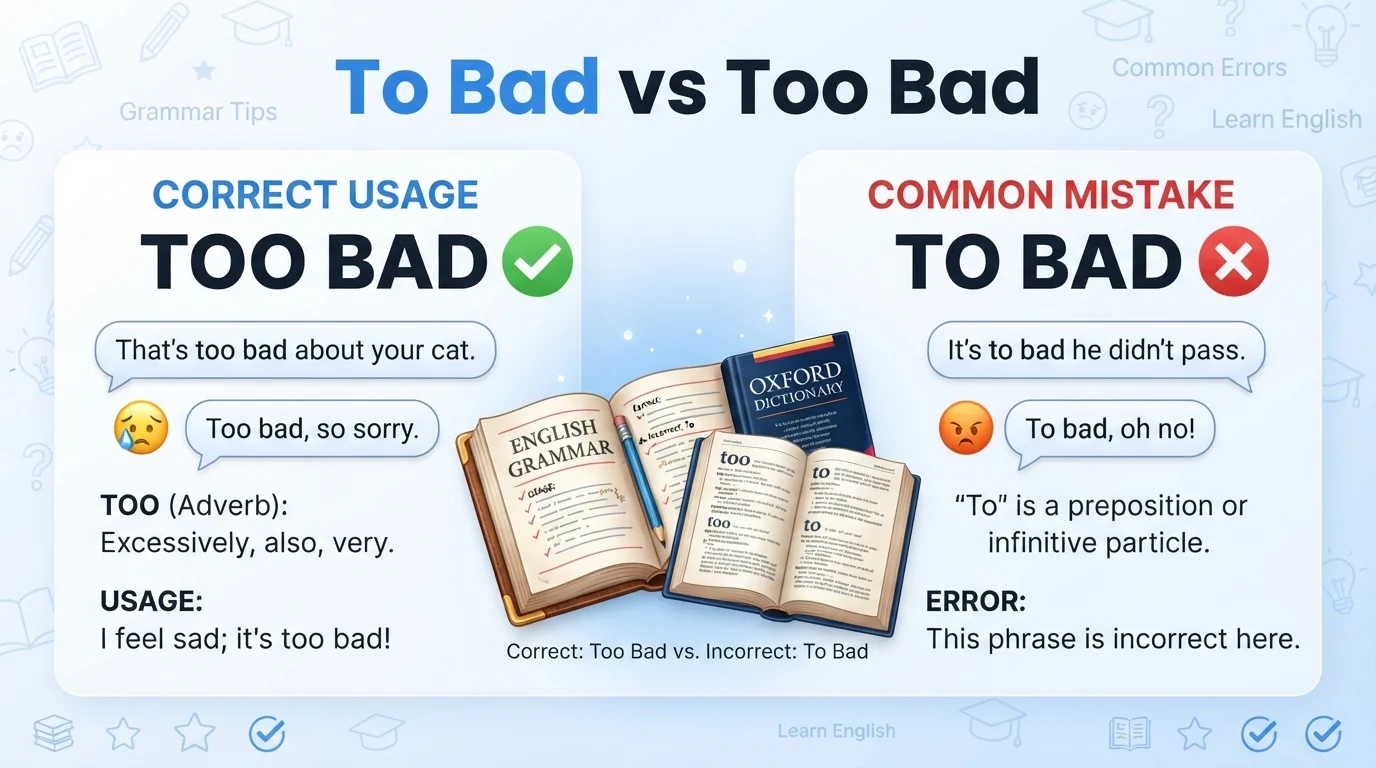
The correct phrase is “too bad.” “To bad” is almost always a grammatical error because to is a preposition or part of an infinitive, while too is an adverb meaning excessively or unfortunately. In this guide, you’ll learn the difference between to bad vs too bad, their meanings, examples, common mistakes, and simple tips to remember the correct form.
Quick Answer
“Too bad” is correct.
“To bad” is incorrect in standard English.
- ✅ Too bad = Unfortunate, disappointing, or excessively bad depending on the context.
- ❌ To bad = A grammatical error in almost every case.
Examples:
- ✅ It’s too bad you couldn’t come.
- ✅ That’s too bad.
- ❌ It’s to bad you couldn’t come.
What Does “Too Bad” Mean?
Too bad is a common English expression with two main meanings:
- Unfortunate or disappointing
- More bad than acceptable (excessively bad)
Most often, it expresses sympathy or disappointment.
Examples:
- That’s too bad. I hope you feel better soon.
- It’s too bad we missed the concert.
- Too bad the weather changed.
It can also mean excessively bad.
Example:
- The damage was too bad to repair.
Why “To Bad” Is Incorrect
The confusion happens because to and too sound exactly the same.
Here’s the difference:
- To = A preposition or part of an infinitive.
- Too = Means also, excessively, or more than enough.
Since the expression refers to something unfortunate or excessive, it always uses too.
Correct:
- ✅ Too bad
Incorrect:
- ❌ To bad
To Bad vs Too Bad
| Feature | To Bad | Too Bad |
|---|---|---|
| Correct spelling | ❌ No | ✅ Yes |
| Standard English | ❌ Incorrect | ✅ Correct |
| Expresses disappointment | ❌ No | ✅ Yes |
| Means excessively bad | ❌ No | ✅ Yes |
| Used in formal writing | ❌ Never | ✅ Yes |
Whenever you’re deciding between to bad vs too bad, always choose too bad.
How to Use “Too Bad” Correctly
Expressing Sympathy
- That’s too bad.
- It’s too bad you couldn’t attend.
Showing Disappointment
- Too bad we missed the train.
- It’s too bad the event was canceled.
Describing Excessiveness
- The weather was too bad for hiking.
- The injuries were too bad to continue playing.
Everyday Conversation
- Too bad you weren’t there.
- That’s too bad, but maybe next time.
Common Mistakes
People often confuse to and too.
Incorrect:
- ❌ to bad
- ❌ its to bad
- ❌ to bad you missed it
- ❌ that’s to bad
Correct:
- ✅ too bad
- ✅ it’s too bad
- ✅ too bad you missed it
- ✅ that’s too bad
Common Expressions with “Too Bad”
You’ll frequently hear too bad in these expressions:
- that’s too bad
- it’s too bad
- too bad you missed it
- too bad for them
- too bad we couldn’t go
- too bad to continue
- too bad to repair
- too bad the weather changed
Examples:
- That’s too bad. I was looking forward to it.
- It’s too bad the store closed early.
- The damage was too bad to fix.
Easy Trick to Remember
A simple memory tip:
Remember:
Too = Too much
If something is too bad, it is more bad than you’d like or unfortunately bad.
Another trick:
- Too has two O’s.
- Think of the two O’s as meaning extra.
If you mean also, very, or excessively, choose too.
American vs British English
There is no difference between American and British English.
Both varieties use:
- ✅ Too bad
- ❌ To bad
The phrase is spelled the same across all English-speaking countries.
Related Expressions
If you’re looking for similar phrases, consider:
- unfortunately
- what a shame
- that’s unfortunate
- what a pity
- regrettably
- sadly
- disappointing
- unlucky
- unfortunate
- that’s a shame
These alternatives work well depending on the tone and context.
Tips to Avoid This Mistake
Use these simple strategies:
- Remember that too means also or more than enough.
- If you’re expressing disappointment, always write too bad.
- Proofread your writing for to bad.
- Think of the two O’s in too as representing extra.
- Practice common phrases like that’s too bad until they become natural.
Frequently Asked Questions
Which is correct: to bad or too bad?
Too bad is the correct phrase.
What does “too bad” mean?
It means unfortunate, disappointing, or excessively bad, depending on the context.
Is “to bad” ever correct?
Almost never. In standard English, to bad is generally a grammatical mistake.
Why do people write “to bad”?
Because to and too sound the same, many writers accidentally choose the wrong word.
Is “too bad” informal?
It’s commonly used in everyday conversation, but it’s also acceptable in most types of writing when appropriate.
Do American and British English use “too bad”?
Yes. Both varieties use the phrase too bad.
How can I remember the correct spelling?
Remember that too means extra or more than enough. If you’re expressing disappointment or saying something is excessively bad, always choose too.
Summary
When comparing to bad vs too bad, the correct phrase is always too bad. It expresses disappointment, sympathy, or the idea that something is excessively bad. To bad is a common grammar mistake caused by confusing the words to and too.
To avoid this error, remember that too means also, excessively, or more than enough. Whenever you’re expressing regret or describing something unfortunate, too bad is the correct choice.
Actionable Takeaway
Before publishing your writing or sending a message, search for “to bad.” If you find it, replace it with “too bad.” This quick proofreading habit will help you write more accurately and naturally.