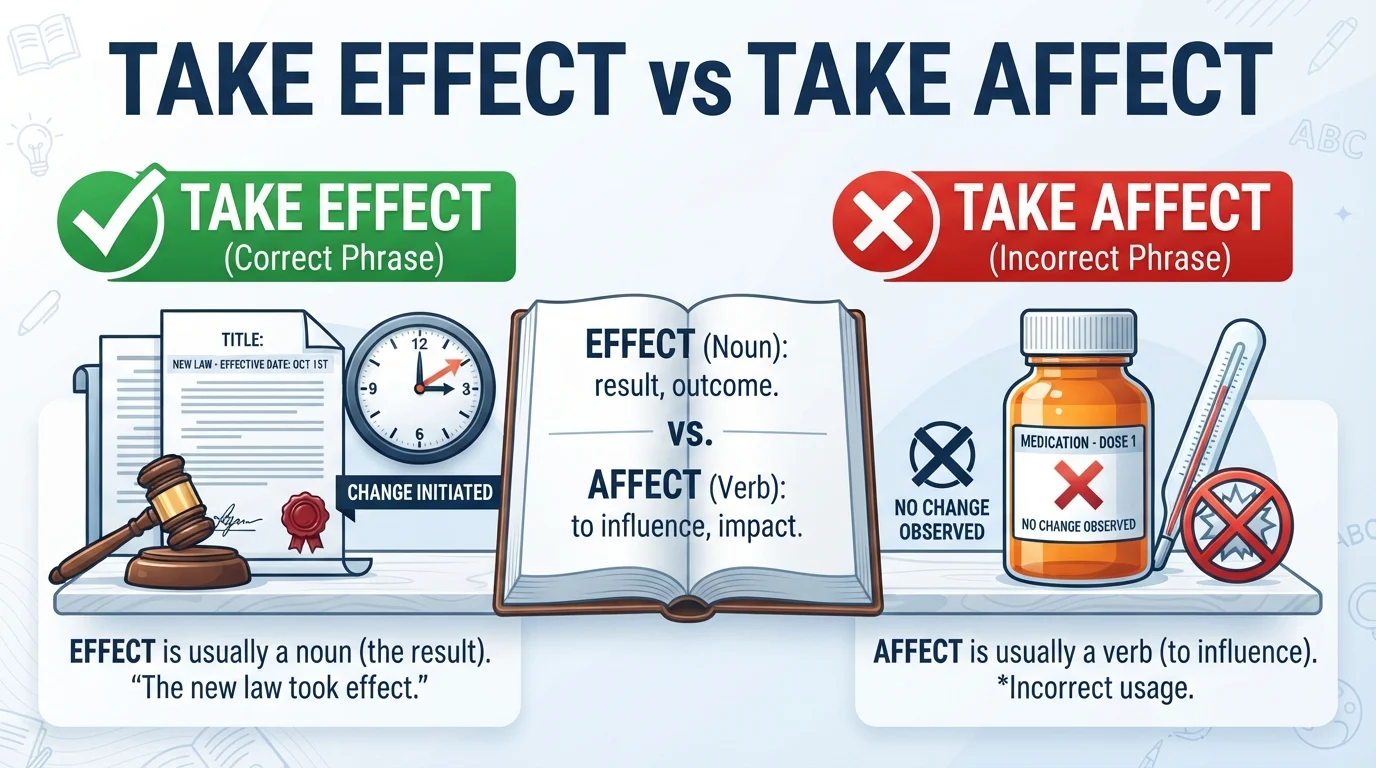
Many English learners and even native speakers confuse “take effect” and “take affect” because effect and affect sound similar. If you are writing about a new law, policy, rule, medicine, or change, choosing the correct phrase is important for clear and professional communication.
The correct phrase is “take effect.” “Take affect” is incorrect in standard English. In this guide, you’ll learn the difference between take effect vs take affect, understand the meaning, see clear examples, learn about common mistakes, and discover an easy trick to remember the correct phrase.
Quick Answer
“Take effect” is correct.
“Take affect” is incorrect in standard English.
- ✅ Take effect = To begin to produce a result or become operational.
- ❌ Take affect = An incorrect phrase caused by confusing affect and effect.
Examples:
- ✅ The new law will take effect next month.
- ✅ The medicine began to take effect quickly.
- ❌ The new law will take affect next month.
What Does “Take Effect” Mean?
The phrase “take effect” means to begin to work, operate, or produce a result.
It is commonly used for:
- laws
- rules
- policies
- agreements
- treatments
- medicines
- decisions
- changes
Examples:
- The new policy will take effect on January 1.
- The medicine took several minutes to take effect.
- The agreement will take effect immediately.
Why “Take Affect” Is Incorrect
The confusion comes from the difference between affect and effect.
Affect
Affect is usually a verb meaning to influence or change something.
Example:
- The weather may affect travel plans.
Effect
Effect is usually a noun meaning a result or consequence.
Example:
- The new rule had a significant effect.
In the phrase “take effect,” effect means that something begins to produce its intended result. Therefore, the correct expression is:
Take effect
Take Effect vs Take Affect
| Feature | Take Affect | Take Effect |
|---|---|---|
| Correct phrase | ❌ No | ✅ Yes |
| Standard English | ❌ Incorrect | ✅ Correct |
| Used for laws and policies | ❌ No | ✅ Yes |
| Used for medicine and treatments | ❌ No | ✅ Yes |
| Means “begin to work” | ❌ No | ✅ Yes |
Whenever you’re deciding between take effect vs take affect, always choose take effect.
How to Use “Take Effect” Correctly
Laws and Regulations
- The new tax law will take effect next year.
- The regulation took effect immediately.
Company Policies
- The updated policy will take effect on Monday.
- The workplace rules took effect after the announcement.
Medicine and Treatment
- The painkiller began to take effect after thirty minutes.
- The treatment may take time to take effect.
Agreements
- The contract will take effect once both parties sign it.
- The agreement took effect after approval.
Changes and Decisions
- The changes will take effect next month.
- The decision took effect immediately.
Common Mistakes
People often use affect instead of effect in this fixed expression.
Incorrect:
- ❌ The new rule will take affect.
- ❌ The medicine has taken affect.
- ❌ The policy took affect yesterday.
Correct:
- ✅ The new rule will take effect.
- ✅ The medicine has taken effect.
- ✅ The policy took effect yesterday.
Common Expressions with “Take Effect”
You will often see take effect in these phrases:
- take effect immediately
- take effect tomorrow
- take effect next month
- take effect on a specific date
- begin to take effect
- gradually take effect
- take full effect
Examples:
- The new rules will take effect immediately.
- The changes will take effect next week.
- The treatment gradually took effect.
Easy Trick to Remember
A simple memory trick is:
Effect = End result
When something takes effect, it begins to produce a result.
Another useful phrase to memorize is:
Affect = Action
Effect = End result
Because take effect refers to something beginning to produce a result, effect is the correct word.
American vs British English
There is no difference between American and British English in this phrase.
Both varieties use:
- ✅ Take effect
- ❌ Take affect
The spelling and meaning are the same in American, British, Canadian, Australian, and other varieties of standard English.
Related Phrases
You may also see these expressions:
- come into effect
- go into effect
- become effective
- become operational
- begin to work
- start producing results
- take hold
Examples:
- The new law will come into effect next year.
- The changes will go into effect immediately.
- The treatment is beginning to take effect.
Tips to Avoid This Mistake
Follow these simple tips:
- Memorize the fixed phrase take effect.
- Associate effect with a result.
- Remember: Affect = Action; Effect = End result.
- Pay special attention when writing about laws, policies, medicine, or changes.
- Proofread phrases such as took affect and take affect.
Frequently Asked Questions
Which is correct: take effect or take affect?
Take effect is the correct phrase.
What does “take effect” mean?
It means to begin working, operating, or producing a result.
Is “take affect” ever correct?
In standard English, take affect is not the correct phrase. Use take effect instead.
Why do people confuse effect and affect?
They sound very similar, and their meanings can overlap in some contexts. However, affect is usually a verb, while effect is usually a noun.
Can I say “the law took effect”?
Yes. This is completely correct.
Example:
- The new law took effect on July 1.
Is “take effect” used in American and British English?
Yes. Both American and British English use take effect.
What is another way to say “take effect”?
Depending on the context, you can say come into effect, go into effect, become effective, or begin to work.
Summary
When comparing take effect vs take affect, the correct phrase is always take effect. It means that something begins to work, operate, or produce a result. The phrase is commonly used with laws, policies, regulations, agreements, medicines, treatments, and important changes.
Take affect is a common spelling mistake caused by confusing affect and effect. To remember the correct expression, think of effect as the end result. When something begins to produce that result, it takes effect.
Actionable Takeaway
Before submitting an email, report, article, or assignment, check for “take affect.” If you find it, replace it with “take effect.” Memorizing this common phrase will help you avoid one of the most frequent affect vs effect mistakes in English.