Have you ever wondered whether superseded or superceded is the correct spelling? If so, you’re not alone. This is one of the most commonly misspelled words in English because it doesn’t follow the usual spelling pattern that many people expect.
If you’re writing a business report, legal document, academic paper, or blog post, using the correct spelling is essential. In this guide, we’ll explain the difference between superseded vs superceded, provide easy-to-understand examples, discuss common mistakes, and share memory tricks to help you remember the correct form.
Quick Answer
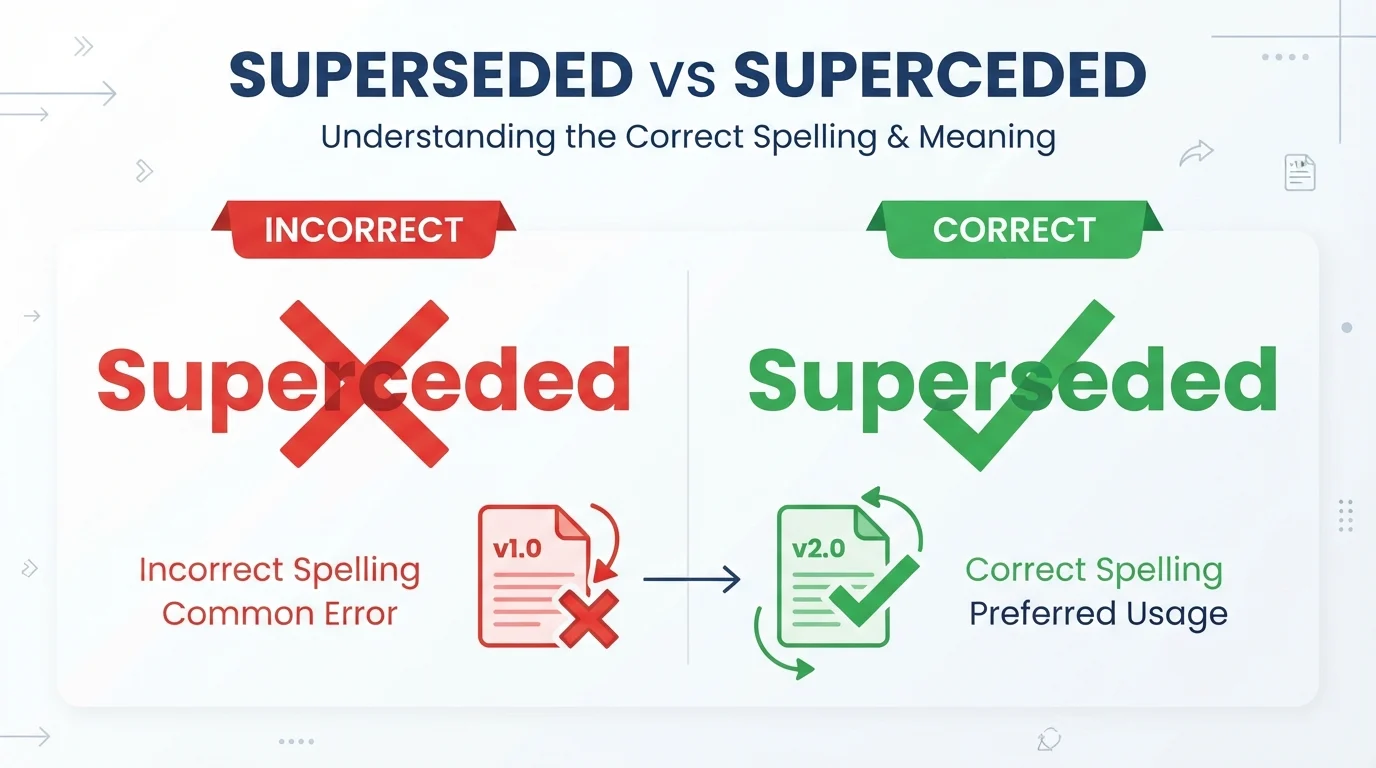
Superseded is the correct spelling.
Superceded is an incorrect spelling and should never be used in standard English.
✅ Correct: The old policy has been superseded by a new one.
❌ Incorrect: The old policy has been superceded by a new one.
If you’re choosing between superseded vs superceded, always use superseded.
What Does Superseded Mean?
Superseded is the past tense and past participle of the verb supersede. It means to replace something older, outdated, or less effective with something newer or better.
The word is commonly used in business, law, technology, government, education, and everyday writing.
Definition
Superseded (verb): Replaced by something newer, more advanced, or more appropriate.
Examples of Superseded
- The old software has been superseded by a newer version.
- This policy was superseded last year.
- Digital cameras largely superseded film cameras.
- The revised contract superseded the original agreement.
- New regulations have superseded the previous rules.
Is Superceded a Real Word?
No. Superceded is not a correct spelling in modern English.
Many people mistakenly assume the word should follow the spelling pattern of words like precede, proceed, or concede, leading them to write superceded. However, the correct verb is supersede, making superseded the only accepted spelling.
Superseded vs Superceded: Comparison Table
| Feature | Superceded | Superseded |
|---|---|---|
| Correct English spelling | ❌ No | ✅ Yes |
| Found in modern dictionaries | ❌ No | ✅ Yes |
| Accepted in formal writing | ❌ No | ✅ Yes |
| Suitable for legal documents | ❌ No | ✅ Yes |
| Means replaced by something newer | ❌ No | ✅ Yes |
The comparison makes it clear that superseded is the only correct spelling.
Why Do People Spell It Superceded?
This spelling mistake happens for several reasons.
- Many English words ending in -cede influence people’s expectations.
- The pronunciation makes the error difficult to notice.
- Spell-check isn’t always available while typing.
- The word is relatively uncommon in everyday conversation.
Despite these factors, English dictionaries consistently recognize only supersede and superseded.
Origin of the Word Supersede
The word supersede comes from the Latin supersedere, meaning to sit above, to refrain, or to take the place of.
Unlike words such as precede and concede, supersede developed with an -sede ending. This historical origin explains why its spelling is considered an exception in English.
Common Uses of Superseded
Business
Companies frequently replace old policies and procedures.
Examples:
- The revised handbook superseded the previous edition.
- Our updated pricing model superseded the older plan.
Technology
New technology often replaces outdated systems.
Examples:
- Cloud storage has superseded many physical storage methods.
- The latest software version superseded the previous release.
Law
Legal documents often replace earlier versions.
Examples:
- The amended contract superseded the original agreement.
- The updated regulation superseded the former law.
Everyday Communication
Examples:
- My old phone has been superseded by a newer model.
- Better research has superseded earlier assumptions.
Common Mistakes
Mistake 1: Writing Superceded
❌ The manual was superceded.
✅ The manual was superseded.
Mistake 2: Misspelling the Base Verb
❌ This document will supercede the previous version.
✅ This document will supersede the previous version.
Mistake 3: Assuming All Similar Words End in -cede
Words like precede, concede, and intercede end with -cede, but supersede is an exception.
Easy Trick to Remember the Correct Spelling
A helpful memory trick is:
Supersede contains the word “seed.”
Think of a new seed replacing an old plant.
Seed → Sede → Supersede
Although it’s not based on the word’s origin, this visual association makes the correct spelling easier to remember.
Another tip:
Remember the complete word supersede instead of trying to apply the spelling rules used by other -cede words.
American vs British English
There is no difference between American and British English.
Both use:
- Supersede
- Superseded
Neither variety accepts superceded.
Synonyms of Superseded
Using related words can improve writing variety and SEO.
Common synonyms include:
- Replaced
- Overtaken
- Substituted
- Displaced
- Outdated
- Overridden
- Updated
- Succeeded
- Made obsolete
- Took the place of
Example
Instead of writing:
- The old system was superseded.
You could write:
- The old system was replaced.
- The old system was made obsolete.
- The old system was substituted.
Why Correct Spelling Matters
Using superseded instead of superceded improves:
- Professional credibility
- Academic writing quality
- Business communication
- Legal accuracy
- Reader confidence
- SEO performance
Because superceded is a common misspelling, using it can make otherwise well-written content appear less trustworthy.
Frequently Asked Questions
Is superceded a correct English word?
No. Superceded is an incorrect spelling. The correct form is superseded.
Which is correct: superseded or superceded?
Superseded is the only accepted spelling in modern English.
Why is superseded spelled with “sede” instead of “cede”?
The spelling comes from the Latin word supersedere, making it an exception to the more common -cede pattern.
What does superseded mean?
It means something has been replaced by a newer, more effective, or updated version.
Is superseded used in legal writing?
Yes. It is commonly used in legal documents, contracts, government regulations, and official policies.
Is there an American and British spelling difference?
No. Both American and British English use superseded.
What is the base verb of superseded?
The base verb is supersede.
Example: The new agreement will supersede the previous contract.
Summary
The difference between superseded vs superceded is simple: superseded is the correct spelling, while superceded is a common misspelling. Although many English words end in -cede, supersede is a historical exception that has retained its -sede ending. Whether you’re writing legal documents, business reports, technical manuals, or academic papers, superseded is always the correct choice.
To avoid this common mistake, remember that supersede and superseded are the only accepted spellings in both American and British English. Using the correct form enhances your credibility, improves readability, and ensures your writing meets professional standards.
Actionable Takeaway
Before submitting or publishing your work, search for superceded and replace it with superseded if it appears. Developing this simple proofreading habit will help eliminate one of the most frequent English spelling errors.