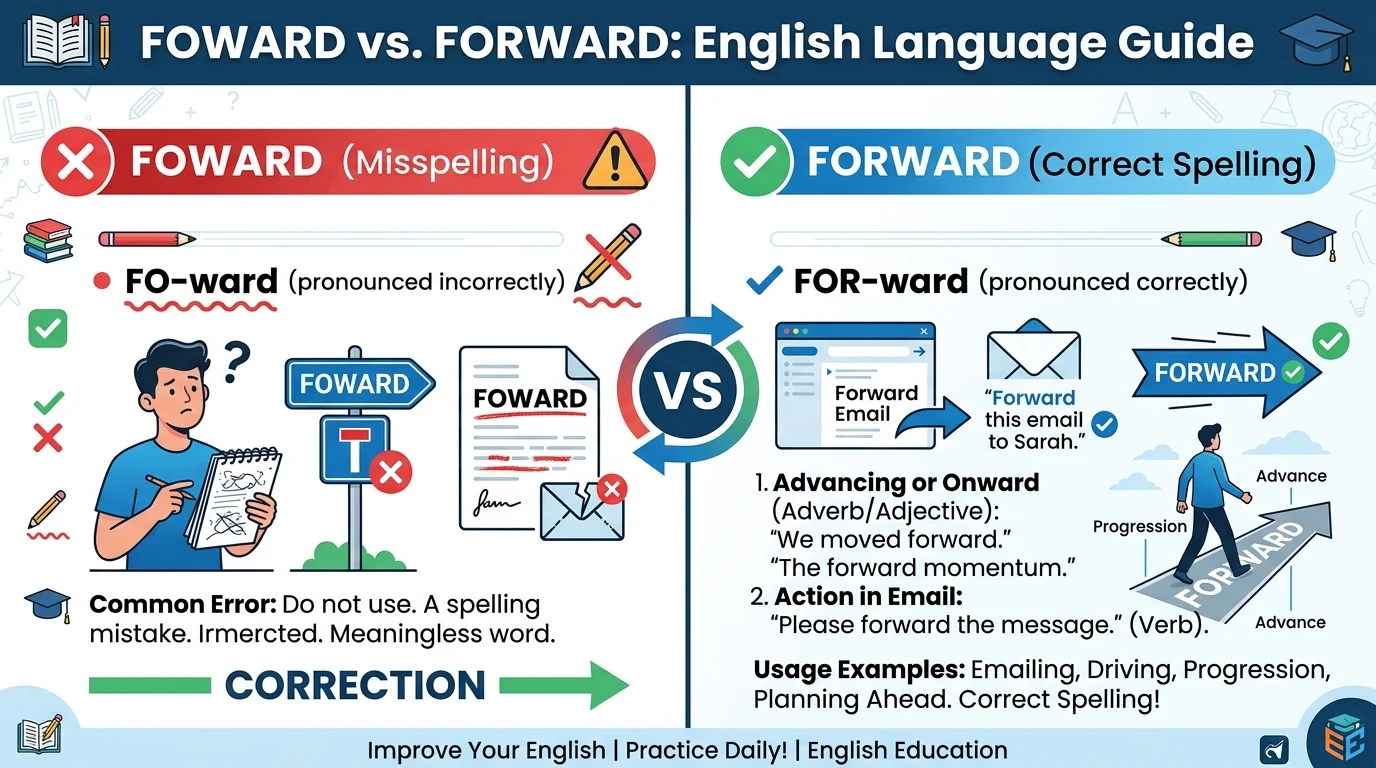
The confusion between foward vs forward is one of the most common spelling mistakes in English. Because the word is frequently used in emails, conversations, and professional writing, it’s easy to accidentally omit the letter “r” and write foward instead of forward.
If you’re unsure which spelling is correct, this guide explains the difference, meaning, examples, common mistakes, and helpful memory tricks.
Quick Answer
✅ Forward is the correct spelling.
❌ Foward is incorrect.
Correct example:
- “Please forward the email to the team.”
Incorrect example:
- “Please foward the email to the team.”
For all forms of standard English, use forward.
What Does Forward Mean?
English Vocabulary Forward can be used as an adjective, adverb, verb, or noun. It generally means:
- toward the front
- ahead in position or progress
- moving onward
- sending something to another person
Examples of Forward
- Take a step forward.
- The project is moving forward.
- Please forward the document to management.
- She leaned forward to hear better.
Why Is “Foward” Incorrect?
The spelling foward is a common typo caused by leaving out the first r.
Many people make this mistake because:
- they type quickly
- they pronounce the word casually
- they overlook the missing letter
However, dictionaries recognize only:
✅ forward
❌ foward
Foward vs Forward: Main Difference
| Word | Status | Meaning |
|---|---|---|
| Forward | Correct spelling | Ahead, onward, or send onward |
| Foward | Incorrect spelling | Common misspelling |
Common Uses of Forward
In Everyday Movement
- Move forward carefully.
- She stepped forward confidently.
- The car rolled forward.
In Business Communication
Business
- Please forward the report.
- Forward the request to the appropriate department.
In Email
- Can you forward that message?
- He forwarded the attachment yesterday.
In Personal Development
- It’s time to move forward.
- We should focus on moving forward rather than dwelling on the past.
Forward as Different Parts of Speech
As an Adverb
- Walk forward.
As an Adjective
- The forward section of the ship was damaged.
As a Verb
- Forward the invoice to accounting.
As a Noun
In sports, a forward is an attacking player.
Examples include players in:
- National Basketball Association basketball
- Premier League football (soccer)
- hockey
Common Mistakes People Make
Mistake 1: Omitting the First R
Incorrect:
- foward
Correct:
- forward
Mistake 2: Fast Typing Errors
Because the word is frequently used, people often type it without noticing the missing letter.
Mistake 3: Email Writing Mistakes
Many workplace emails contain accidental foward typos.
Synonyms for Forward
Depending on the context, common alternatives include:
For Movement
- ahead
- onward
- forth
For Sending Information
- transmit
- send
- relay
- pass along
Examples
Instead of:
- “Forward the file.”
You could say:
- “Send the file.”
Forward vs Forwards
Both forms exist, but usage differs slightly.
| Word | Common Usage |
|---|---|
| Forward | More common in American English |
| Forwards | More common in British English as an adverb |
Examples
- Move forward. ✅
- Move forwards. ✅
Both are acceptable depending on the context.
American vs British English Differences
American English
- Usually prefers forward
British English
- Uses forward and sometimes forwards
However, neither variety uses:
❌ foward
Both agree that:
✅ forward is correct.
Why Correct Spelling Matters
Professional Communication Correct spelling improves:
- professionalism
- clarity
- credibility
- communication effectiveness
Since forward is extremely common in business emails and reports, spelling it correctly is important.
Easy Trick to Remember the Correct Spelling
Remember: “For + Ward”
Think of the word as:
for + ward
Notice the r appears after “fo.”
Memory tip:
- forward = contains two r’s ✅
- foward = missing an r ❌
Another simple reminder:
You move forward, not foward.
Related Word Forms
| Word Type | Example |
|---|---|
| Verb | forward |
| Adjective | forward |
| Adverb | forward |
| Noun | forward |
| Adverb Variant | forwards |
Example Sentences
- The team moved forward with the project.
- Please forward the email.
- She stepped forward to speak.
FAQs
Which spelling is correct: foward or forward?
Forward is the correct spelling.
Is foward a real word?
No. It is considered a misspelling of forward.
What does forward mean?
It means ahead, onward, toward the front, or to send something onward.
How do you use forward in a sentence?
Example: “Please forward the report by Friday.”
Is forward a verb?
Yes. It can mean to send information, files, or messages to someone else.
What is the difference between forward and forwards?
Forward is more common in American English, while forwards is sometimes used as an adverb in British English.
Do British and American English use different spellings?
No. Both use forward as the standard spelling.
Can spell-check catch foward?
Yes. Most spell-check tools flag foward and suggest forward.
Final Summary
The difference between foward vs forward is simple. Forward is the correct English spelling and can mean ahead, onward, toward the front, or to send something to another person. Foward is a common typo caused by accidentally omitting the letter r.
Whether you’re writing emails, business reports, or everyday messages, always use forward. Remember that the word contains two r’s, which can help you avoid this frequent spelling error.
Actionable Takeaway
Keep this rule in mind:
- forward = correct spelling ✅
- foward = incorrect spelling ❌
For accurate and professional writing:
- move forward ✅
- move foward ❌
A quick check for the missing r can instantly improve your writing accuracy.