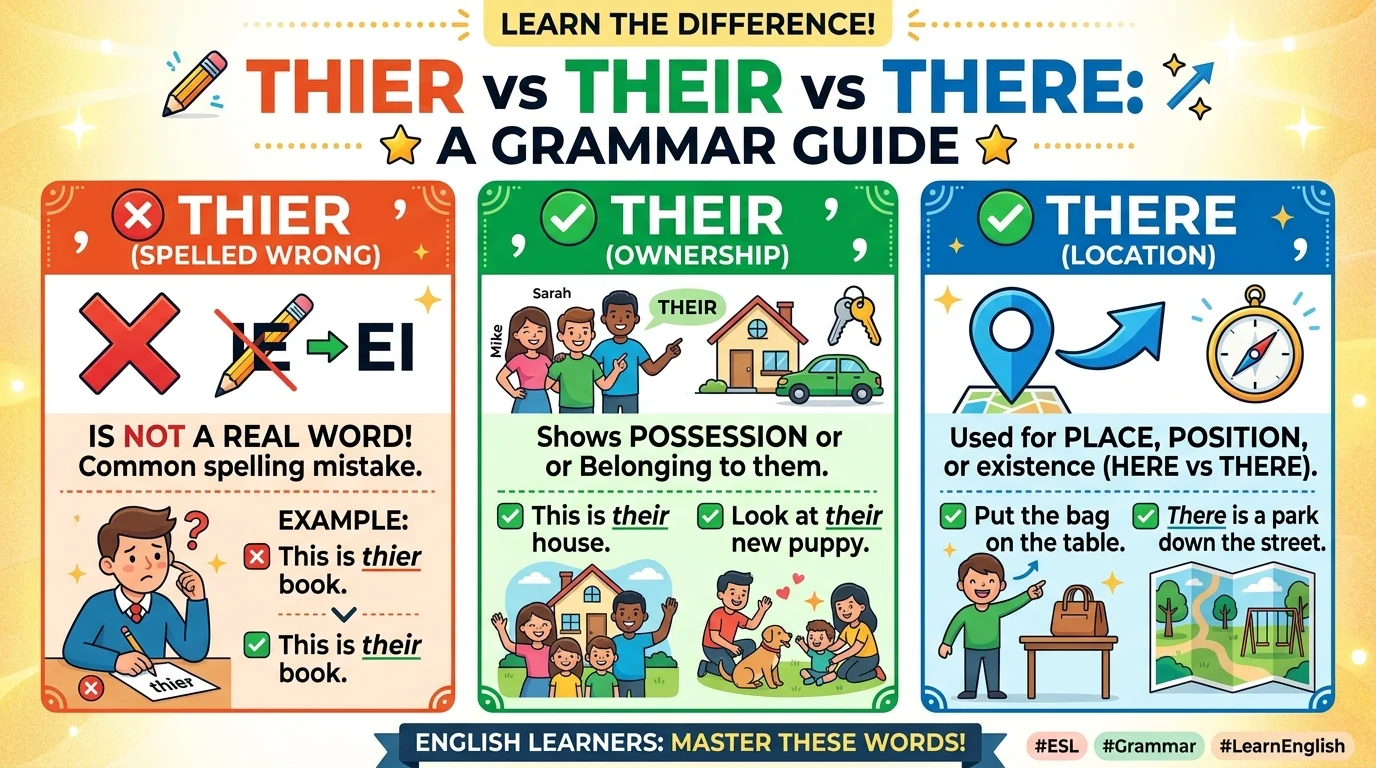
The confusion between thier vs their vs there is one of the most common spelling and grammar problems in English. These words look and sound similar, which makes them easy to mix up in emails, essays, social media posts, and everyday writing.
However, each word has a completely different meaning. One is a misspelling, one shows possession, and one refers to location or existence. Learning the difference can instantly improve your grammar and writing confidence.
In this guide, you’ll learn the meaning of their and there, why thier is incorrect, grammar rules, examples, common mistakes, memory tricks, and real-life usage.
Quick Answer
✅ Their = shows possession
✅ There = refers to place, position, or existence
❌ Thier = incorrect spelling
Correct examples:
- “Their house is beautiful.”
- “The books are over there.”
Incorrect example:
- “Thier house is beautiful.”
What Does Their Mean?
English Grammar Their is a possessive determiner used to show ownership.
It means something belongs to:
- them
- a group of people
- someone whose gender may not be specified
Examples of Their
- Their car is parked outside.
- Students should bring their notebooks.
- The team celebrated their victory.
- Parents love their children.
What Does There Mean?
There usually refers to:
- a place
- a location
- existence
Examples of There
- Put the bag over there.
- There is a problem with the computer.
- We traveled to Paris and stayed there for a week.
- There are many books on the shelf.
What Does Thier Mean?
❌ Thier is not a correct English word.
It is simply a common misspelling of:
- their
This mistake usually happens because:
- people type quickly
- the letters “i” and “e” get reversed
- pronunciation sounds similar
Thier vs Their vs There: Main Difference
| Word | Meaning | Correct? |
|---|---|---|
| Their | Shows possession | ✅ Yes |
| There | Refers to place or existence | ✅ Yes |
| Thier | Misspelling of “their” | ❌ No |
Why People Confuse These Words
Several reasons make these words difficult for learners.
Similar Pronunciation
In spoken English, their and there often sound nearly identical.
Spelling Patterns
The “ie” and “ei” letter combination causes confusion.
Fast Typing
Many people accidentally type thier instead of their.
Common Mistakes People Make
Mistake 1: Using Thier Instead of Their
Incorrect:
- “Thier dog is friendly.”
Correct:
- “Their dog is friendly.”
Mistake 2: Mixing Their and There
Incorrect:
- “There car is expensive.”
Correct:
- “Their car is expensive.”
Mistake 3: Using Their for Location
Incorrect:
- “Put the chairs their.”
Correct:
- “Put the chairs there.”
Real-Life Examples of Their
Family
- Their children attend the same school.
Sports
Manchester United
- The players celebrated their victory.
Business
Business
- Employees submitted their reports on time.
Technology
- Users manage their accounts online.
Real Life Examples of There
Location
- The restaurant is over there.
Existence
- There are many opportunities available.
Travel
Japan
- They visited Japan and loved their time there.
Everyday Conversation
- Is there enough food for everyone?
Easy Tricks to Remember the Difference
Their = Ownership
The word their contains:
- heir
An heir inherits ownership or possessions.
So:
- their = belongs to someone
There = Place
The word there contains:
- here
Both relate to location.
So:
- there = place or position
Thier = Incorrect
Remember:
- “i before e” confusion often creates the typo thier.
Their vs There in Sentences
| Correct Sentence | Why It’s Correct |
|---|---|
| Their house is big. | Shows ownership |
| The keys are there. | Refers to location |
| There are five students. | Shows existence |
| Their teacher is kind. | Possession |
American vs British English Differences
Both:
- United States American English
- United Kingdom British English
use the same spellings and grammar rules:
✅ their
✅ there
❌ thier
There is no regional difference.
Why Correct Spelling Matters
Education Correct grammar and spelling improve:
- professionalism
- academic credibility
- communication clarity
- reader confidence
Mistakes like thier can distract readers and weaken polished writing.
Related Grammar Terms
Possessive Words
- my
- your
- his
- her
- their
Location Words
- here
- there
- everywhere
- nowhere
FAQs
Which spelling is correct: thier or their?
Their is the correct spelling. Thier is a misspelling.
What does their mean?
It shows possession or ownership.
What does there mean?
It refers to place, location, or existence.
Is thier a real word?
No. It is considered an incorrect spelling.
How can I remember their vs there?
- their = ownership
- there = place
Why do people confuse these words?
Because they sound similar and have similar spellings.
Do British and American English use these differently?
No. Both use the same grammar rules.
Can spell-check detect thier?
Yes. Most spell-check tools identify thier as incorrect and suggest their.
Final Summary
The difference between thier vs their vs there becomes much easier once you understand each word’s role. Their is used for possession, there refers to location or existence, and thier is simply an incorrect spelling caused by letter confusion.
Whenever you write about ownership, use their. Whenever you discuss place or existence, use there. Avoid using thier in formal writing because it is considered a spelling mistake. Mastering these small differences can greatly improve your grammar and communication skills.
Actionable Takeaway
Before choosing the word, ask yourself:
- Does it show ownership? → Use their
- Does it refer to place or existence? → Use there
- Is it spelled thier? → Correct it immediately
That quick check will help you avoid this common English mistake every time.