The confusion between whos vs whose is one of the most common English grammar mistakes. Since the words sound nearly identical when spoken, many people accidentally use the wrong spelling in emails, essays, social media posts, and everyday writing.
However, these two forms have completely different meanings and grammar functions. Understanding the difference is easier than it seems once you learn a few simple rules.
In this guide, you’ll learn the meaning of whose, why whos is usually incorrect, grammar rules, examples, common mistakes, and easy tricks to remember the difference.
Quick Answer
✅ Whose is the correct standard English word.
❌ Whos is usually incorrect.
Correct example:
- “Whose jacket is this?”
Incorrect example:
- “Whos jacket is this?”
The word whose is used to show possession or ownership.
What Does Whose Mean?
English Grammar Whose is a possessive pronoun and determiner. It asks or shows who owns something.
It is similar to:
- my
- your
- his
- her
- their
Examples of Whose
- Whose phone is ringing?
- Do you know whose bag this is?
- She met the author whose book became famous.
- Whose turn is it?
Why “Whos” Is Incorrect
The spelling whos is not accepted as a standard English word in modern grammar.
People usually write it by mistake when they actually mean:
- whose
- who’s
Important Difference
| Word | Meaning |
|---|---|
| whose | shows possession |
| who’s | contraction of “who is” or “who has” |
| whos | incorrect in standard English |
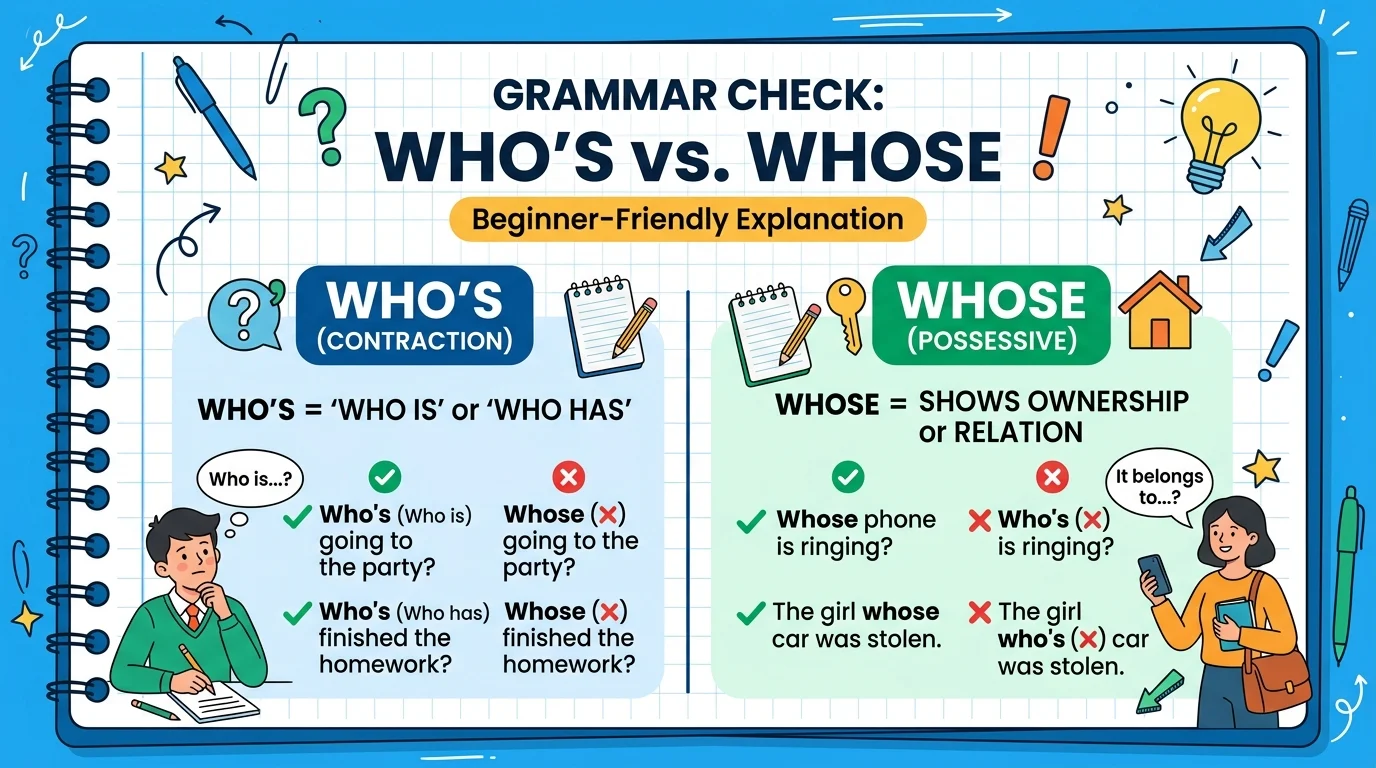
Whose vs Who’s
This is where many writers become confused.
Whose = Possession
- Whose shoes are these?
- Whose idea was this?
Who’s = Who Is / Who Has
- Who’s coming to dinner?
- Who’s finished the assignment?
A simple test:
- Replace who’s with who is
- If the sentence still makes sense, use who’s
Common Mistakes People Make
Mistake 1: Writing Whos Instead of Whose
Incorrect:
- “Whos keys are on the table?”
Correct:
- “Whose keys are on the table?”
Mistake 2: Confusing Whose and Who’s
Incorrect:
- “Who’s backpack is this?”
Correct:
- “Whose backpack is this?”
Why? Because the sentence refers to ownership.
Mistake 3: Forgetting Apostrophe Rules
Many people assume every shortened word needs an apostrophe, which causes confusion between whose and who’s.
Real-Life Examples of Whose
School and Education
Education
- Whose notebook did you borrow?
Work and Business
Business Communication
- We need to identify whose responsibility this is.
Literature
To Kill a Mockingbird
- The novel features characters whose actions shape the story.
Everyday Conversation
- Whose car is parked outside?
Whose in Relative Clauses
Linguistics Whose can also connect ideas in sentences.
Examples
- The teacher whose class I joined was kind.
- I met a musician whose songs became popular.
In these sentences, whose connects ownership to another noun.
American vs British English Differences
Both:
- United States American English
- United Kingdom British English
use the same spellings and grammar:
✅ whose
✅ who’s
❌ whos
There is no regional difference.
Easy Trick to Remember the Difference
A quick memory trick:
Whose = Ownership
Think:
- whose book?
- whose phone?
- whose idea?
Who’s = Who Is
Replace it with:
- who is
- who has
Example:
- Who’s ready? → Who is ready?
If replacement works, use who’s.
If not, use whose.
Why Correct Grammar Matters
Professional Communication Correct grammar improves:
- professionalism
- readability
- academic writing
- communication clarity
Small mistakes like whos can distract readers and weaken polished writing.
Related Grammar Examples
| Correct | Incorrect |
|---|---|
| whose jacket | whos jacket |
| whose idea | whos idea |
| who’s coming | whose coming |
| who’s finished | whose finished |
Synonyms and Related Terms
Related Possessive Words
- my
- your
- his
- her
- their
Related Question Words
- who
- whom
- what
- which
FAQs
Which spelling is correct: whos or whose?
Whose is the correct standard English spelling.
What does whose mean?
It shows ownership or possession.
Is whos a real word?
No. Whos is generally considered incorrect in modern English.
What is the difference between whose and who’s?
- Whose = possession
- Who’s = who is / who has
How can I test whether to use who’s?
Replace it with “who is.” If the sentence still makes sense, use who’s.
Is whose always possessive?
Yes. Whose relates to ownership or association.
Do British and American English use whose differently?
No. Both follow the same grammar rules.
Can spell-check detect whos?
Usually yes. Most spell-check tools suggest whose or who’s.
Final Summary
The difference between whos vs whose becomes simple once you understand possession and contractions. Whose is the correct word used to show ownership, while whos is generally an incorrect spelling in standard English. Many writers also confuse whose with who’s, but remembering that who’s means “who is” makes the distinction much easier.
Whenever you talk about ownership or ask who something belongs to, always use whose. Learning this small grammar rule can significantly improve your writing clarity and professionalism.
Actionable Takeaway
Before writing the word, ask yourself:
- Am I talking about ownership? → Use whose
- Can I replace it with “who is”? → Use who’s
If neither works, whos is probably incorrect.