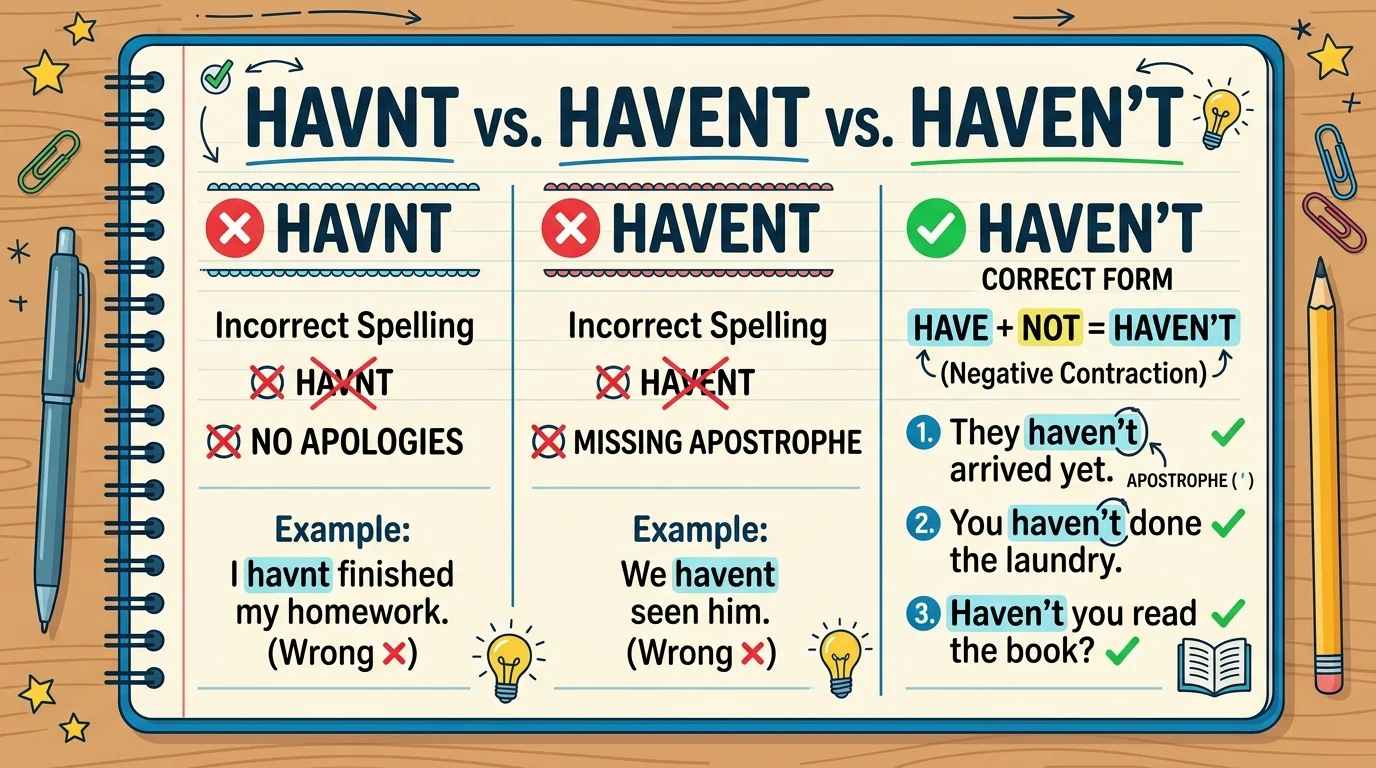
The confusion between havnt vs havent is extremely common in texting, social media, emails, and casual online writing. Since both spellings appear frequently on the internet, many people assume one must be correct. However, standard English grammar follows a different rule.
The truth is that both havnt and havent are incorrect in formal English. The correct word actually includes an apostrophe. In this guide, you’ll learn the proper spelling, grammar rules, examples, common mistakes, and easy memory tricks to help you use the correct form confidently.
Quick Answer
❌ Havnt is incorrect.
❌ Havent is also incorrect.
✅ Haven’t is the correct spelling.
Correct example:
- “I haven’t finished my work yet.”
Incorrect examples:
- “I havent finished my work yet.”
- “I havnt finished my work yet.”
The correct form is the contraction:
- have + not = haven’t
What Does Haven’t Mean?
English Grammar Haven’t is a contraction of:
- have not
It is commonly used in spoken and written English to make sentences shorter and more natural.
Examples of Haven’t
- We haven’t seen that show.
- They haven’t arrived yet.
- I haven’t eaten dinner.
- You haven’t answered my question.
Why Havnt Is Incorrect
The spelling havnt is not accepted in standard English because it:
- removes the letter “e”
- skips the apostrophe
- breaks normal contraction rules
English contractions keep the original spelling structure while replacing missing letters with an apostrophe.
So:
- have not → haven’t
Not:
- havnt
Why Havent Is Also Incorrect
The spelling havent keeps the correct letters but still misses the apostrophe.
In English grammar:
- contractions require apostrophes
Therefore:
- havent ❌
- haven’t ✅
Although havent appears often in texting or casual chats, it is still considered grammatically incorrect in formal writing.
Havnt vs Havent vs Haven’t
| Word | Correct? | Meaning |
|---|---|---|
| Haven’t | ✅ Yes | Contraction of “have not” |
| Havent | ❌ No | Missing apostrophe |
| Havnt | ❌ No | Missing apostrophe and letter |
Why Apostrophes Matter
Linguistics Apostrophes show that letters have been removed in contractions.
Examples
| Full Form | Correct Contraction |
|---|---|
| do not | don’t |
| cannot | can’t |
| have not | haven’t |
| is not | isn’t |
Without an apostrophe, the contraction becomes incorrect in standard English.
Common Mistakes People Make
Mistake 1: Leaving Out the Apostrophe
Incorrect:
- “I havent finished yet.”
Correct:
- “I haven’t finished yet.”
Mistake 2: Dropping the Letter “E”
Incorrect:
- “We havnt started the meeting.”
Correct:
- “We haven’t started the meeting.”
Mistake 3: Using Texting Habits in Formal Writing
People often skip apostrophes while texting quickly, but professional and academic writing should follow standard grammar rules.
Real-Life Examples of Haven’t
Education
Education
- Students haven’t submitted the assignment yet.
Business
Business Communication
- We haven’t received your documents.
Entertainment
Avatar
- Many people haven’t watched the sequel yet.
Travel
Dubai
- I haven’t visited Dubai before.
Formal vs Informal Usage
Formal Writing
Use:
- have not
or - haven’t
Correct:
- “We haven’t completed the report.”
Informal Texting
People may type:
- havent
But it remains grammatically incorrect.
American vs British English Differences
Both:
- United States American English
- United Kingdom British English
use the same correct contraction:
✅ haven’t
❌ havent
❌ havnt
There is no regional spelling difference.
Easy Trick to Remember the Correct Form
A simple memory trick:
Haven’t = Have + Not
Take:
- have
- not
Remove the “o” from not and replace it with an apostrophe:
- haven’t
If there is no apostrophe, the spelling is wrong.
Related Contractions
| Full Form | Correct Contraction |
|---|---|
| has not | hasn’t |
| had not | hadn’t |
| are not | aren’t |
| were not | weren’t |
Why Correct Grammar Matters
Professional Communication Correct grammar improves:
- professionalism
- readability
- academic credibility
- communication clarity
Even small mistakes like missing apostrophes can make writing appear careless.
FAQs
Which spelling is correct: havnt or havent?
Neither is fully correct. The correct spelling is haven’t.
What does haven’t mean?
It is the contraction of “have not.”
Is havent a real word?
It appears informally online but is grammatically incorrect because it lacks an apostrophe.
Why is havnt incorrect?
Because it removes both the apostrophe and the letter “e.”
What is the correct contraction of have not?
The correct contraction is haven’t.
Do British and American English spell haven’t differently?
No. Both use haven’t.
Are apostrophes necessary in contractions?
Yes. Standard English contractions require apostrophes.
Can spell-check detect havnt and havent?
Yes. Most spell-check tools suggest haven’t instead.
Final Summary
The difference between havnt vs havent comes down to proper English contraction rules. Both spellings are incorrect because they either remove important letters or omit the apostrophe. The only correct standard form is haven’t, which properly combines “have” and “not.”
Whenever you write professionally, academically, or formally, always include the apostrophe in contractions. Remembering this small grammar rule will improve your writing clarity, accuracy, and professionalism.
Actionable Takeaway
Before writing the word, remember:
- have + not = haven’t
- contractions need apostrophes
So:
- haven’t ✅
- havent ❌
- havnt ❌
That quick grammar check will help you avoid the mistake every time.