The confusion between heros vs heroes is a very common English spelling mistake. Since many plural nouns simply add -s, people often assume that hero becomes heros. However, English grammar follows a different rule for certain words ending in -o.
If you’ve ever wondered which spelling to use in essays, social media captions, school assignments, or professional writing, this guide will explain the correct form, grammar rules, pronunciation, examples, common mistakes, and easy tricks to remember the difference.
Quick Answer
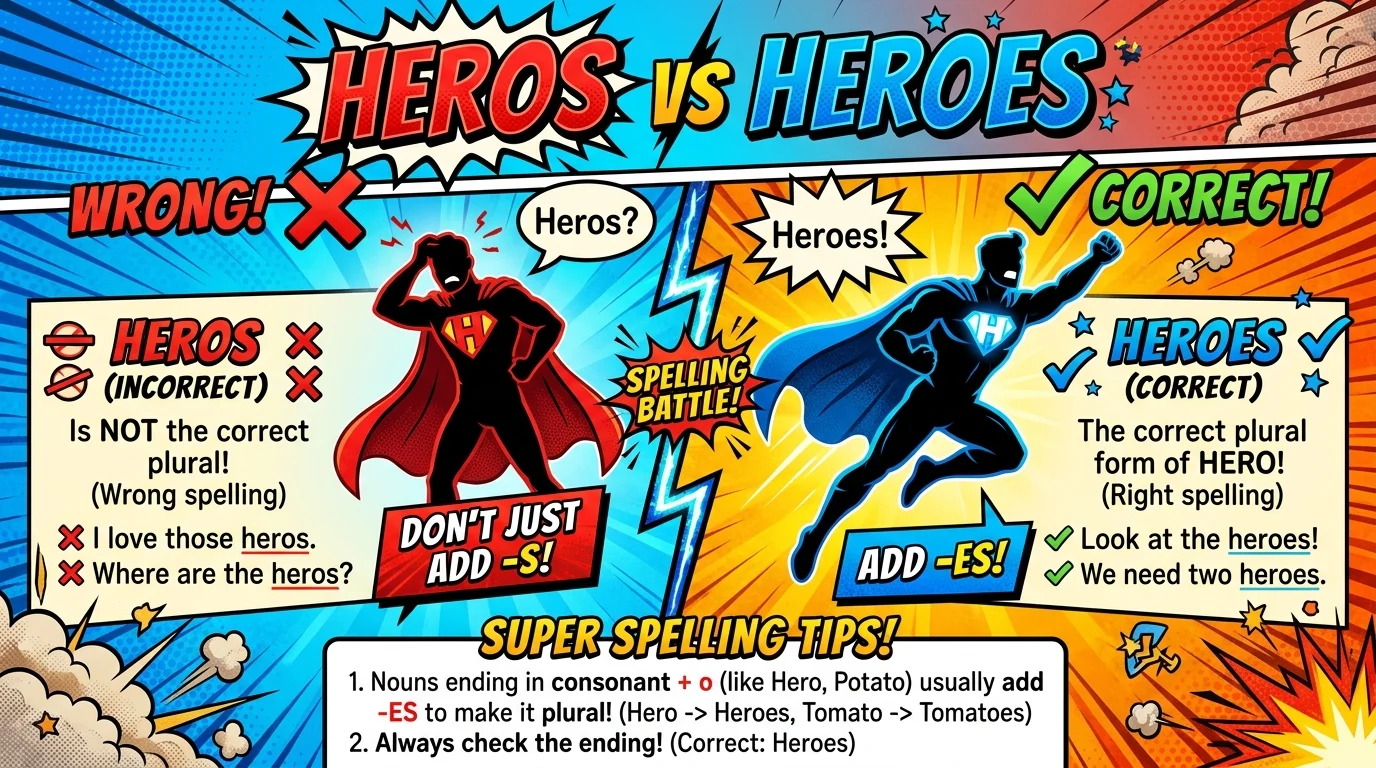
✅ Heroes is the correct plural spelling.
❌ Heros is incorrect in standard English.
Correct example:
- “The firefighters were true heroes.”
Incorrect example:
- “The firefighters were true heros.”
The word heroes is the plural form of hero.
What Does Hero Mean?
English Grammar A hero is a person admired for:
- bravery
- courage
- achievements
- noble qualities
Heroes may appear in:
- real life
- history
- movies
- books
- mythology
- sports
Examples of Hero
- The doctor became a local hero.
- Children often admire superheroes.
- Soldiers were celebrated as national heroes.
- She was the hero of the story.
Why “Heroes” Is Correct
English grammar changes many nouns ending in -o by adding -es to form the plural.
So:
- hero → heroes
Not:
- hero → heros
Similar Examples
| Singular | Correct Plural |
|---|---|
| hero | heroes |
| potato | potatoes |
| tomato | tomatoes |
| echo | echoes |
Why People Write “Heros”
The spelling heros is a very common mistake because:
- many English plurals only add “s”
- pronunciation can sound similar
- people type quickly
- some words ending in “o” do take only “s”
For example:
- piano → pianos
- photo → photos
This inconsistency causes confusion.
Heros vs Heroes: Main Difference
| Word | Status | Meaning |
|---|---|---|
| Heroes | Correct plural form | More than one hero |
| Heros | Incorrect spelling | Grammar mistake |
Grammar Rule Behind Heroes
Linguistics Many nouns ending in consonant + o form plurals by adding -es.
Examples
| Singular | Plural |
|---|---|
| hero | heroes |
| volcano | volcanoes |
| tornado | tornadoes |
| mosquito | mosquitoes |
However, English has exceptions, which is why learners sometimes become confused.
Common Mistakes People Make
Mistake 1: Adding Only “S”
Incorrect:
- “Comic book heros are popular.”
Correct:
- “Comic book heroes are popular.”
Mistake 2: Assuming All “O” Words Follow the Same Rule
Some words use only “s,” including:
- photos
- radios
- pianos
But hero is not one of them.
Mistake 3: Fast Typing Errors
Writers often accidentally skip the “e” while typing quickly online.
Real Life Examples of Heroes
Movies
The Avengers
- Marvel heroes are popular worldwide.
Sports
Pakistan National Cricket Team
- Fans considered the players national heroes after the victory.
Healthcare
Medicine
- Doctors and nurses were called everyday heroes.
Literature
Harry Potter and the Philosopher’s Stone
- Many fantasy stories focus on unlikely heroes.
Heroes in Popular Culture
Spider-Man
Superheroes are among the most recognizable modern fictional heroes.
Common hero themes include:
- courage
- sacrifice
- justice
- resilience
American vs British English Differences
Both:
- United States American English
- United Kingdom British English
use the same plural spelling:
✅ heroes
❌ heros
There is no regional spelling difference.
Synonyms for Hero
Using related vocabulary improves readability and writing variety.
Common Synonyms
- champion
- savior
- warrior
- protector
- legend
- role model
Example
Instead of:
- “They became heroes.”
You could say:
- “They became champions.”
Why Correct Spelling Matters
Education Correct spelling improves:
- professionalism
- academic credibility
- communication clarity
- writing quality
Even small spelling mistakes like heros can distract readers.
Easy Trick to Remember the Correct Form
A quick memory trick:
- hero needs extra strength → heroes gets extra letters
Or remember:
- potato → potatoes
- hero → heroes
Related Word Forms
| Word Type | Example |
|---|---|
| Singular noun | hero |
| Plural noun | heroes |
| Adjective | heroic |
| Noun quality | heroism |
Example Sentence
- “Heroes often display heroic courage during difficult situations.”
FAQs
Which spelling is correct: heros or heroes?
Heroes is the correct plural spelling.
Why is heroes spelled with “es”?
Because many nouns ending in consonant + “o” form plurals using -es.
Is heros a real word?
No. Heros is considered a spelling mistake in standard English.
What is the singular form of heroes?
The singular form is hero.
Do British and American English spell heroes differently?
No. Both use the spelling heroes.
What does hero mean?
A hero is a person admired for courage, bravery, or noble actions.
Are superheroes considered heroes?
Yes. Fictional superheroes are modern examples of heroes.
Can spell-check detect heros?
Yes. Most spell-check tools identify heros as incorrect and suggest heroes.
Final Summary
The difference between heros vs heroes is simple once you understand the plural spelling rule. Heroes is the correct plural form of hero, while heros is a common spelling mistake. English grammar often adds -es to nouns ending in consonant + “o,” which is why the correct spelling becomes heroes.
Whenever you write about brave people, fictional champions, or admired individuals, always use heroes. Remembering similar patterns like potatoes and tomatoes can make the rule easier to remember and improve your writing accuracy.
Actionable Takeaway
Before writing the plural form, remember:
- hero → heroes
- potato → potatoes
- tomato → tomatoes
Many words ending in consonant + “o” need -es for the plural.
That simple rule will help you avoid the mistake every time.