The confusion between flys vs flies is a very common English grammar mistake. Since both words appear online and sound similar, many people are unsure which spelling to use in writing. However, the correct choice depends on grammar, meaning, and context.
If you’ve ever wondered whether to write flys or flies in emails, essays, captions, or daily conversation, this guide will explain the correct spelling, grammar rules, examples, pronunciation, and common mistakes in a simple and clear way.
Quick Answer
✅ Flies is usually the correct spelling for the plural noun and third-person verb form of fly.
⚠️ Flys is rare and only correct in limited specialized uses or proper names.
Correct examples:
- “Birds flies south in winter.” ❌ (grammar mistake)
- “Birds fly south in winter.” ✅
- “The airplane flies daily.” ✅
- “Flies are annoying in summer.” ✅
In most situations, you should use flies, not flys.
What Does Flies Mean?
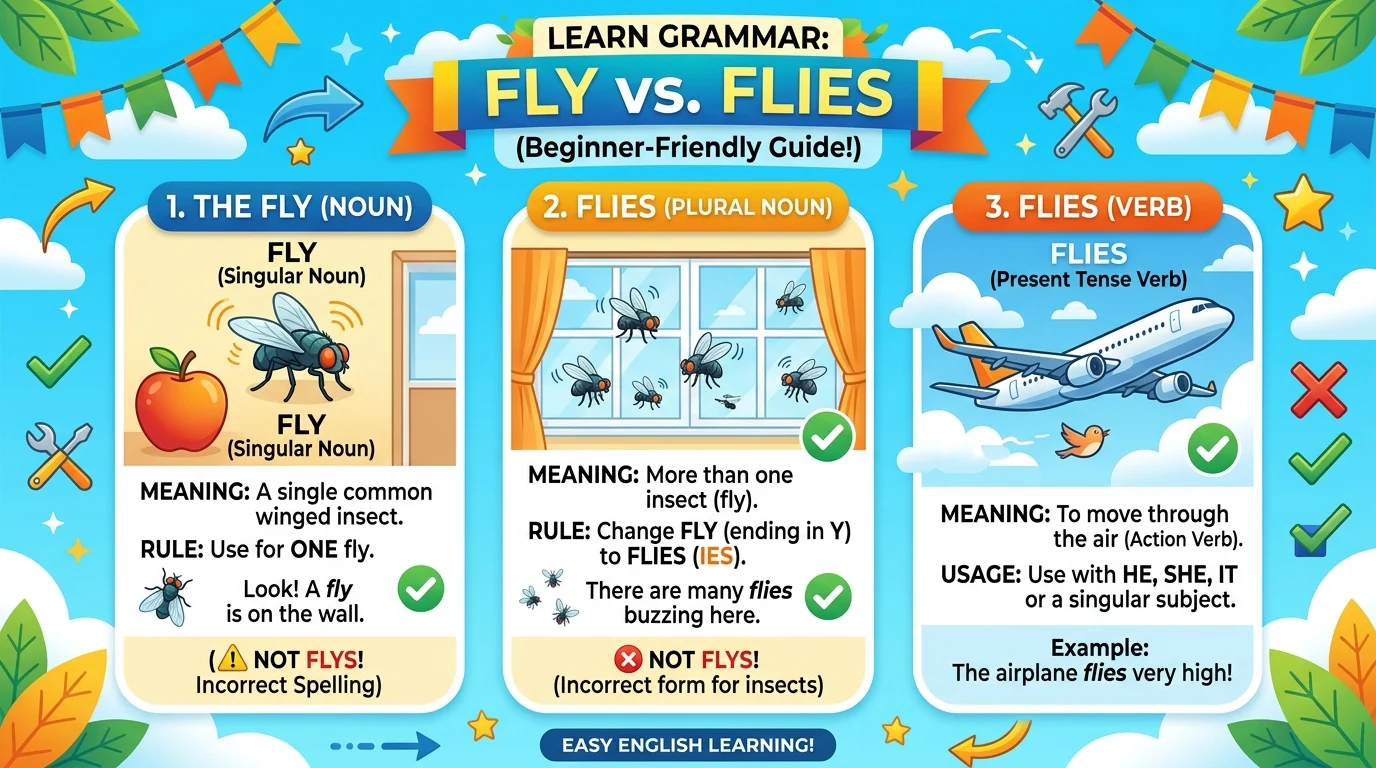
English Grammar Flies has two main uses in English:
- The plural form of fly (the insect)
- The third-person singular form of the verb fly
Flies as a Plural Noun
When referring to more than one fly insect, the correct plural spelling is:
✅ flies
Examples
- Flies were buzzing around the food.
- Houseflies spread germs quickly.
- The kitchen had too many flies.
Why Does Fly Become Flies?
English grammar changes many nouns ending in -y to -ies when forming plurals.
Examples
| Singular | Plural |
|---|---|
| fly | flies |
| baby | babies |
| city | cities |
| story | stories |
The “y” changes to “ies.”
Flies as a Verb
Flies is also the third-person singular form of the verb fly.
Examples
- The bird flies over the lake.
- She flies to Dubai every month.
- The superhero flies through the sky.
Is Flys Ever Correct?
The spelling flys is usually incorrect in standard grammar.
However, it may appear in:
- surnames
- company names
- specialized terminology
- intentional stylized branding
For example:
- Flys
But in normal English grammar, the correct form is almost always:
✅ flies
❌ flys
Flys vs Flies: Main Difference
| Word | Correct Usage | Commonness |
|---|---|---|
| Flies | Standard plural and verb form | Very common |
| Flys | Rare special usage | Uncommon |
Common Grammar Rule Behind Flies
Linguistics The spelling rule is simple:
When a word ends in:
- consonant + y
change:
- y → ies
Examples
| Word | Correct Form |
|---|---|
| fly | flies |
| cry | cries |
| try | tries |
| reply | replies |
Common Mistakes People Make
Mistake 1: Writing Flys Instead of Flies
Incorrect:
- “There are many flys in the room.”
Correct:
- “There are many flies in the room.”
Mistake 2: Confusing Verb and Noun Forms
Incorrect:
- “The airplane flys every morning.”
Correct:
- “The airplane flies every morning.”
Mistake 3: Forgetting the “Y to IES” Rule
Many learners remember adding “s” for plurals but forget that words ending in consonant + y follow a different rule.
Real Life Examples of Flies
Nature
Housefly
- Flies are attracted to uncovered food.
Travel
Emirates
- The airline flies internationally every day.
Sports and Movement
Los Angeles Lakers
- The ball flies across the court during fast passes.
Fiction
Superman
- Superman flies faster than most heroes.
American vs British English Differences
Both:
- United States American English
- United Kingdom British English
use the same spelling:
✅ flies
❌ flys
There is no spelling difference between the dialects.
Synonyms
Related Verb Synonyms
- soars
- glides
- travels by air
- hovers
Related Noun Terms
- insects
- bugs
- houseflies
- fruit flies
Why Correct Spelling Matters
Education Correct grammar improves:
- readability
- professionalism
- academic writing
- communication clarity
Mistakes like flys can distract readers and weaken writing quality.
Easy Trick to Remember the Correct Form
A quick memory trick:
If the word ends in:
- consonant + y
change:
- y → ies
So:
- fly → flies
- cry → cries
- baby → babies
Related Word Forms
| Word Type | Example |
|---|---|
| Verb Base | fly |
| Third-Person Verb | flies |
| Noun Singular | fly |
| Noun Plural | flies |
| Past Tense | flew |
Example Sentence
- “The bird flies high while smaller flies gather near the lake.”
FAQs
Which spelling is correct: flys or flies?
Flies is the correct standard spelling in most contexts.
Is flys a real word?
It can appear in names or specialized uses, but it is generally incorrect in normal grammar.
Why does fly become flies?
Because words ending in consonant + y usually change “y” to “ies” in plural and third-person forms.
Is flies a noun or a verb?
It can be both:
- plural noun
- third-person singular verb
What is the plural of fly?
The plural form is flies.
Do British and American English spell flies differently?
No. Both use flies.
What is the past tense of fly?
The past tense is flew.
Can spell-check detect flys?
Yes. Most spell-check tools suggest flies instead.
Final Summary
The difference between flys vs flies mainly comes down to standard English grammar rules. Flies is the correct spelling for both the plural form of fly and the third-person singular form of the verb fly. The spelling flys is rare and generally incorrect in everyday writing.
Whenever a word ends in consonant + y, English grammar usually changes the “y” to “ies.” Remembering this simple rule will help you spell flies correctly and avoid one of the most common English writing mistakes.
Actionable Takeaway
Before writing the word, remember:
- fly → flies
- cry → cries
- baby → babies
Change “y” to “ies” after a consonant.
That quick grammar rule will help you avoid mistakes every time.