The phrases “to that effect” and “to that affect” are often confused because effect and affect are two of the most commonly mixed-up words in English. Since they sound almost identical, it’s easy to use the wrong spelling especially in expressions you’ve heard more often than you’ve seen in writing.
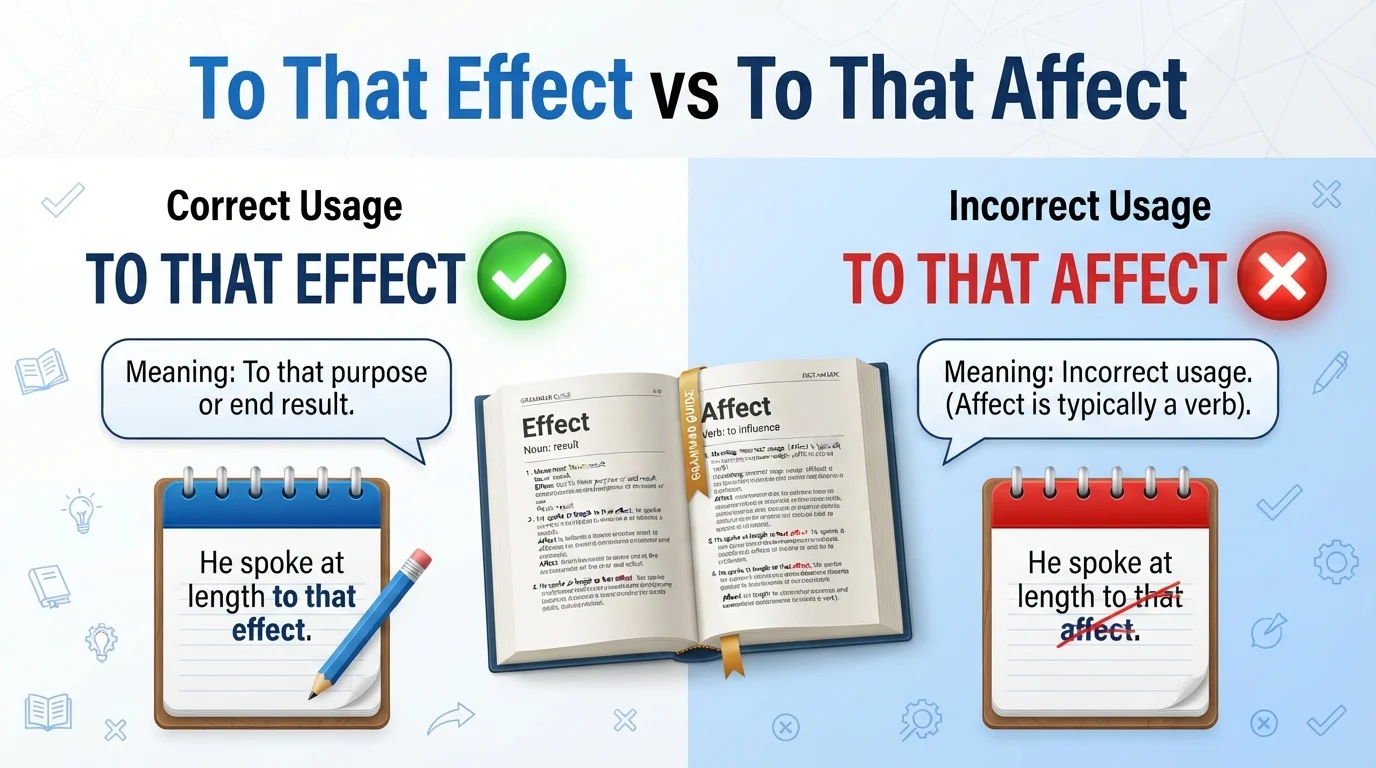
The correct phrase is “to that effect.” “To that affect” is incorrect because the idiom requires the noun effect, not the verb affect. In this guide, you’ll learn the difference between to that effect vs to that affect, their meanings, examples, common mistakes, and easy ways to remember the correct phrase.
Quick Answer
“To that effect” is correct.
“To that affect” is incorrect in standard English.
- ✅ To that effect = Meaning something similar to what was said; expressing the same general idea.
- ❌ To that affect = Incorrect phrase caused by confusing affect and effect.
Examples:
- ✅ She said something to that effect during the meeting.
- ✅ The email included words to that effect.
- ❌ She said something to that affect.
What Does “To That Effect” Mean?
To that effect is an idiomatic phrase meaning “with that meaning,” “along those lines,” or “expressing essentially the same idea.”
It’s used when you’re not quoting someone exactly but are summarizing what they said.
Examples:
- He said he was too busy, or words to that effect.
- The manager made a comment to that effect.
- She nodded and replied to that effect.
Why “To That Affect” Is Incorrect
The confusion comes from mixing up affect and effect.
- Affect is usually a verb meaning to influence or change.
- Effect is usually a noun meaning a result, outcome, or meaning.
In the phrase “to that effect,” effect refers to the meaning or substance of what was said—not to influencing something.
Therefore:
- ✅ To that effect
- ❌ To that affect
To That Effect vs To That Affect
| Feature | To That Affect | To That Effect |
|---|---|---|
| Correct phrase | ❌ No | ✅ Yes |
| Standard English | ❌ Incorrect | ✅ Correct |
| Uses the noun “effect” | ❌ No | ✅ Yes |
| Used in formal writing | ❌ Never | ✅ Yes |
| Used in everyday English | ❌ No | ✅ Yes |
Whenever you’re deciding between to that effect vs to that affect, always choose to that effect.
How to Use “To That Effect” Correctly
Summarizing Speech
- She apologized, or words to that effect.
- The witness made a statement to that effect.
Meetings
- The CEO made comments to that effect during the presentation.
- Someone mentioned to that effect that changes were coming.
Emails
- The message included a sentence to that effect.
- He replied to that effect, although not in those exact words.
Everyday Conversations
- She said something to that effect, but I don’t remember the exact wording.
- His response was to that effect.
Common Mistakes
People often confuse effect with affect in this phrase.
Incorrect:
- ❌ to that affect
- ❌ words to that affect
- ❌ something to that affect
Correct:
- ✅ to that effect
- ✅ words to that effect
- ✅ something to that effect
Common Expressions with “Effect”
You’ll often encounter effect in these expressions:
- to that effect
- words to that effect
- take effect
- in effect
- into effect
- have an effect
- cause-and-effect
- special effects
Examples:
- The new policy will take effect tomorrow.
- The medicine had little effect.
- She said words to that effect.
Easy Trick to Remember
A simple memory tip:
Think of the phrase:
Words to that effect.
Here, effect refers to the meaning of the words.
Another helpful reminder:
- Affect = Action (both start with A)
- Effect = End Result (both start with E)
Since to that effect refers to the meaning or result of what was said, effect is the correct choice.
American vs British English
There is no difference between American and British English.
Both varieties use:
- ✅ To that effect
- ❌ To that affect
The phrase is identical in spelling and meaning across English-speaking countries.
Related Phrases
If you’re looking for similar expressions, you can also use:
- along those lines
- in other words
- in essence
- something like that
- words to that effect
- more or less
- roughly speaking
- in similar terms
- with that meaning
- to the same effect
These alternatives work well when summarizing someone’s statement without quoting them exactly.
Tips to Avoid This Mistake
Follow these simple tips:
- Remember the fixed phrase is to that effect.
- Associate effect with meaning or result.
- Use affect only when referring to influencing something.
- Proofread your writing for this common error.
- Memorize the expression words to that effect to reinforce the correct spelling.
Frequently Asked Questions
Which is correct: to that effect or to that affect?
To that effect is the correct and standard English phrase.
What does “to that effect” mean?
It means expressing essentially the same idea, even if not using the exact words.
Why is “to that affect” incorrect?
Because the idiom uses the noun effect, not the verb affect.
Is “to that effect” an idiom?
Yes. It is a common English idiomatic expression.
Can I say “words to that effect”?
Yes. Words to that effect is a very common and correct phrase.
Do American and British English use the same phrase?
Yes. Both use to that effect.
How can I remember the correct spelling?
Think of effect as referring to the meaning or result of what someone said. The phrase is always to that effect.
Summary
When comparing to that effect vs to that affect, the correct phrase is always to that effect. It means “with that meaning” or “expressing essentially the same idea.” To that affect is incorrect because affect is usually a verb, while this expression requires the noun effect.
To avoid this common mistake, remember the phrase “words to that effect.” Associating effect with meaning or result will help you choose the correct spelling every time and make your writing more polished and accurate.
Actionable Takeaway
Before sending an email, writing an article, or submitting an assignment, check for “to that affect.” If you find it, replace it with “to that effect.” This small correction will improve your grammar and make your writing sound more natural.