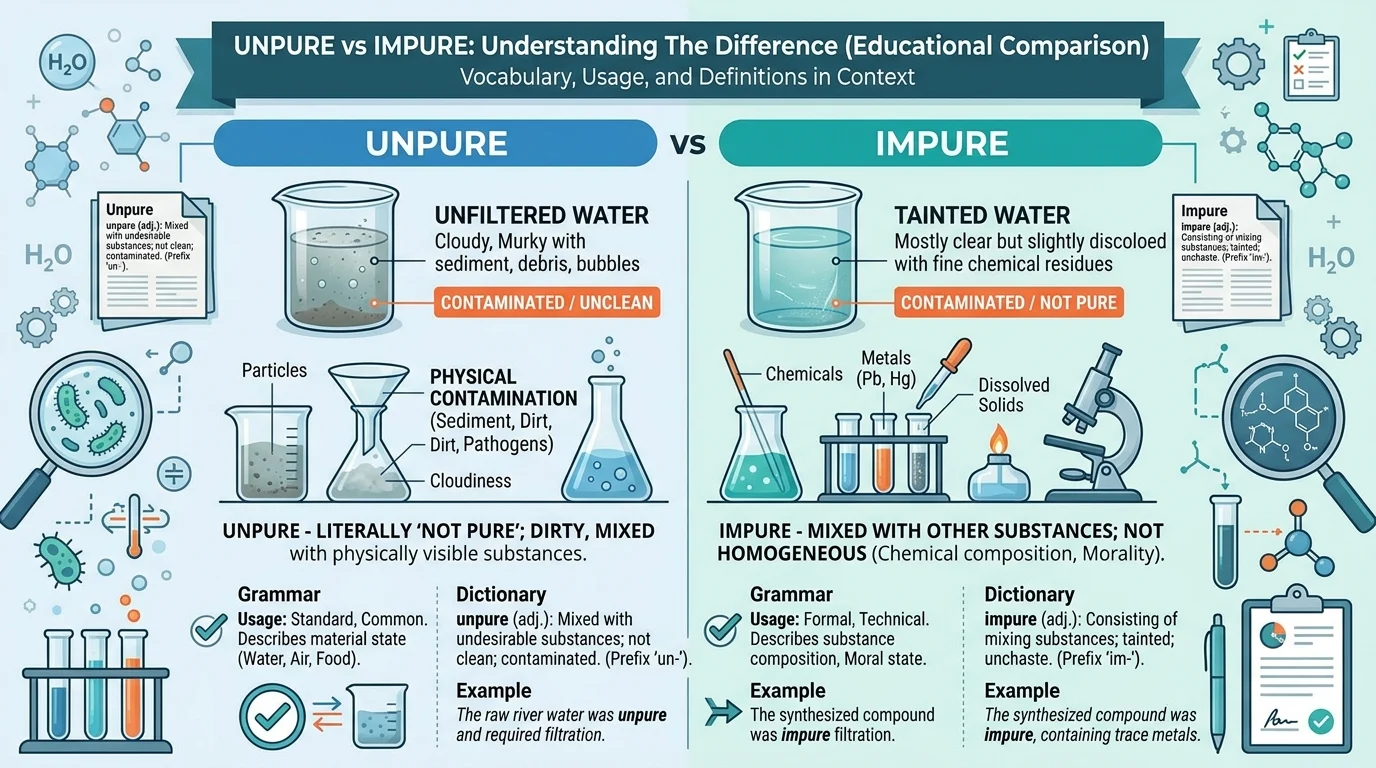
The comparison between unpure vs impure often confuses English learners and writers because both words seem logical opposites of pure. However, while one is the standard and widely accepted term, the other is rare and generally considered nonstandard in modern English.
If you’re unsure whether to use unpure or impure, this guide explains the correct word, meanings, examples, common mistakes, and usage differences.
Quick Answer
✅ Impure is the correct and standard word.
⚠️ Unpure exists in some historical or rare contexts but is generally not used in modern English.
Correct example:
- “The water was found to be impure.”
Uncommon example:
- “The water was unpure.”
In modern English, impure is almost always the better choice.
What Does Impure Mean?
English Vocabulary Impure is an adjective that means:
- not pure
- contaminated or mixed with unwanted substances
- morally or spiritually unclean (in some contexts)
- not in its original or clean state
Examples of Impure
- The laboratory detected impure chemicals.
- The water became impure after contamination.
- Ancient texts sometimes refer to impure objects.
- The metal was impure and required refining.
Why Is Impure Preferred Over Unpure?
English often uses the prefix im- before certain words to create the opposite meaning.
Examples
| Word | Opposite |
|---|---|
| Pure | Impure |
| Possible | Impossible |
| Mature | Immature |
| Polite | Impolite |
Because of this pattern, impure became the accepted opposite of pure.
Unpure vs Impure: Comparison Table
| Word | Status | Usage |
|---|---|---|
| Impure | ✅ Standard | Common in modern English |
| Unpure | ⚠️ Rare/Nonstandard | Uncommon in modern usage |
Common Uses of Impure
Science and Chemistry
Chemistry
- The sample was impure.
- Scientists removed impure substances.
Water Quality
- The river contained impure water.
- Impure drinking water can cause health problems.
Metals and Materials
- The gold was impure.
- Impure materials reduced product quality.
Religious or Moral Contexts
- Some traditions distinguish between pure and impure items.
- The text described impure practices.
Is Unpure Ever Used?
The word unpure has appeared historically in older texts and literature. However, it is extremely uncommon in modern English.
Today, most dictionaries, style guides, and professional writers strongly prefer:
✅ impure
over
⚠️ unpure
As a result, using unpure may sound awkward or outdated to many readers.
Examples Comparing the Two
Standard Usage
- The chemical mixture was impure. ✅
- The chemical mixture was unpure. ⚠️
Water Quality
- The water source became impure. ✅
- The water source became unpure. ⚠️
Scientific Writing
- Researchers identified impure compounds. ✅
- Researchers identified unpure compounds. ⚠️
Common Mistakes People Make
Mistake 1: Assuming Every Opposite Uses “Un-“
Many English words use prefixes other than un-.
Examples:
- impure
- impossible
- immature
- imperfect
Mistake 2: Using Unpure in Formal Writing
Although understandable, it is not the preferred modern form.
Mistake 3: Confusing Meaning With Acceptability
Both words suggest “not pure,” but only impure is widely accepted.
Synonyms for Impure
Depending on the context, alternatives include:
- contaminated
- polluted
- tainted
- adulterated
- corrupted
- unclean
Example
Instead of:
- “The water was impure.”
You could say:
- “The water was contaminated.”
American vs British English Differences
Both:
- United States American English
- United Kingdom British English
strongly prefer:
✅ impure
Neither variety commonly uses unpure.
Why Correct Word Choice Matters
Professional Communication Using the standard word helps improve:
- clarity
- professionalism
- credibility
- readability
In scientific, academic, and professional writing, impure is the expected choice.
Easy Trick to Remember
Think of Similar Opposites
Remember these common pairs:
- pure → impure
- mature → immature
- possible → impossible
Memory tip:
If the opposite of possible is impossible, the opposite of pure is impure.
Related Word Forms
| Word | Part of Speech |
|---|---|
| Pure | Adjective |
| Impure | Adjective |
| Purity | Noun |
| Impurity | Noun |
Example Sentences
- The substance is pure.
- The substance is impure.
- Purity is important in manufacturing.
- Scientists tested for impurities.
FAQs
Which is correct: unpure or impure?
Impure is the correct and standard modern English word.
Is unpure a real word?
It exists historically and occasionally appears in writing, but it is rare and generally nonstandard today.
What does impure mean?
It means not pure, contaminated, mixed, or unclean.
Why is impure more common?
English adopted im- as the accepted negative prefix for pure.
Can I use unpure in formal writing?
It is not recommended. Use impure instead.
Is impure used in science?
Yes. It is commonly used in chemistry, biology, and environmental science.
Do British and American English use different forms?
No. Both overwhelmingly prefer impure.
What is the noun form of impure?
The noun form is impurity.
Final Summary
The difference between unpure vs impure is simple. While both suggest the meaning “not pure,” impure is the standard and widely accepted English word. Unpure is rare, outdated, and generally avoided in modern writing.
Whether you’re discussing water quality, chemicals, metals, or moral concepts, impure is the correct choice. Using the standard form will make your writing sound more natural, professional, and accurate.
Actionable Takeaway
Remember this rule:
- impure = correct and standard ✅
- unpure = rare and generally avoided ⚠️
For clear and professional writing:
- impure water ✅
- unpure water ⚠️
When in doubt, choose impure.