Have you ever paused while writing and wondered whether layed or laid is the correct word? You’re not alone. This is one of the most common grammar and spelling mistakes in English because the verbs lay and lie already confuse many writers. Adding the past tense only makes things trickier.
If you’re searching for layed vs laid, this guide will explain the difference in simple terms. You’ll learn the correct spelling, discover why the confusion happens, see practical examples, avoid common mistakes, and master this frequently misunderstood English word.
Quick Answer
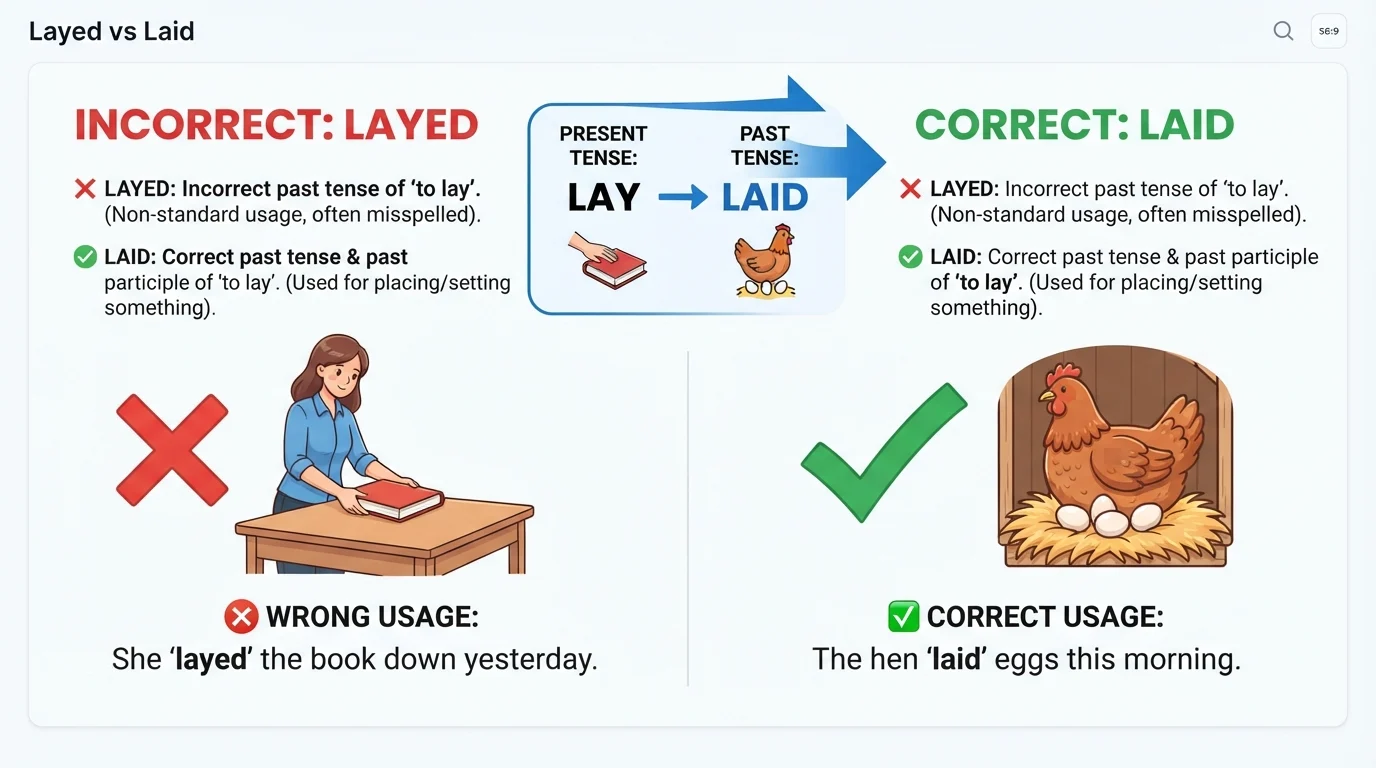
Laid is the correct past tense and past participle of the verb lay.
Layed is an incorrect spelling and is not accepted in standard English.
✅ Correct: She laid the book on the table.
❌ Incorrect: She layed the book on the table.
If you’re choosing between layed vs laid, always use laid.
What Does Laid Mean?
Laid is the past tense and past participle of the verb lay, which means to put or place something down carefully. Unlike lie, the verb lay always takes a direct object, meaning something is being placed somewhere.
Definition
Laid (verb): The past tense and past participle of lay, meaning to place, set, or put something down.
Examples of Laid
- She laid the keys on the kitchen counter.
- The workers laid new tiles in the hallway.
- He laid the baby gently in the crib.
- They laid the foundation for the new building.
- The hen laid three eggs this morning.
Is Layed a Real Word?
No. Layed is not a standard English word.
Many people mistakenly create layed by adding -ed to the verb lay, but lay is an irregular verb. Its correct past tense is laid, not layed.
Always use laid in formal and informal writing.
Layed vs Laid: Comparison Table
| Feature | Layed | Laid |
|---|---|---|
| Correct English spelling | ❌ No | ✅ Yes |
| Found in modern dictionaries | ❌ No | ✅ Yes |
| Past tense of lay | ❌ No | ✅ Yes |
| Suitable for formal writing | ❌ No | ✅ Yes |
| Accepted in academic writing | ❌ No | ✅ Yes |
The comparison clearly shows that laid is the only correct spelling.
Why Do People Write Layed?
This common mistake happens for several reasons:
- Assuming every verb forms the past tense by adding -ed
- Confusing the verbs lay and lie
- Typing quickly
- Lack of familiarity with irregular verbs
Since lay is irregular, it changes to laid rather than layed.
Understanding Lay vs Lie
Many people confuse these two verbs, so here’s a simple breakdown.
| Verb | Present | Past | Past Participle |
| Lay (to put something down) | Lay | Laid | Laid |
| Lie (to recline) | Lie | Lay | Lain |
Examples
Lay
- I lay the book on the desk.
- Yesterday, I laid the book on the desk.
Lie
- I lie on the couch every evening.
- Yesterday, I lay on the couch.
This difference is one reason layed is such a common mistake.
Common Uses of Laid
Everyday Activities
- She laid her phone on the table.
- He laid the groceries on the counter.
Construction
- Workers laid bricks all day.
- The crew laid fresh asphalt on the road.
Animals
- The chicken laid an egg.
- The turtle laid eggs on the beach.
Figurative Use
- The teacher laid out the lesson clearly.
- They laid the groundwork for future success.
Common Mistakes
Mistake 1: Writing Layed
❌ He layed the blanket on the bed.
✅ He laid the blanket on the bed.
Mistake 2: Treating Lay as a Regular Verb
Incorrect:
❌ Lay → Layed
Correct:
✅ Lay → Laid
Mistake 3: Confusing Lay and Lie
❌ I laid on the sofa all afternoon.
✅ I lay on the sofa all afternoon.
Remember:
- Lay means to place something.
- Lie means to recline.
Easy Trick to Remember the Correct Spelling
A simple memory trick is:
Think of the phrase:
“Chickens laid eggs.”
You’ll almost always see laid, never layed.
Another easy reminder:
Lay → Laid
Just like:
- Say → Said
Although the spelling changes are different, both are irregular verbs that don’t simply add -ed.
American vs British English
There is no difference between American and British English.
Both varieties use:
- Laid
Neither accepts layed as the standard spelling.
Synonyms of Laid
Using related words naturally improves readability and SEO.
Common synonyms include:
- Placed
- Set
- Put
- Positioned
- Arranged
- Deposited
- Installed
- Spread
- Established
- Positioned carefully
Example
Instead of writing:
- She laid the book down.
You could write:
- She placed the book down.
- She set the book on the table.
- She positioned the book carefully.
Why Correct Spelling Matters
Using laid instead of layed helps you:
- Improve grammar accuracy
- Build reader confidence
- Write professionally
- Avoid common spelling mistakes
- Improve SEO performance
- Communicate more clearly
Using the correct form demonstrates a strong understanding of English grammar.
Frequently Asked Questions
Is layed a real English word?
No. Layed is not a standard English word. The correct form is laid.
Which is correct: layed or laid?
Laid is always the correct past tense of lay.
What does laid mean?
It is the past tense and past participle of lay, meaning to place or put something down.
Why do people write layed?
Many people mistakenly assume lay forms its past tense by adding -ed, but it is an irregular verb.
Is laid used in both American and British English?
Yes. Both American and British English use laid.
What is the difference between lay and lie?
Lay means to put something down and requires an object.
Lie means to recline or rest and does not take an object.
What is the past tense of lay?
The correct past tense is laid.
Example: She laid the papers on the desk.
Summary
The difference between layed vs laid is simple. Laid is the correct past tense and past participle of the verb lay, while layed is a common misspelling that should be avoided. Because lay is an irregular verb, it changes to laid instead of adding -ed.
Whether you’re talking about placing an object on a table, laying bricks, or a hen laying eggs, always use laid. Learning this irregular verb will make your writing more accurate, professional, and grammatically correct in both American and British English.
Actionable Takeaway
Whenever you use the past tense of lay, remember that the correct form is laid, not layed. Before publishing or submitting your writing, do a quick search for layed and replace it with laid to eliminate this common grammar