Have you ever wondered whether tieing or tying is the correct spelling? You’re not alone. This spelling confusion is common because many English verbs ending in -ie change their spelling when -ing is added. If you’re writing an email, essay, blog post, or social media update, using the correct form is important.
If you’re searching for tieing vs tying, this guide will explain the difference, provide easy-to-follow examples, highlight common mistakes, and share simple memory tricks. By the end, you’ll know exactly which spelling to use with confidence.
Quick Answer
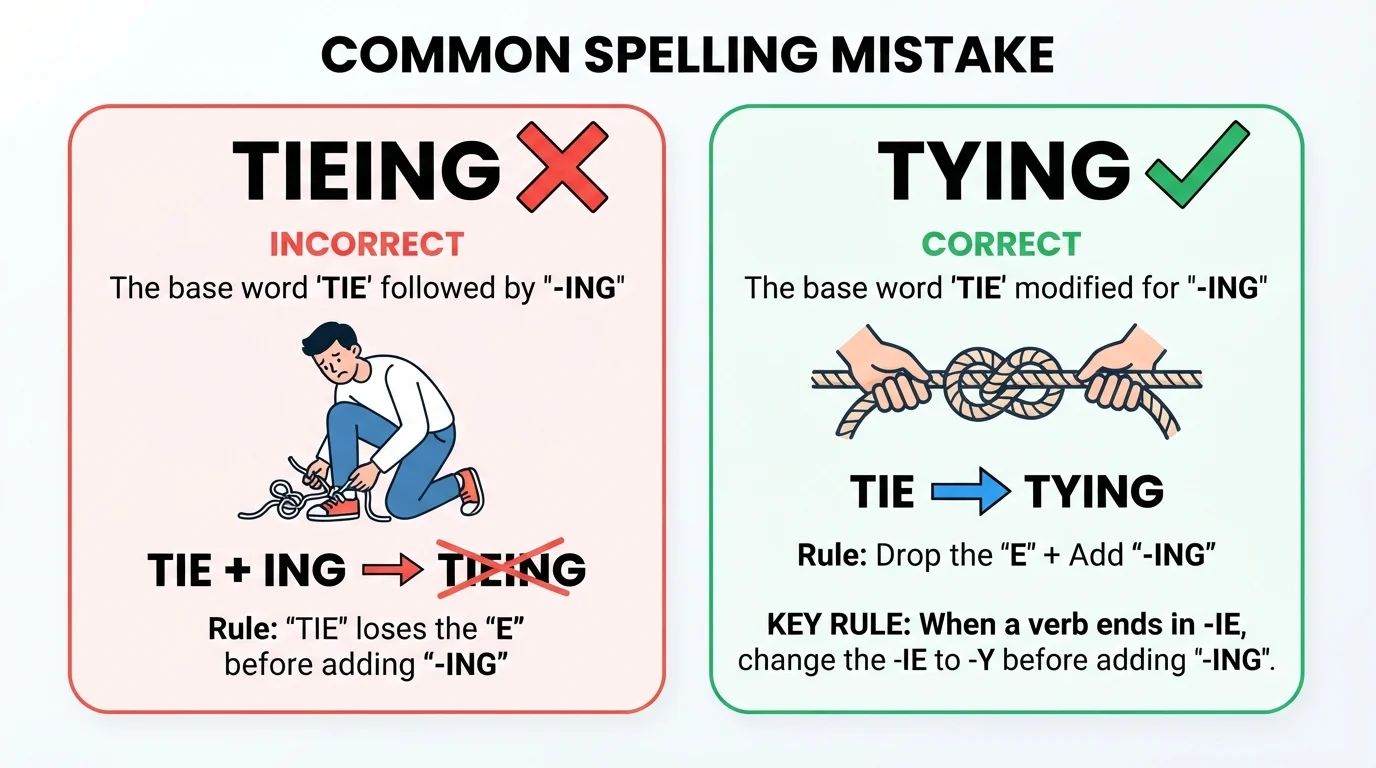
Tying is the correct spelling.
Tieing is generally considered an incorrect spelling in modern English and should be avoided in most writing.
✅ Correct: She is tying her shoelaces.
❌ Incorrect: She is tieing her shoelaces.
If you’re choosing between tieing vs tying, always use tying.
What Does Tying Mean?
Tying is the present participle and gerund form of the verb tie. It means fastening, securing, connecting, or making a knot with something such as a rope, string, ribbon, or shoelace.
The word is also used figuratively to describe connecting ideas, linking events, or ending with the same score in a competition.
Definition
Tying (verb): The act of fastening, securing, connecting, or making a knot.
Examples of Tying
- She is tying her shoes before the race.
- He spent the afternoon tying fishing knots.
- They are tying balloons for the birthday party.
- The detective is tying the evidence together.
- The teams are tying late in the game.
Is Tieing a Real Word?
In modern English, tieing is generally regarded as a misspelling of tying.
You may occasionally encounter tieing in older documents, technical contexts, or historical texts, but major dictionaries and style guides recommend tying as the standard spelling.
For everyday, academic, business, and professional writing, always use tying.
Tieing vs Tying: Comparison Table
| Feature | Tieing | Tying |
|---|---|---|
| Correct modern spelling | ❌ No | ✅ Yes |
| Found in modern dictionaries | Rare/Nonstandard | ✅ Yes |
| Suitable for formal writing | ❌ No | ✅ Yes |
| Used in everyday English | ❌ Rarely | ✅ Yes |
| Present participle of “tie” | ❌ No | ✅ Yes |
The comparison clearly shows that tying is the accepted spelling in modern English.
Why Is It Spelled Tying Instead of Tieing?
Many English verbs ending in -ie follow a special spelling rule when -ing is added.
The final -ie changes to -y before adding -ing.
Examples include:
- Tie → Tying
- Die → Dying
- Lie → Lying
This rule prevents awkward spellings such as tieing, dieing, and lieing.
Common Uses of Tying
Everyday Activities
- She is tying her apron.
- He finished tying the package.
Sports
- The teams are tying with only minutes remaining.
- They ended the match by tying the score.
Crafts and Sewing
- She enjoys tying ribbons on gift boxes.
- The instructor demonstrated different tying techniques.
Figurative Use
- The speaker kept tying every point back to the main topic.
- The report is tying together data from several studies.
Common Mistakes
Mistake 1: Writing Tieing
❌ He is tieing his necktie.
✅ He is tying his necktie.
Mistake 2: Forgetting the -ie Rule
Some writers simply add -ing without changing the ending.
Incorrect:
❌ Tie + ing = Tieing
Correct:
✅ Tie → Tying
Mistake 3: Confusing Similar Verbs
Remember these correct forms:
- Tie → Tying
- Die → Dying
- Lie → Lying
All three follow the same spelling rule.
Easy Trick to Remember the Correct Spelling
A simple memory trick is:
If a verb ends in -ie, change -ie to -y before adding -ing.
Examples:
- Tie → Tying
- Die → Dying
- Lie → Lying
Remember the phrase:
“Drop IE, add Y before ING.”
This rule will help you spell several common English verbs correctly.
American vs British English
There is no difference between American and British English.
Both varieties use:
- Tying
Neither standard variety recommends tieing for everyday writing.
Synonyms of Tying
Using related words naturally improves readability and SEO.
Common synonyms include:
- Fastening
- Securing
- Binding
- Connecting
- Joining
- Linking
- Attaching
- Knotting
- Lashing
- Wrapping
Example
Instead of writing:
- She is tying the rope.
You could write:
- She is fastening the rope.
- She is securing the rope.
- She is knotting the rope.
Why Correct Spelling Matters
Using tying instead of tieing helps you:
- Improve grammar accuracy
- Build reader confidence
- Create professional writing
- Avoid common spelling mistakes
- Enhance readability
- Improve SEO quality
Correct spelling demonstrates attention to detail, especially in academic and professional writing.
Frequently Asked Questions
Is tieing a correct English word?
In modern English, tieing is generally considered incorrect. Tying is the standard and recommended spelling.
Which is correct: tieing or tying?
Tying is the correct spelling.
Why is tying spelled with a “y”?
English changes the ending -ie to -y before adding -ing, creating tying.
What does tying mean?
It means fastening, securing, connecting, or making a knot with something.
Is tying used in both American and British English?
Yes. Both American and British English use tying.
What other words follow the same spelling rule?
Examples include:
- Die → Dying
- Lie → Lying
- Tie → Tying
Can tying also refer to sports?
Yes. Tying can describe two teams reaching the same score during a game or competition.
Summary
The difference between tieing vs tying is straightforward. Tying is the correct spelling and follows the English rule that changes -ie to -y before adding -ing. Tieing is generally considered a misspelling in modern English and should be avoided in formal, academic, and everyday writing.
Whether you’re describing someone tying shoelaces, securing a package, or referring to teams tying in a game, always use tying. Remembering the simple spelling rule will help you avoid this common mistake and make your writing more polished and professional.
Actionable Takeaway
Whenever you add -ing to the verb tie, remember to change -ie to -y first. Before publishing or submitting your work, search for tieing and replace it with tying to ensure your writing follows standard English