Have you ever wondered if to write laying or lying? These two words are among the most commonly confused words in English because they are related to the verbs lay and lie, which follow different grammar rules.
Even native English speakers sometimes pause before choosing the correct one.
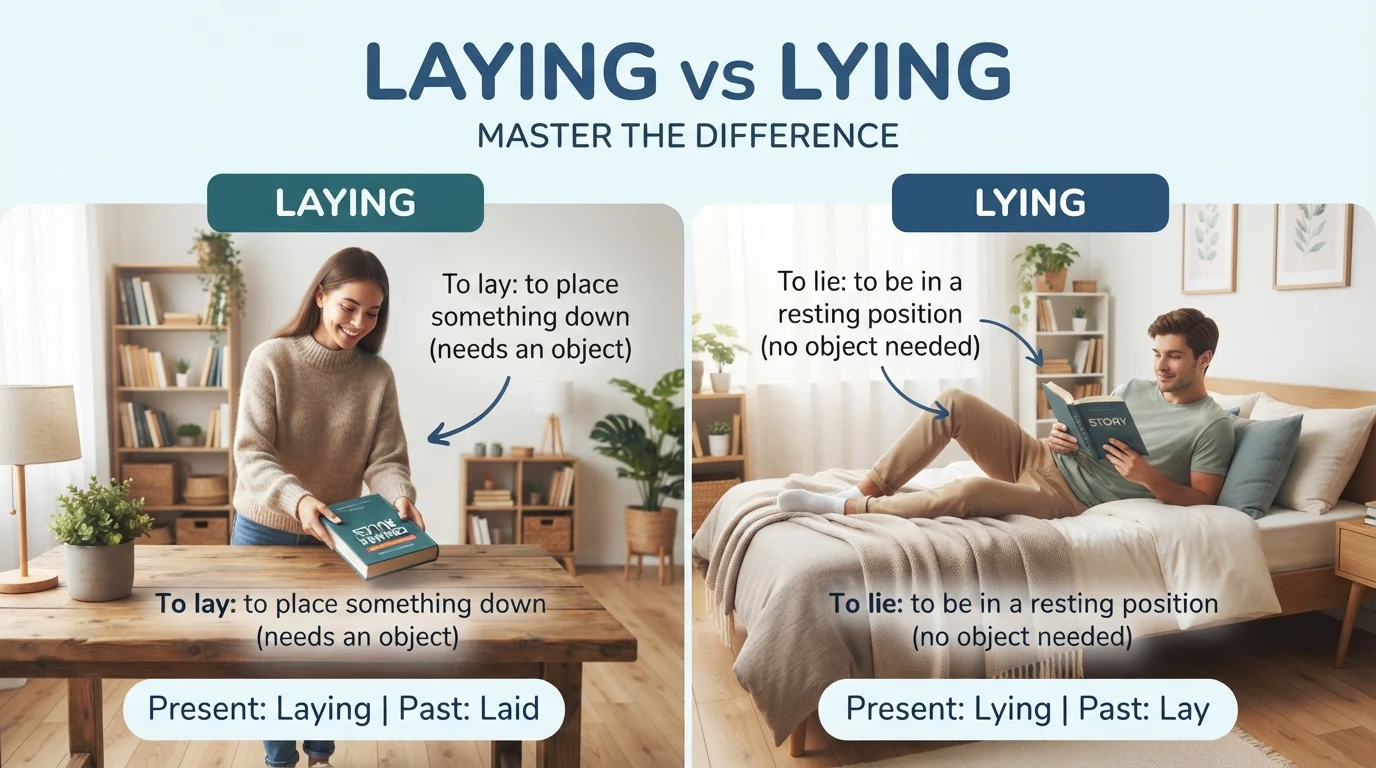
The key difference is simple: laying means putting something down, while lying means resting or being in a flat or horizontal position. Once you understand if an object is involved, choosing between laying vs lying becomes much easier.
Quick Answer: Laying vs Lying
Laying means placing or putting something somewhere.
- She is laying the book on the table.
Lying means resting, reclining, or being in a horizontal position.
- She is lying on the bed.
Easy memory trick
Lay = put something down.
Lie = rest yourself.
If there is a direct object, you usually need laying.
If the person or thing is simply resting, you usually need lying.
What Does “Laying” Mean?
Laying is the present participle form of the verb lay.
The verb lay means to put, place, or set something down. It usually requires a direct object.
Examples of “laying”
- I am laying the keys on the desk.
- She is laying the baby in the crib.
- He is laying the documents on the table.
- They are laying bricks for the new wall.
- The hen is laying eggs.
In each example, something is being placed, created, or produced.
A simple question to ask
Ask:
What is being placed or put down?
If you can answer that question, laying may be the correct word.
Example:
She is laying the blanket on the floor.
What is she laying?
The blanket.
Therefore, laying is correct.
What Does “Lying” Mean?
Lying is the present participle form of the verb lie when lie means to rest or recline.
It describes a person or thing that is already in a horizontal or resting position.
Examples of “lying”
- I am lying on the sofa.
- The cat is lying under the table.
- He was lying on the beach.
- The book is lying on the floor.
- She is lying down because she feels tired.
In these examples, the subject is resting or positioned somewhere. The action is not about putting something down.
Laying vs Lying: The Main Difference
| Word | Base Verb | Meaning | Example |
|---|---|---|---|
| Laying | Lay | Putting or placing something down | He is laying the book on the desk. |
| Lying | Lie | Resting or being in a flat position | He is lying on the sofa. |
The most important question is:
Is someone putting something somewhere, or is someone resting?
- Putting something somewhere → laying
- Resting or reclining → lying
The Verb Forms of Lay and Lie
Understanding the verb forms can make this topic much easier.
Lay: to put something down
| Tense | Form | Example |
|---|---|---|
| Present | lay | I lay the book down. |
| Past | laid | I laid the book down. |
| Present participle | laying | I am laying the book down. |
| Past participle | laid | I have laid the book down. |
Lie: to rest or recline
| Tense | Form | Example |
|---|---|---|
| Present | lie | I lie on the bed. |
| Past | lay | I lay on the bed yesterday. |
| Present participle | lying | I am lying on the bed. |
| Past participle | lain | I have lain on the bed. |
This is where English becomes confusing. The past tense of lie is lay, but the present participle is lying.
The most useful pattern
- Lay → laid → laying
- Lie → lay → lain → lying
Common Mistakes With Laying and Lying
Mistake 1: “I am laying on the bed.”
❌ I am laying on the bed.
✅ I am lying on the bed.
You are resting on the bed, not placing something down.
Mistake 2: “She is lying the baby in the crib.”
❌ She is lying the baby in the crib.
✅ She is laying the baby in the crib.
She is placing the baby somewhere, so laying is correct.
Mistake 3: “The book is laying on the table.”
❌ The book is laying on the table.
✅ The book is lying on the table.
The book is already resting on the table. It is not placing another object there.
Mistake 4: Confusing the past tense
❌ Yesterday, I lied on the sofa.
✅ Yesterday, I lay on the sofa.
When lie means to rest, its past tense is lay.
However, lied is the past tense of lie when lie means to tell an untruth.
Compare:
- I lay on the sofa yesterday. = I rested.
- He lied to me yesterday. = He was not truthful.
Laying vs Lying: Examples in Sentences
Examples with “laying”
- She is laying the clothes on the bed.
- The farmer is laying seeds in the soil.
- He is laying the foundation for the house.
- I am laying the plates on the table.
- The hen is laying an egg.
Examples with “lying”
- She is lying on the floor.
- He is lying in bed.
- The dog is lying beside the door.
- The papers are lying on the desk.
- I have been lying here for an hour.
How to Choose Between Laying and Lying
Use this three-step method.
Step 1: Identify the action
Is someone putting something down?
Use laying.
Example:
- I am laying the phone on the desk.
Is someone or something resting?
Use lying.
Example:
- I am lying on the bed.
Step 2: Look for a direct object
A direct object receives the action.
She is laying the book down.
What is she laying?
The book.
That means laying is correct.
But:
She is lying on the bed.
There is no object being placed. She is simply resting.
Therefore, lying is correct.
Step 3: Use the memory trick
Lay something. Lie down.
This is one of the easiest ways to remember the difference.
- Lay the book down.
- Lie down on the bed.
Laying vs Lying in American and British English
The basic grammar rules for laying and lying are the same in American English and British English.
Both varieties use:
- Laying for putting or placing something down
- Lying for resting or being in a horizontal position
However, everyday speech can sometimes make the distinction less obvious, especially because many people use these verbs incorrectly in casual conversation.
The standard grammar rules remain the same regardless of whether you are writing American or British English.
Laying vs Lying: Special Cases
Some situations can be confusing because objects can also be in a resting position.
Example:
The book is lying on the table.
The book is already there. It is resting on the table.
But:
She is laying the book on the table.
She is actively putting the book there.
The difference is the action:
- Laying = placing something
- Lying = already resting
What About “Laying Down” and “Lying Down”?
This is one of the most common areas of confusion.
“Lying down”
Use lying down when a person or animal is resting.
- I am lying down.
- The dog is lying down.
- She is lying down for a few minutes.
“Laying something down”
Use laying when an object is being placed.
- I am laying the book down.
- He is laying the baby down.
- She is laying the keys down.
The difference is if there is an object receiving the action.
Quick Practice: Laying or Lying?
Choose the correct word:
- I am ______ on the sofa.
- She is ______ the baby in the crib.
- He is ______ the plates on the table.
- The dog is ______ under the chair.
- The workers are ______ bricks.
- I am ______ down because I am tired.
Answers
- lying
- laying
- laying
- lying
- laying
- lying
Why Are Laying and Lying So Commonly Confused?
The confusion comes from the unusual forms of lay and lie.
The verb lay means to put something down, but its past tense is laid.
The verb lie means to rest, but its past tense is lay.
This creates a confusing pattern:
- Today: I lie down.
- Yesterday: I lay down.
- I am: lying down.
At the same time:
- Today: I lay the book down.
- Yesterday: I laid the book down.
- I am: laying the book down.
The best way to master these words is to learn the verb patterns rather than relying only on pronunciation.
Is “I am laying on the bed” correct?
Usually, no. If you mean that you are resting on the bed, the correct sentence is I am lying on the bed.
Is “I am lying the book on the table” correct?
No. The correct sentence is I am laying the book on the table because you are placing the book there.
What is the easiest way to remember laying vs lying?
Remember: Lay something down, but lie down yourself.
Is “laying down” always wrong?
No. Laying down is correct when you are placing something down.
Example: She is laying the baby down.
Is “lying down” correct?
Yes. Lying down is correct when someone or something is resting in a horizontal position.
Example: I am lying down.
What is the past tense of lie?
When lie means to rest or recline, its past tense is lay.
Example: I lay on the sofa yesterday.
What is the past tense of lay?
The past tense of lay is laid.
Example: She laid the book on the table.
Do American and British English use laying and lying differently?
No. The basic grammar rules are the same in American and British English.
Final Summary: Laying vs Lying
The difference between laying vs lying depends on if something is being placed somewhere or simply resting. Laying is used when someone puts or places something down, such as in “She is laying the book on the table.”
Lying is used when someone or something is resting in a horizontal position, such as in “She is lying on the bed.”
The easiest rule to remember is: Lay something down, but lie down yourself. If there is a direct object receiving the action, use laying. If the subject is simply resting or reclining, use lying. With regular practice, this commonly confused grammar pair becomes much easier to use correctly.
Actionable Takeaway
Before choosing between laying and lying, ask yourself: “Am I putting something somewhere, or am I resting?” Putting something somewhere means laying; resting means lying.