Have you ever wondered if to use past or passed in a sentence? These two words sound the same in many English accents, but they have different meanings and grammatical roles. Because of this, past vs passed is a common English grammar and spelling confusion.
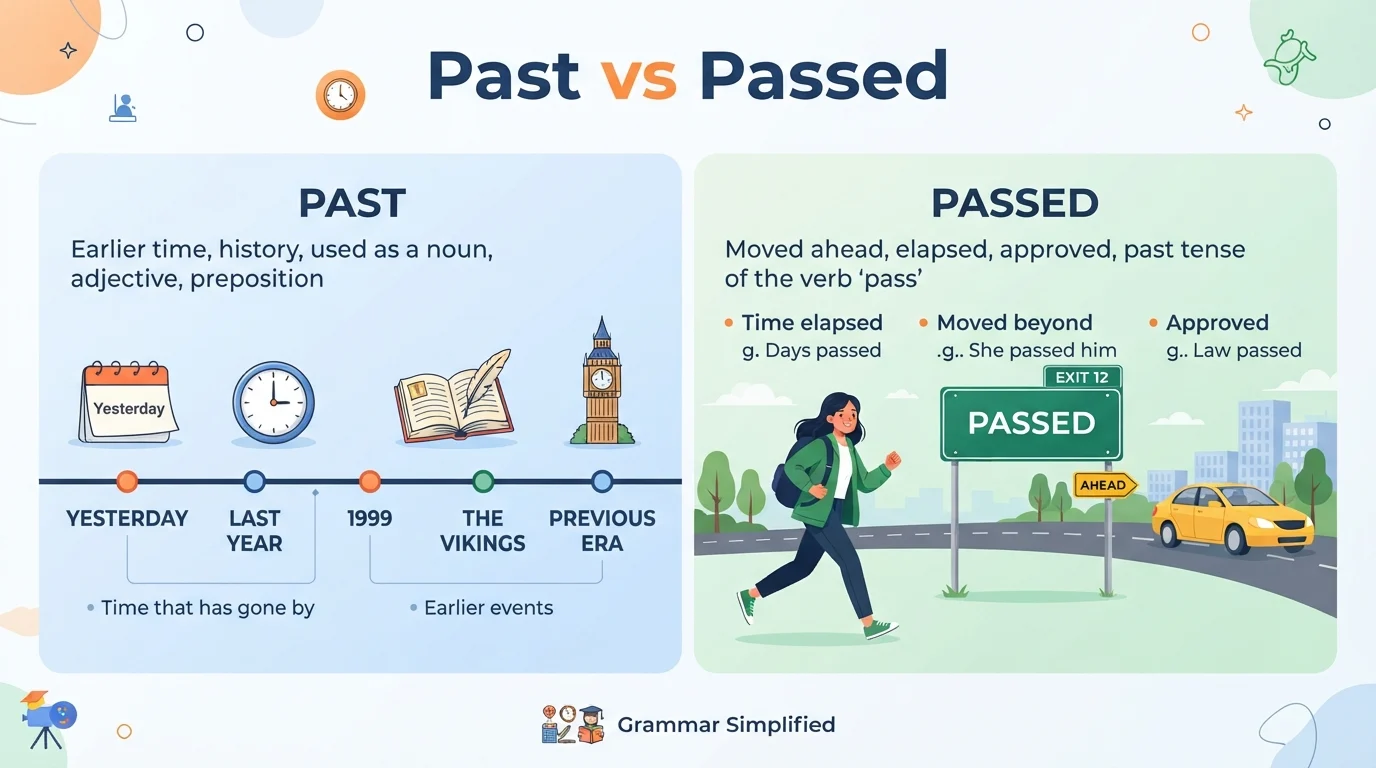
The good news is that the difference is easier than it first appears. Past usually refers to an earlier time, a previous period, or something beyond a particular point.
Passed is usually the past tense of the verb pass, meaning moved beyond something, succeeded, handed something over, or went by. Once you understand the basic rule, choosing the correct word becomes much easier.
Quick Answer: Past vs Passed
Past usually relates to time, history, or position.
- We talked about the past.
- The car drove past the house.
Passed is the past tense of the verb pass.
- She passed the exam.
- He passed the ball.
Easy memory trick
If you can replace the word with went by, moved beyond, or succeeded, use passed.
If you are talking about earlier time or something beyond a point, use past.
What Does “Past” Mean?
Past can function as a noun, adjective, preposition, or adverb. Its meaning usually relates to time, history, or movement beyond a particular place or point.
“Past” as a noun
As a noun, past refers to a time that has already happened.
Examples:
- We cannot change the past.
- She often thinks about her past.
- The past can teach us valuable lessons.
- He has learned from his past.
In these sentences, past means an earlier period or previous experiences.
“Past” as an adjective
As an adjective, past describes something that happened before now.
Examples:
- The past year was challenging.
- He is a past president of the organization.
- We discussed past mistakes.
- Her past experiences shaped her career.
“Past” as a preposition
As a preposition, past means beyond a particular place or time.
Examples:
- Walk past the library.
- The train went past the station.
- It is past midnight.
- She drove past my house.
“Past” as an adverb
As an adverb, past can describe movement beyond something.
Example:
- The car drove past quickly.
What Does “Passed” Mean?
Passed is the past tense and past participle of the verb pass.
It can have several meanings depending on the sentence.
Passed means moved beyond
Examples:
- The train passed the station.
- We passed the old church.
- She passed me on the street.
- The car passed the truck.
In these examples, something moved beyond another person, object, or location.
Passed means succeeded
Examples:
- I passed my driving test.
- She passed the exam.
- He passed the interview.
- They passed the final assessment.
Here, passed means successfully completed or achieved the required result.
Passed means handed something over
Examples:
- He passed me the salt.
- She passed the message to her friend.
- Please pass the book to me.
The past form is:
- He passed me the salt.
Passed means time went by
Examples:
- Several hours passed.
- The years passed quickly.
- Time passed while we waited.
This meaning is often confused with past.
Past vs Passed: The Main Difference
| Word | Main Function | Meaning | Example |
|---|---|---|---|
| Past | Noun, adjective, preposition, adverb | Earlier time or beyond a point | We walked past the store. |
| Passed | Verb | Moved, succeeded, handed over, or went by | We passed the store. |
The easiest test
Ask:
Is the word describing an action?
If yes, passed may be correct.
- She passed the exam.
- The car passed the house.
Is the word describing time or location?
If yes, past may be correct.
- In the past, things were different.
- Walk past the house.
Past vs Passed Examples
Examples using “past”
- I have learned from my past.
- We walked past the restaurant.
- It is half past six.
- She is a past member of the committee.
- The past few weeks have been busy.
Examples using “passed”
- She passed her driving test.
- The bus passed us quickly.
- He passed the ball to his teammate.
- Two hours passed before they arrived.
- The message was passed from one person to another.
Common Mistakes With Past and Passed
Mistake 1: “I walked passed the store.”
❌ I walked passed the store.
✅ I walked past the store.
Here, past is a preposition meaning beyond the store.
Mistake 2: “She past the exam.”
❌ She past the exam.
✅ She passed the exam.
The sentence describes an action and means she succeeded, so passed is correct.
Mistake 3: “Time past quickly.”
❌ Time past quickly.
✅ Time passed quickly.
Time is moving by, so the verb passed is required.
Mistake 4: “In the passed”
❌ In the passed, people communicated differently.
✅ In the past, people communicated differently.
The sentence refers to an earlier time, so past is correct.
Mistake 5: “The car passed the house” vs “The car drove past the house”
Both can be correct, but the grammar is slightly different.
- The car passed the house. = The car moved beyond the house.
- The car drove past the house. = Past describes the direction or position.
Past vs Passed: A Simple Memory Trick
Use this rule:
Past = time or place.
Passed = action.
For example:
- In the past, I lived in London. → time
- I passed the library. → action
Another useful trick is to replace passed with a related verb:
- Passed the exam → succeeded
- Passed the car → overtook or moved beyond
- Time passed → went by
If one of these meanings fits, passed is probably correct.
Past vs Passed in Time Expressions
Many common expressions use past.
Common examples:
- In the past
- The past few days
- Half past three
- Past experience
- Past mistakes
- Past events
- The recent past
Examples:
- It is quarter past four.
- I have learned from past experience.
- The past few months have been exciting.
However, when time is actively moving by, use passed.
Example:
- Five years passed before they met again.
Past vs Passed in Movement
Both words can appear in sentences about movement, which can make the difference confusing.
Use “past” to describe a position or direction
- She walked past the school.
- The dog ran past me.
- We drove past the hotel.
Use “passed” as the action
- She passed the school.
- The dog passed me.
- We passed the hotel.
Both structures may be grammatically correct, depending on the sentence. The key is understanding if past is functioning as a preposition or if passed is the main verb.
Past vs Passed in American and British English
The basic difference between past and passed is the same in American English and British English.
Both varieties use:
- Past for earlier time, history, or location beyond something
- Passed as the past tense of pass
Pronunciation may vary slightly depending on regional accent, but in many accents, past and passed sound the same or very similar.
This is why context is essential when listening.
Quick Practice: Past or Passed?
Choose the correct word:
- She ______ her driving test.
- We walked ______ the old house.
- The years ______ quickly.
- In the ______, people wrote more letters.
- The train ______ the station.
- It is half ______ eight.
Answers
- passed
- past
- passed
- past
- passed
- past
Why Are Past and Passed So Commonly Confused?
The main reason is pronunciation. In many English accents, past and passed sound nearly identical.
Their meanings are also connected to movement and time, which can create additional confusion.
The best way to distinguish them is to focus on grammar:
- Past is often a noun, adjective, preposition, or adverb.
- Passed is a verb form.
When editing your writing, ask yourself if the sentence needs an action word. If it does, passed may be the right choice.
Is “passed” the past tense of “pass”?
Yes. Passed is the past tense and past participle of pass.
Example: She passed the exam.
Is “past” a verb?
Usually, no. Past can function as a noun, adjective, preposition, or adverb, but it is not normally the past tense of pass.
Is it “walk past” or “walk passed”?
The correct phrase is walk past.
Example: We walked past the store.
Is it “passed the exam” or “past the exam”?
The correct phrase is passed the exam because it means successfully completed the exam.
Is “time passed” correct?
Yes. Time passed means time went by.
Example: Several hours passed while we waited.
Is “in the past” correct?
Yes. In the past refers to an earlier time.
Example: In the past, people traveled differently.
Do past and passed sound the same?
They often sound the same or very similar in many American and British English accents, which is why they are commonly confused.
What is the easiest way to remember past vs passed?
Remember: Past = time or place; passed = action.
Final Summary: Past vs Passed
The difference between past vs passed becomes much easier when you focus on meaning and grammar. Past usually refers to an earlier time, previous experiences, or a position beyond something. Passed is the past tense of the verb pass and can mean moved beyond, succeeded, handed something over, or went by.
A simple rule can help you remember the difference: Past is usually about time or place, while passed describes an action. For example, “We walked past the school,” but “We passed the exam.” When you are unsure, ask whether the word describes an action or refers to time and position.
Actionable Takeaway
Before using past or passed, check the sentence carefully. If you mean earlier time or beyond a location, use past. If you mean moved, succeeded, handed over, or went by, use passed.