Have you ever wondered if the correct word is specs or specks? These two words sound very similar, but they have completely different meanings. One is commonly used as a short form for specifications or spectacles, while the other refers to tiny spots or small particles.
The difference between specs vs specks is easy to understand once you focus on the spelling and context. Specs can mean technical details, specifications, or glasses. Specks means tiny spots, dots, or small particles. Learning this simple distinction can help you avoid common spelling mistakes in everyday English.
Quick Answer: Specs vs Specks
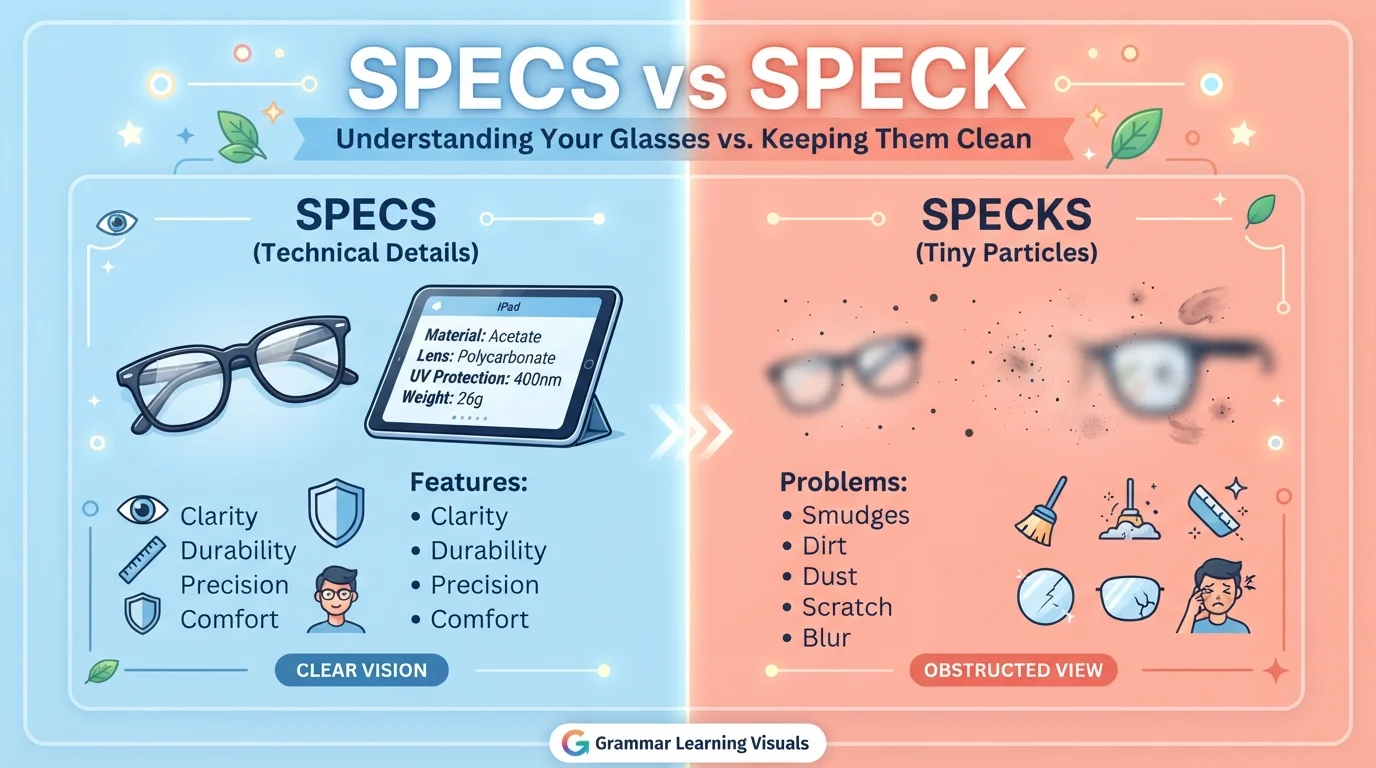
Specs is a shortened form of specifications or spectacles.
- Check the phone’s specs before buying it.
- I need my specs to read this small print.
Specks means tiny spots, dots, or particles.
- There were specks of dust on the table.
- The sky was filled with tiny specks of light.
Easy memory trick
Specs = specifications or spectacles.
Specks = tiny spots.
The k in specks can remind you of tiny little marks or dots.
What Does “Specs” Mean?
Specs is an informal abbreviation with two common meanings.
Specs meaning specifications
In technology, engineering, cars, products, and other areas, specs means specifications.
Specifications are details that describe the features, size, performance, or technical qualities of something.
Examples of “specs” meaning specifications
- What are the phone’s specs?
- I compared the specs of two laptops.
- The car has impressive performance specs.
- Check the product specs before ordering.
- The camera’s technical specs are listed online.
Common product specifications may include:
- Size
- Weight
- Speed
- Storage
- Battery life
- Power
- Materials
- Dimensions
Specs meaning spectacles
In informal British English, specs can also mean spectacles, or eyeglasses.
Examples:
- I forgot my specs at home.
- She wears specs for reading.
- Where did I put my specs?
In this context, specs is a casual abbreviation for spectacles.
What Does “Specks” Mean?
Specks is the plural form of speck.
A speck is a very small spot, mark, particle, or piece of something.
Examples of “specks”
- There are specks of dust on the screen.
- I noticed specks of paint on the floor.
- The stars looked like tiny specks in the night sky.
- There were dark specks in the photograph.
- A few specks of dirt were stuck to his shoes.
The word specks is usually connected with something small and visible.
Specs vs Specks: The Main Difference
| Word | Meaning | Example |
|---|---|---|
| Specs | Specifications or spectacles | Check the phone’s specs. |
| Specks | Tiny spots, dots, or particles | I saw specks of dust. |
The simplest rule
Use specs when talking about:
- Technical details
- Product specifications
- Glasses or spectacles
Use specks when talking about:
- Tiny spots
- Small particles
- Little marks
- Small visible dots
Specs vs Specks Examples
Examples with “specs”
- The laptop has excellent technical specs.
- I need to compare the specs of these two phones.
- His new specs look stylish.
- Please send me the full product specs.
- These specs help me read small text.
Examples with “specks”
- I found specks of dust on the shelf.
- The painting contains tiny specks of gold.
- The birds looked like tiny specks in the distance.
- There were specks of mud on the car.
- The microscope revealed several tiny specks.
Common Mistakes With Specs and Specks
Mistake 1: Using “specks” for product details
❌ What are the phone’s specks?
✅ What are the phone’s specs?
The sentence asks about specifications, so specs is correct.
Mistake 2: Using “specs” for tiny spots
❌ There are specs of dust on the table.
✅ There are specks of dust on the table.
Tiny particles are specks.
Mistake 3: Confusing “specs” with “specks” when talking about glasses
❌ I forgot my specks at home.
✅ I forgot my specs at home.
When specs means spectacles or glasses, there is no k.
Specs vs Specks in American and British English
The word specs can mean specifications in both American and British English.
However, specs as an informal word for spectacles is especially common in British English. In American English, people are more likely to say glasses.
For example:
British English
- I need my specs to read this.
American English
- I need my glasses to read this.
The word specks, meaning tiny spots or particles, has the same basic meaning in both American and British English.
Specs vs Specks in Technology and Product Reviews
In technology and shopping, specs is a very common abbreviation for specifications.
For example, when comparing phones, you might look at:
- Screen size
- Camera resolution
- Storage
- Processor
- Battery capacity
- Memory
These are the phone’s specs.
Example:
Before buying a new laptop, I always check its specs.
Using specks in this context would be incorrect.
Specs vs Specks in Everyday Descriptions
When describing something tiny, use specks.
Examples:
- Specks of dust
- Specks of dirt
- Specks of paint
- Specks of colour
- Specks of light
- Specks of gold
Example:
The black shirt had tiny specks of white fabric on it.
Here, specks refers to small visible marks or particles.
A Simple Memory Trick for Specs vs Specks
Remember:
Specs = details or glasses
Think:
- Product specs
- Technical specs
- Reading specs
Specks = tiny spots
Think:
- Specks of dust
- Specks of dirt
- Specks of paint
Quick phrase to remember
Specs tell you details; specks are tiny spots.
Quick Practice: Specs or Specks?
Choose the correct word:
- I need to check the phone’s ______.
- There were tiny ______ of dust on the table.
- He forgot his ______ at home.
- The camera’s technical ______ are impressive.
- The painting contains small ______ of gold.
Answers
- specs
- specks
- specs
- specs
- specks
Why Are Specs and Specks So Commonly Confused?
The main reason is pronunciation. Specs and specks sound very similar, especially in fast speech.
The extra k in specks changes the spelling and meaning, but the difference may not always be obvious when listening.
The best way to avoid confusion is to focus on context:
- Technical details or glasses → specs
- Tiny spots or particles → specks
What is the difference between specs and specks?
Specs means specifications or, informally, spectacles. Specks means tiny spots, dots, or particles.
What does “specs” mean in technology?
Specs is short for specifications, meaning the technical details or features of a product.
Does “specs” mean glasses?
Yes. Specs can be an informal abbreviation for spectacles, especially in British English.
What does “specks” mean?
Specks are very small spots, marks, particles, or dots.
Is it “phone specs” or “phone specks”?
The correct phrase is phone specs when talking about a phone’s technical features.
Is it “specks of dust” or “specs of dust”?
The correct phrase is specks of dust.
Are specs and specks pronounced the same?
They sound very similar and may be pronounced almost identically in some accents, which is why they are commonly confused.
Do American and British English use “specs” differently?
Yes, slightly. Specs can mean specifications in both varieties, but British English commonly uses specs as an informal term for spectacles, while American English more often says glasses.
Final Summary: Specs vs Specks
The difference between specs vs specks is simple. Specs is short for specifications and can also mean spectacles, or glasses, especially in British English. For example, you can check a phone’s specs or put on your specs to read.
Specks, on the other hand, are tiny spots, particles, or marks. You might see specks of dust, specks of paint, or tiny specks of light. Remember the key rule: Specs are details or glasses; specks are tiny spots.
Actionable Takeaway
When you mean technical details or spectacles, use specs. When you mean tiny spots, dots, or particles, use specks.