Have you ever wondered if to use foreword or forward? These two words look and sound similar, but they have completely different meanings. One is commonly found at the beginning of a book, while the other is used to describe movement, direction, progress, or sending something onward.
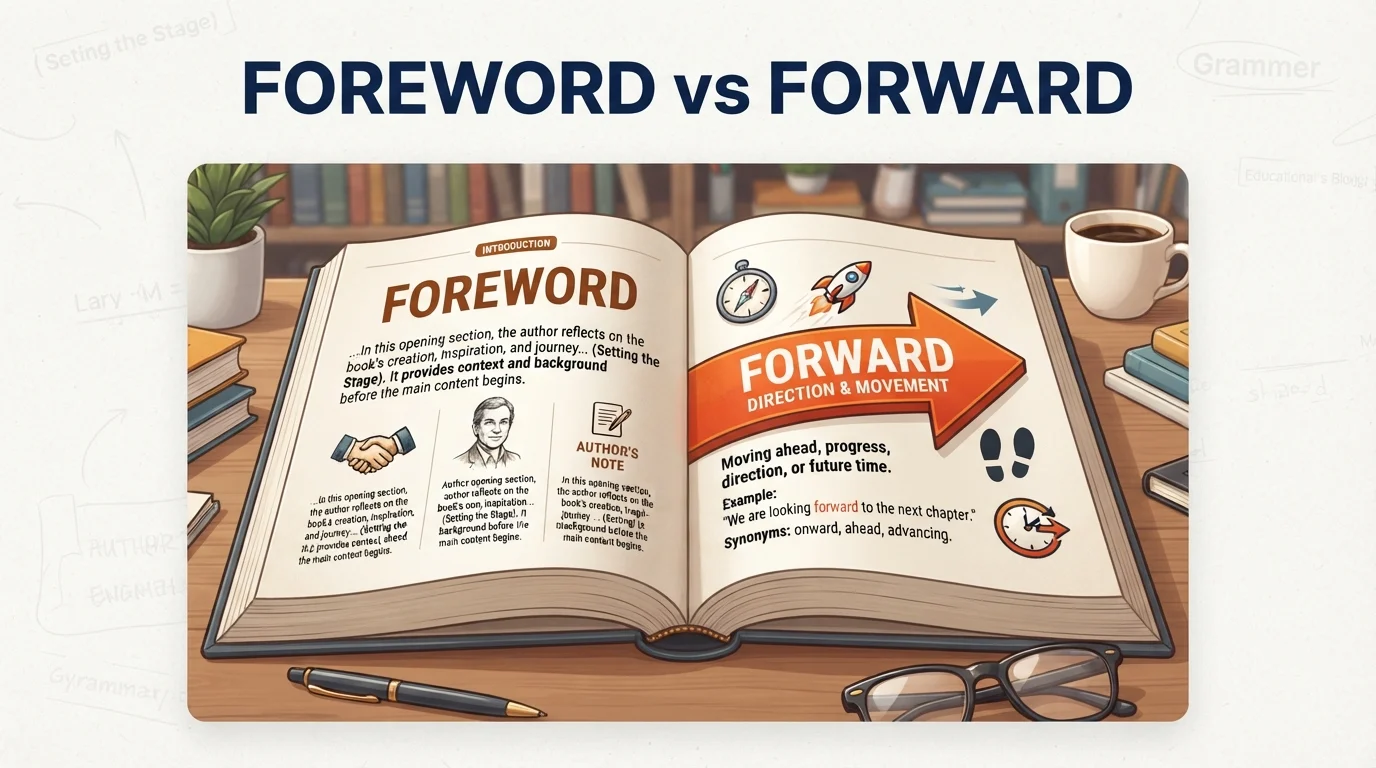
The difference between foreword vs forward is simple once you understand the meaning of each word. Foreword is a short introduction to a book, usually written by someone other than the author. Forward relates to moving ahead, sending something on, or making progress.
Quick Answer: Foreword vs Forward
Foreword = an introduction at the beginning of a book.
- The author asked a famous professor to write the foreword.
Forward = toward the front, ahead, onward, or in advance.
- She took a step forward.
Easy memory trick
Foreword = words at the front of a book.
Forward = moving ahead.
Think of foreword as a special type of “word” that appears before the main text.
What Does “Foreword” Mean?
A foreword is a short introductory section at the beginning of a book. It is often written by someone other than the book’s author.
A foreword may:
- Introduce the author
- Explain the importance of the book
- Provide background information
- Discuss the author’s work
- Recommend the book to readers
Examples of “foreword”
- The professor wrote the foreword to the new book.
- I always read the foreword before starting a biography.
- The author’s mentor contributed a thoughtful foreword.
- The book includes a foreword by a respected historian.
The word foreword is especially common in books, memoirs, academic works, and other published texts.
What Does “Forward” Mean?
Forward has several meanings. It can be an adverb, adjective, verb, noun, or, in some contexts, a preposition.
Its central meaning is related to moving or directing something ahead.
Forward as a direction
- Take one step forward.
- The car moved forward.
- She looked forward.
- Move forward carefully.
Forward as progress
- We need to move forward with the project.
- The company is looking forward to future growth.
- He is making forward progress.
Forward as sending something onward
- Please forward the email to me.
- She forwarded the message to her manager.
- I will forward the documents tomorrow.
Forward in time
- The meeting was moved forward by one hour.
- Looking forward, we need a better plan.
Foreword vs Forward: The Main Difference
| Word | Meaning | Example |
|---|---|---|
| Foreword | An introduction to a book | The novel includes a foreword by a famous writer. |
| Forward | Ahead, onward, or towards the front | We moved forward with the plan. |
The easiest rule
Use foreword when talking about a book’s introductory section.
Use forward when talking about direction, progress, time, or sending something onward.
Foreword vs Forward Examples
Examples with “foreword”
- The foreword was written by a well known scientist.
- The book begins with a short foreword.
- Her foreword explains why the research matters.
- The editor asked a leading expert to write the foreword.
Examples with “forward”
- Please move forward in the queue.
- I am looking forward to the weekend.
- Could you forward this email?
- The team must move forward with the plan.
- He stepped forward to accept the award.
Common Mistakes With Foreword and Forward
Mistake 1: Using “forward” for a book introduction
❌ The book begins with a forward by the author’s friend.
✅ The book begins with a foreword by the author’s friend.
A book introduction is a foreword.
Mistake 2: Using “foreword” for movement
❌ She stepped foreword.
✅ She stepped forward.
The sentence describes movement ahead, so forward is correct.
Mistake 3: Confusing “foreword” with “forward” in email
❌ Please foreword the email to the team.
✅ Please forward the email to the team.
To send an email or message onward, use forward.
Foreword vs Forward vs Preface
Another common source of confusion is the difference between a foreword and a preface.
Foreword
A foreword is usually written by someone other than the author.
It often explains why the book is important or why the author is worth reading.
Preface
A preface is usually written by the author.
It may explain:
- Why the book was written
- How the research was completed
- The author’s purpose
- The book’s background
Example
A book may contain:
- Foreword written by another expert
- Preface written by the author
- Main content
This distinction is useful when discussing the structure of books and published works.
How to Remember Foreword vs Forward
Use this simple association:
Foreword = book words
The word foreword contains word:
fore + word = words at the front
This helps you remember that a foreword is an introduction at the beginning of a book.
Forward = move ahead
Think of:
- Move forward
- Step forward
- Look forward
- Forward an email
All of these involve going or sending something ahead.
Forward in Common Expressions
The word forward appears in many common phrases.
Look forward to
- I look forward to meeting you.
- We look forward to hearing from you.
Important: After look forward to, use a noun or -ing form.
✅ I look forward to meeting you.
❌ I look forward to meet you.
Move forward
- The project is ready to move forward.
Step forward
- A volunteer stepped forward to help.
Forward-thinking
- The company has a forward-thinking approach.
Forward the message
- Please forward the message to the correct department.
Foreword vs Forward in American and British English
The meanings and spellings of foreword and forward are essentially the same in American English and British English.
However, some pronunciation differences may occur depending on regional accent.
The basic rule remains unchanged:
- Foreword = book introduction
- Forward = ahead, onward, or send onward
Quick Practice: Foreword or Forward?
Choose the correct word:
- The book includes a ______ by a famous historian.
- Please ______ this email to your manager.
- She took a step ______.
- I am looking ______ to your reply.
- The author asked her mentor to write the ______.
Answers
- foreword
- forward
- forward
- forward
- foreword
Why Are Foreword and Forward So Commonly Confused?
These words are easy to confuse because they look and sound very similar. Both begin with fore/for and are pronounced similarly in everyday speech.
The key difference is their meaning:
- Foreword is connected to words and books.
- Forward is connected to movement, progress, direction, or sending something onward.
When writing, focus on the context rather than pronunciation.
What is the difference between foreword and forward?
A foreword is an introduction at the beginning of a book. Forward means ahead, onward, or towards the front, and it can also mean to send something onward.
Is it “foreword” or “forward” in a book?
The correct word is foreword when referring to an introductory section of a book.
Is a foreword written by the author?
Usually, a foreword is written by someone other than the author. The author usually writes the preface.
Is “please forward this email” correct?
Yes. Forward means to send an email or message onward to another person.
Is it “looking foreword” or “looking forward”?
The correct phrase is looking forward.
Example: I am looking forward to hearing from you.
What is the easiest way to remember foreword vs forward?
Remember: Foreword = words at the front of a book. Forward = moving ahead.
Do American and British English use foreword and forward differently?
No. The basic meanings and spellings are the same in both American and British English.
Final Summary: Foreword vs Forward
The difference between foreword vs forward is easy to remember. Foreword is a short introduction found at the beginning of a book, often written by someone other than the author.
Forward means ahead, onward, towards the front, or in advance. It can also mean sending something to another person, as in “Please forward this email.”
The best memory trick is to connect foreword with word: a foreword contains words placed at the front of a book. For everything related to movement, progress, direction, or sending something onward, use forward.
Actionable Takeaway
Remember: Foreword = a book introduction; forward = move or send ahead. If you are talking about the beginning of a book, choose foreword. If you are talking about direction, progress, or sending something onward, choose forward.